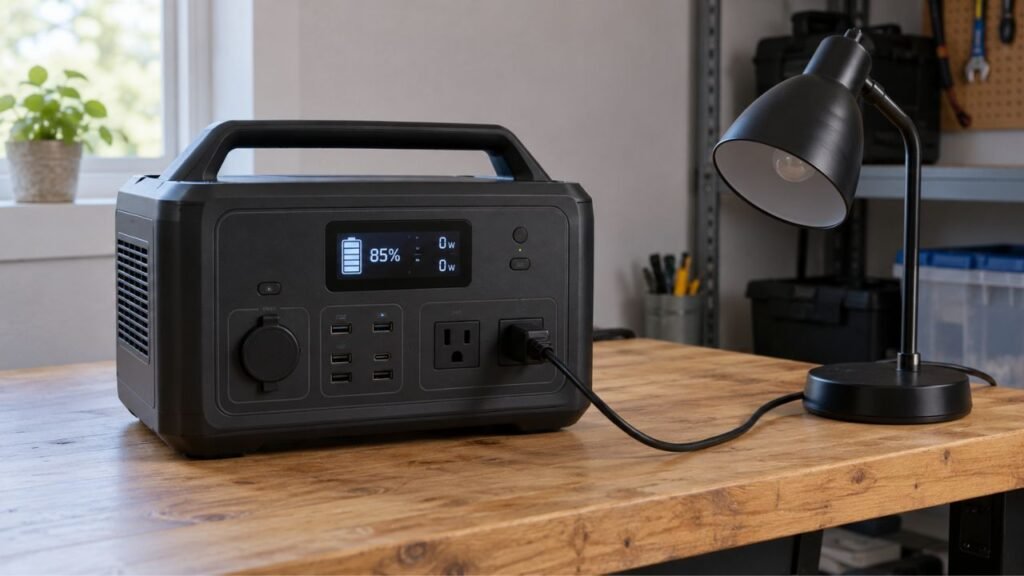
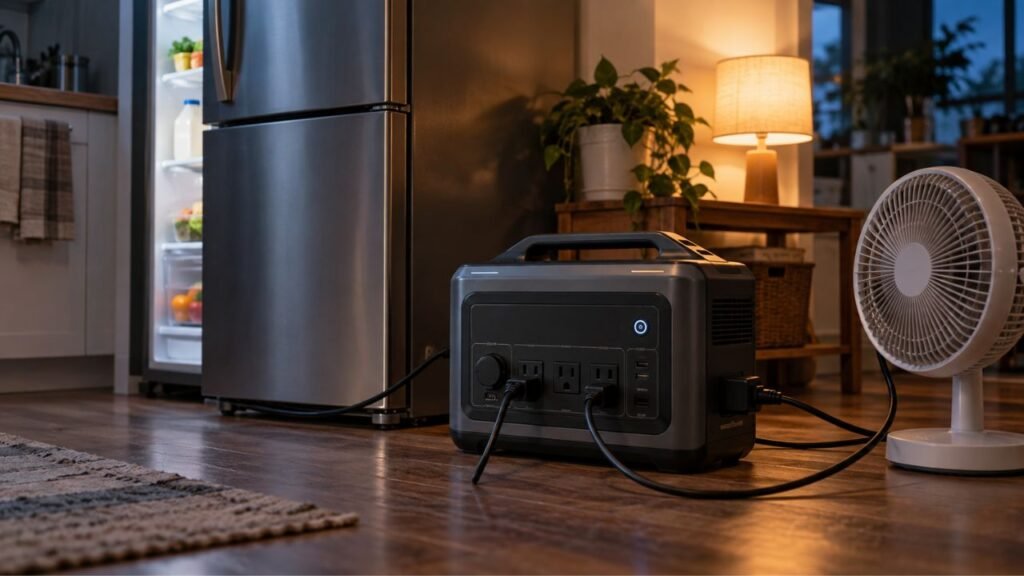
A portable power station usually shuts off under load because a protection limit has been reached. Common causes include excessive wattage, startup surge, low battery voltage, overheating, short circuits, or an output-specific overload.
The good news is that many shutdowns do not mean the station is damaged. I’ll help you identify the pattern, find the likely cause, and safely fix it.
Key Takeaways
- An instant shutdown often points to startup surge or overload.
- A delayed shutdown may indicate overheating or sustained excessive load.
- Low battery charge can make heavy loads harder to support.
- Motors and compressors can demand high power during startup.
- Each AC, DC, or USB output may have separate limits.
- ECO mode can sometimes look like an unexpected shutdown.
- Pass-through charging may change available output on certain models.
- Repeated shutdowns with small loads may indicate an internal problem.
- Never bypass protection systems to keep a station running.
- Check the exact manual before assuming the power station is faulty.
Quick Diagnosis: Why Is My Portable Power Station Shutting Off?
The timing of the shutdown gives you one of the best clues. Start by noticing what happens immediately before the power disappears.
| What You Notice | Likely Cause | What to Check First | First Step |
| Station shuts off as an appliance starts | Startup surge | Appliance starting watts | Disconnect it and check surge requirements |
| Station runs briefly, then shuts down | Continuous overload | Total output watts | Reduce the connected load |
| Station becomes hot before shutting down | Thermal protection | Vents, fans, room temperature | Let the unit cool |
| Works fully charged but fails at lower charge | Voltage sag or low battery | Battery percentage | Recharge fully and retest |
| Shuts down when another appliance starts | Combined load | Total simultaneous demand | Run appliances separately |
| Only AC output turns off | AC inverter protection | AC error or warning | Disconnect AC appliances |
| Only DC or USB stops | Port overload | Port wattage/current limit | Reduce that output load |
| Works on battery but fails while charging | Pass-through limitation | Pass-through output rating | Reduce connected AC load |
| Output turns off after a similar time period | ECO or auto-off setting | Power-saving settings | Check the station settings |
| Random shutdown with a small load | Possible hardware issue | Error codes and behavior | Stop repeated testing |
What Does Shutting Off Under Load Actually Mean?
A portable power station is more than a large battery. Several electronic systems work together whenever you connect an appliance.
The basic power path looks like this:
Battery → Battery Management System → Inverter → Connected appliance
The Battery Management System, or BMS, monitors the battery continuously. The inverter converts stored DC power into household AC electricity.
Both systems have protection limits.
They may monitor:
- Battery voltage
- Current draw
- Internal temperature
- Output wattage
- Short circuits
- Charging conditions
- Individual output limits
If one monitored value moves outside its safe range, protection activates. The station may shut down completely or disable one output.
That shutdown is usually intentional.
One important distinction also causes plenty of confusion.
Battery watt-hours and inverter watts measure different things.
Watt-hours tell you approximately how much energy the battery stores. Watts tell you how much power the inverter can deliver.
A 2,000Wh battery does not automatically support a 2,000W appliance.
Always check both ratings separately.
Why Does a Portable Power Station Shut Off Under Load?
Several different protection events can create almost identical symptoms. Understanding each one makes troubleshooting much easier.
The Connected Load Exceeds the Continuous Output Rating
Every portable power station has a continuous AC output rating.
Suppose your station is rated for 1,000 watts continuously. That does not mean you can continuously run 1,200 watts.
Once the total load exceeds the inverter’s limit, protection can activate.
You may encounter this when running several appliances together.
For example:
- Refrigerator: 150 watts
- Television: 120 watts
- Coffee maker: 900 watts
The refrigerator and television may run without trouble.
Once the coffee maker starts, total demand becomes much higher. The station may immediately switch off its AC output.
Look at the total load, not each appliance individually.
Startup Surge Is Higher Than the Station Can Handle
Startup surge is one of the most common hidden causes.
Some appliances consume much more electricity during startup than afterward.
A refrigerator compressor is a good example.
It may consume only a few hundred watts while running. However, starting the compressor requires a short burst of additional power.
That burst is called startup surge or inrush current.
Common high-surge appliances include:
- Refrigerators
- Freezers
- Window air conditioners
- Sump pumps
- Well pumps
- Air compressors
- Power tools
- Shop vacuums
Your display may show reasonable wattage after startup.
However, the inverter still has to survive that first surge.
If the surge exceeds the inverter’s limit, output can shut down instantly.
Several Appliances Create a Combined Startup Surge
Sometimes every appliance works perfectly when tested separately.
Then everything shuts down when you use them together.
The problem may be overlapping startup demand.
Imagine your refrigerator is already running. You then start a sump pump while a television and several lights remain connected.
The station must support all existing loads plus the pump’s startup surge.
That short burst can exceed the inverter rating.
This situation becomes more common during home power outages. Several appliances may cycle automatically without warning.
Try starting demanding appliances separately whenever possible.
Low Battery Voltage Triggers BMS Protection
A nearly empty battery may struggle with a heavy appliance.
The display might still show remaining charge. However, the battery voltage can fall sharply under high current demand.
If voltage reaches the station’s low-voltage protection point, the BMS responds.
It may shut the output off to protect the battery.
This explains why a heavy appliance may work at 90% charge but fail at 15%.
Recharge the station fully before testing the appliance again.
If the problem disappears, low battery voltage likely contributed.
Battery Voltage Sag Gets Worse Under Heavy Load
Battery voltage does not remain perfectly constant during discharge.
Heavy loads pull more current from the battery.
That current can temporarily push battery voltage downward. This effect is commonly called voltage sag.
A small load may work normally at the same battery percentage. A larger appliance may cause enough voltage sag to trigger protection.
Battery condition can influence this behavior.
Temperature and battery age may also affect high-current performance.
Do not assume the displayed percentage tells the complete story.
The Power Station Is Overheating
High output produces heat inside the power station.
Cooling fans and vents help remove that heat. Problems begin when the station cannot cool itself properly.
Common causes include:
- Blocked ventilation openings
- Direct sunlight
- Hot garages
- Small enclosed cabinets
- Dust around cooling vents
- High continuous loads
- Cooling fan problems
Imagine running a large appliance inside a closed storage compartment.
The station may handle the electrical load correctly. However, its internal temperature can continue rising.
Eventually, thermal protection can shut the output down.
Move the station somewhere cooler and improve airflow.
Never cover the ventilation openings while the unit operates.
A Short Circuit or Faulty Appliance Triggers Protection
The problem is not always inside the power station.
A damaged appliance, plug, cable, or adapter can create abnormal current.
The station may detect that condition and immediately cut power.
Pay attention when one particular device causes repeated shutdowns.
If other compatible devices work normally, inspect that appliance carefully.
Look for:
- Damaged insulation
- Bent connectors
- Burn marks
- Loose plugs
- Moisture
- Melted plastic
- Unusual smells
Do not repeatedly reconnect a device showing visible damage.
You Exceeded a Specific Port’s Limit
The power station’s advertised maximum wattage does not apply equally everywhere.
Each output may have its own limit.
For example, your station might include:
- AC outlets
- USB-A ports
- USB-C ports
- 12V car outlet
- DC barrel outputs
A station might support thousands of watts through AC. Its 12V outlet could still have a much lower current limit.
The same applies to USB-C ports.
Always check the rating of the exact output being used.
A DC overload does not necessarily mean the entire station is overloaded.
Pass-Through Charging Changes the Available Output
This cause can be especially confusing.
Your appliance may work perfectly when the station uses battery power. Then it shuts down while the station charges from a wall outlet.
Some portable power stations use different limits during pass-through operation.
Pass-through means the station is charging while powering connected equipment.
Depending on the model, charging conditions can affect available output.
Do not assume the normal inverter rating always applies unchanged.
Check your manual for terms such as:
- Pass-through charging
- EPS mode
- UPS mode
- AC bypass
- Simultaneous charging and discharging
If shutdown happens only while charging, investigate this first.
ECO Mode or AC Timeout Looks Like an Overload
Not every unexpected shutdown happens because of excessive power.
Many stations include an automatic power-saving feature.
The station may disable an output when demand becomes very low.
This can happen with devices that cycle on and off.
A refrigerator might stop its compressor after reaching temperature. Its power draw then becomes very small.
Some stations interpret this as an unused outlet.
The AC inverter may shut itself off after a preset period.
Check your station’s app or settings for options such as:
- ECO mode
- AC timeout
- Auto shutdown
- Standby timer
- Low-load shutdown
A repeatable shutdown after the same time interval strongly suggests a setting.
Battery Aging May Reduce High-Load Performance
Batteries gradually lose performance after years of use and charging cycles.
An older station may still run small electronics without obvious problems.
Heavy loads tell a different story.
The battery may struggle to maintain voltage under higher current demand.
You might notice that an appliance worked previously but now causes shutdowns.
One failure does not prove battery damage.
However, repeated changes in high-load performance deserve further investigation.
Firmware, BMS, or Inverter Problems Can Cause Shutdowns
Internal faults are possible, but check simpler causes first.
Potential problems may involve:
- Battery monitoring electronics
- Inverter controls
- Temperature sensors
- Internal communications
- Firmware
- Cooling systems
A hardware problem becomes more likely when small compatible loads also fail.
Record any error codes before resetting the station.
If your manufacturer offers firmware updates, check their instructions.
Do not open the station to repair internal high-voltage components yourself.
Why Does My Power Station Say Overload Below the Rated Watts?
Seeing an overload warning below the advertised rating can feel confusing. Several factors can explain why the numbers seem inconsistent.
Your Appliance Has a Hidden Startup Surge
The display normally shows the power being consumed at that moment.
A very brief startup spike may happen too quickly to notice.
The appliance can therefore show 300 watts after starting. Yet its startup event may have demanded much more.
Motors and compressors are especially likely to behave this way.
The Display May Miss a Very Fast Power Spike
A power station display provides helpful information.
However, it should not be treated like laboratory measuring equipment.
A surge can occur and trigger protection before you see it.
That means displayed watts may appear below the inverter’s rating.
This is especially important when the shutdown happens immediately.
Other Devices Are Already Using Inverter Capacity
You may be focusing only on the newest appliance.
Look at everything connected to the station.
Several smaller appliances can consume significant combined power.
Then one additional device starts and pushes demand beyond the limit.
Disconnect unnecessary loads and test again.
Battery Charge and Temperature Can Affect Performance
Advertised output specifications are normally based on defined operating conditions.
A very hot, cold, or heavily discharged battery may behave differently.
Your station’s protection systems may intervene before expected.
Follow the operating temperature range provided by the manufacturer.
You May Be Looking at the Wrong Rating
Portable power station specifications contain several different wattage numbers.
It is easy to compare the wrong ones.
You may see:
- Battery capacity in Wh
- Continuous AC output in W
- Surge output in W
- Solar input in W
- AC charging input in W
- USB-C output in W
- DC output limits
Only the relevant output rating determines whether your appliance fits.
How to Troubleshoot a Portable Power Station That Shuts Off Under Load
Use a simple process instead of repeatedly restarting the station. These steps can help you narrow down the cause safely.
- Disconnect every appliance. Remove the load before restarting the power station.
- Check the screen for error information. Record warning symbols, codes, battery percentage, and output readings.
- Notice which output stopped. Determine whether AC stopped or the entire station turned off.
- Check the battery charge level. Recharge fully before testing a demanding appliance again.
- Turn the station on without any load. Confirm that it starts and remains stable normally.
- Connect one small known-good device. Try a lamp, charger, or another modest compatible load.
- Check the continuous inverter rating. Find the exact AC output specification for your model.
- Check your appliance’s running watts. Use the nameplate, manual, or reliable power measurement.
- Consider startup surge. Pay special attention to motors, compressors, and pumps.
- Reconnect devices one at a time. Watch the total output as each appliance starts.
- Check the station’s temperature. Move it away from heat and unblock ventilation openings.
- Check the individual output limit. Confirm the AC, USB, or 12V port supports the device.
- Review power-saving settings. Look for ECO mode, AC timeout, and auto-off controls.
- Check pass-through restrictions. Do this when the problem appears during simultaneous charging.
- Use the manufacturer’s reset procedure when appropriate. Do not randomly hold buttons unless your manual directs it.
- Contact support if normal loads still cause shutdowns. Repeated unexplained protection events deserve proper diagnosis.
How to Check Whether Your Appliance Is Too Large
You need to compare several numbers before connecting demanding equipment. Do not rely only on the appliance’s normal running wattage.
Find the Power Station’s Continuous AC Rating
Start with the continuous output rating.
You can usually find it on:
- The product label
- Owner’s manual
- Manufacturer specifications
- Companion app
Suppose your station provides 1,800W continuous AC output.
That is the maximum sustained AC load under specified conditions.
Do not confuse it with the surge rating.
Find the Appliance’s Running Wattage
Look for a wattage rating on the appliance label.
Sometimes the label only lists volts and amps.
You can estimate power with:
Watts = Volts × Amps
For example:
120 volts × 5 amps = 600 watts
Actual consumption can differ from a simple nameplate calculation.
Use measured or manufacturer-provided wattage whenever available.
Check the Starting or Surge Requirement
This matters most for appliances containing electric motors.
A pump could have modest running consumption but high startup demand.
Compare that starting demand against your station’s surge capability.
The surge rating also has a limited duration.
Do not assume it can support that level continuously.
Add Devices That Run at the Same Time
Next, calculate your likely simultaneous load.
Suppose you have:
- Refrigerator: 180 watts
- Television: 100 watts
- Router: 15 watts
- Lights: 40 watts
Your normal running total becomes approximately 335 watts.
However, refrigerator startup demand may temporarily push it much higher.
Plan for both running load and realistic startup events.
Leave Practical Operating Headroom
Running constantly near the inverter’s maximum leaves little room for changes.
An appliance may cycle or briefly consume more power.
Leaving some headroom can make the setup more reliable.
However, there is no universal 80% rule for every station.
Always follow the continuous and surge ratings of your exact model.
Appliances Most Likely to Cause Shutdowns
Certain appliances regularly cause trouble because of high running watts or startup demand. Check these devices carefully before assuming your station has failed.
- Refrigerator
- Freezer
- Sump pump
- Well pump
- Window air conditioner
- Portable air conditioner
- Air compressor
- Circular saw
- Shop vacuum
- Microwave
- Coffee maker
- Electric kettle
- Space heater
- Hair dryer
Motor-driven equipment often causes trouble during startup.
Heating appliances usually create problems because their running wattage stays high.
Those are two different overload patterns.
Does Boost or High-Wattage Mode Prevent Shutdowns?
Some portable power stations include special modes for higher-wattage appliances.
You might see names such as power lifting or boost mode.
These features can help with certain compatible appliances.
However, they do not necessarily increase the inverter’s normal rating.
Some systems manage output voltage or appliance behavior differently.
That makes them better suited to certain simple resistive loads.
They may not solve compressor or motor startup problems.
Never assume boost mode makes every high-wattage appliance safe.
Check the manufacturer’s compatibility guidance before using it.
Repeated overload trips should not be solved by forcing boost mode.
Why Does It Work at 100% Battery but Shut Off Later?
This pattern usually points toward battery voltage under heavy demand.
A fully charged battery starts at a higher operating voltage.
As the battery discharges, its voltage gradually drops.
Now add a heavy appliance.
The high current creates additional temporary voltage sag.
Eventually, that voltage may reach the station’s protection threshold.
The BMS then cuts the load.
That is why a large appliance might work at 90% charge. The same appliance may cause problems much later.
Temperature and battery condition can also influence this behavior.
Recharge fully and perform one controlled test.
If the problem repeatedly happens unusually early, contact the manufacturer.
Why Does Only the AC Output Shut Off?
Sometimes the display stays on while household outlets stop working. That usually points toward the AC inverter rather than complete battery failure.
AC Inverter Overload
The connected AC appliances may exceed the continuous inverter limit.
Remove the load and check their combined wattage.
AC Overtemperature Protection
The inverter creates additional heat while delivering large AC loads.
Poor ventilation can therefore shut down only that part.
Let the station cool before testing again.
AC Timeout or ECO Setting
Power-saving settings may switch off the inverter automatically.
The battery and other outputs can remain active.
Check your AC timeout settings before assuming there is a fault.
Inverter Fault
Persistent AC failure with small known-good loads needs more attention.
Record the error message and follow the manufacturer’s troubleshooting procedure.
What You Should Not Do After an Overload Shutdown
Protection systems exist to prevent damage and unsafe operating conditions. Treat a repeated shutdown as information rather than something to defeat.
- Do not keep restarting the same oversized appliance.
- Do not bypass the BMS or overload protection.
- Do not open the power station casing.
- Do not use visibly damaged cables or adapters.
- Do not block ventilation openings.
- Do not assume battery Wh equals inverter watts.
- Do not force an appliance through an undocumented workaround.
- Do not assume boost mode supports every appliance.
- Do not ignore recurring temperature warnings.
- Do not ignore repeated short-circuit errors.
- Do not continue using equipment that smells burnt.
When Should You Stop Using the Power Station?
Most overload events can be investigated safely after removing the load. Some warning signs mean you should stop using the unit entirely.
Stop operating the station if you notice:
- Smoke
- Burning smell
- Swollen casing
- Melted outlet
- Severe discoloration
- Crackling sounds
- Electrical arcing
- Liquid damage
- Unusual excessive heat
- Repeated short-circuit warnings
- Cooling fan failure with overheating
- Visible damage from a hard impact
- Persistent internal fault codes
- Shutdowns with very small known-good loads
Disconnect connected equipment when it is safe.
Then contact the manufacturer or an authorized service provider.
How to Prevent Portable Power Station Shutdowns Under Load
You can avoid many shutdowns by planning around actual power requirements. A few simple habits also make troubleshooting easier later.
- Know your station’s continuous AC rating.
- Check startup demand for compressors and motors.
- Avoid starting several large appliances simultaneously.
- Leave practical room below the inverter limit.
- Recharge before using demanding appliances.
- Keep ventilation openings clear.
- Avoid placing the station in direct sunlight.
- Use the correct output for each device.
- Check individual USB and DC port limits.
- Review ECO and automatic shutdown settings.
- Check pass-through limits before charging and powering together.
- Test important backup appliances before an outage.
- Keep the station firmware current when supported.
- Follow storage and operating temperature recommendations.
Testing before an emergency is especially important.
You do not want to discover an incompatibility during an outage.
Is My Portable Power Station Faulty or Just Protecting Itself?
A protection shutdown does not automatically mean something is broken.
If a large appliance causes an immediate overload, the station may simply be working correctly. The same applies when heat or low battery triggers protection.
Look for a repeatable pattern.
A fault becomes more likely when the station repeatedly fails with a small, compatible, known-good load.
Before contacting support, record:
- Battery percentage
- Connected appliance
- Output wattage
- Error code
- Operating temperature
- Which output stopped
- Whether the station was charging
- How long it ran before shutting down
Those details can make manufacturer troubleshooting much faster.
Final Words
A portable power station shutting off under load usually means a protection limit was reached. The most common causes are excessive wattage, startup surge, low battery voltage, overheating, or an output-specific limit.
Start by watching exactly when the shutdown occurs. Then check the appliance, battery level, output rating, temperature, and error message.
If normal compatible loads continue causing unexplained shutdowns, stop repeated testing. At that point, manufacturer support is the safer next step.
Related FAQs
Why Does My Portable Power Station Shut Off When I Plug Something In?
An immediate shutdown usually points to startup surge, excessive wattage, a short circuit, or a damaged appliance. Disconnect the device and compare its power requirements with your station’s continuous and surge ratings.
Why Does My Power Station Keep Saying Overload?
Your connected equipment may exceed the inverter limit, create a startup surge, overload a specific output, or trigger protection because of temperature. Check the actual error code before assuming every overload warning has the same cause.
Why Does My Power Station Overload Below Its Rated Wattage?
A brief startup surge may exceed the inverter limit even when displayed running watts look safe. Other connected devices, battery condition, temperature, or operating mode can also affect the shutdown.
Can a Low Battery Cause a Portable Power Station to Shut Off Under Load?
Yes. Heavy loads can cause battery voltage to sag when charge is low. If voltage reaches the BMS protection threshold, the station may disconnect the output before the percentage reaches zero.
Why Does My Power Station Shut Off When My Refrigerator Starts?
The refrigerator compressor can require much more power during startup than normal operation. That brief surge may exceed the station’s inverter capability even when the refrigerator’s running wattage seems low.
Why Does My Power Station Run a Refrigerator for Hours and Then Shut Off?
The refrigerator may create another compressor startup surge later. Low battery charge, temperature, ECO mode, or an AC timeout setting can also cause a delayed shutdown.
Can Overheating Cause an Overload Warning?
High load creates additional internal heat, but overload and thermal protection are usually separate conditions. Check the displayed warning or error code to determine which protection actually triggered.
Does Battery Percentage Affect How Much Power a Power Station Can Deliver?
It can affect heavy-load behavior on some systems. As battery charge falls, voltage also changes, and a demanding appliance may cause enough voltage sag to trigger low-voltage protection.
Why Does My Power Station Work Until I Connect a Second Appliance?
The first appliance may already use much of the inverter’s available capacity. Adding another appliance can exceed the continuous limit or create a combined startup surge.
Can Pass-Through Charging Cause My Power Station to Overload?
Yes, depending on the model. Some stations have different output limits during pass-through, EPS, UPS, or bypass operation. Check the specifications for simultaneous charging and discharging.
Should I Reset My Power Station After an Overload?
You can reset it when the manufacturer recommends doing so, but remove the overload first. Repeatedly resetting the station without addressing the cause can trigger the same protection again.
Does a Bigger Battery Prevent Overload Shutdowns?
Not necessarily. A larger watt-hour capacity mainly increases runtime. The inverter’s continuous and surge wattage ratings determine whether the station can safely handle a particular appliance.

Warren Turner writes practical guides and reviews on generators, portable power stations, and battery backup systems. He focuses on real-world performance, everyday power needs, and helping readers choose dependable equipment without unnecessary complexity.