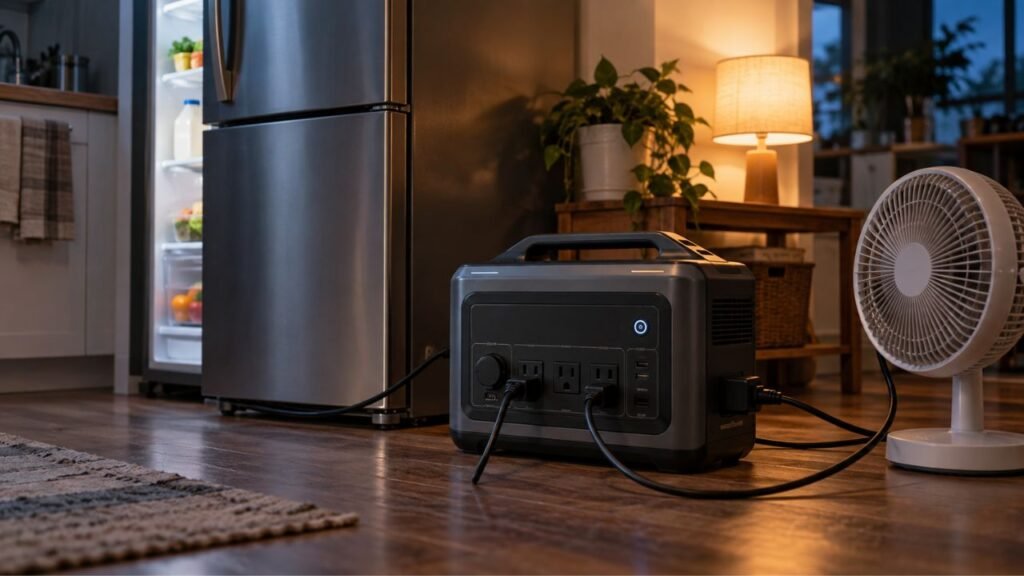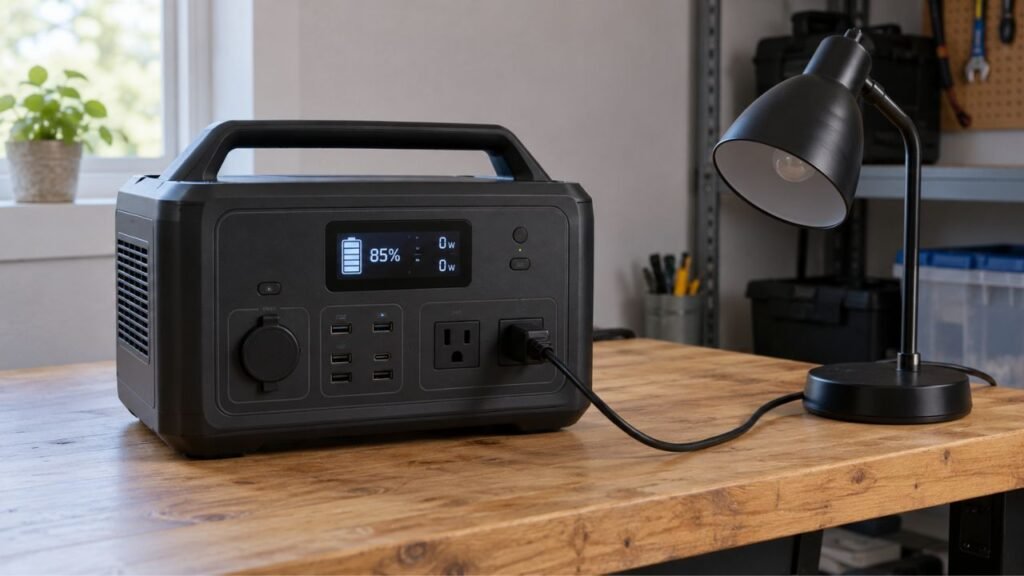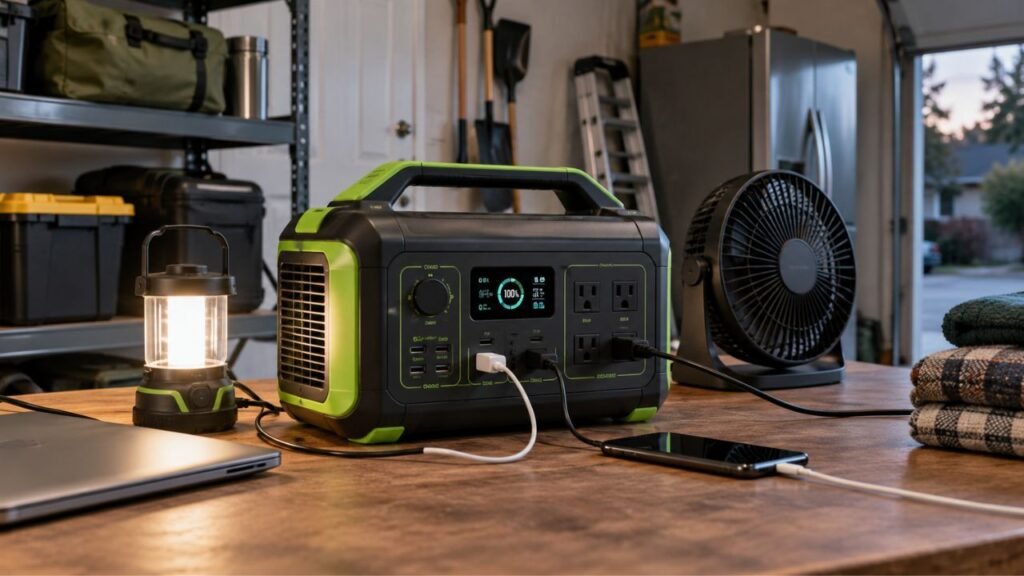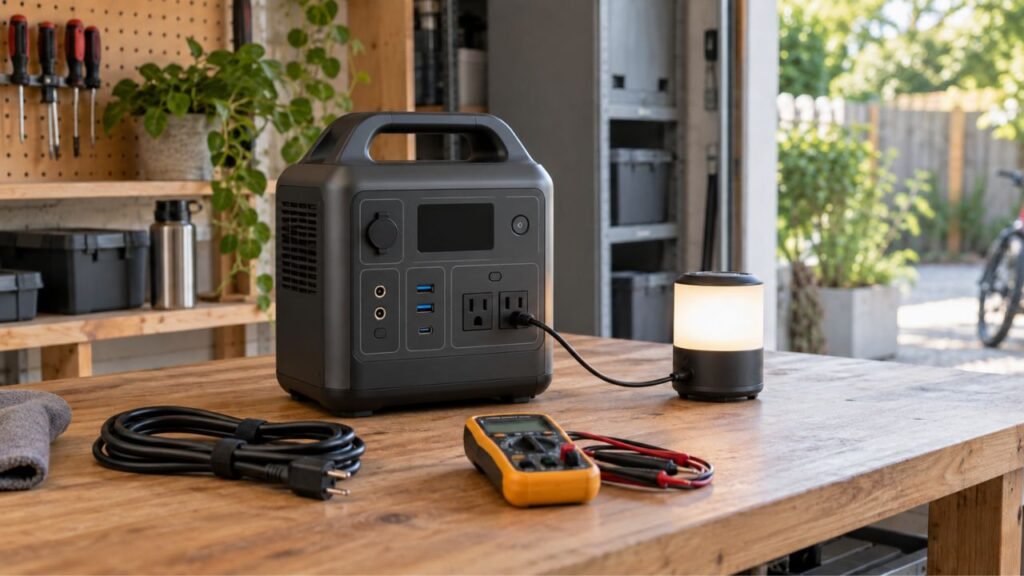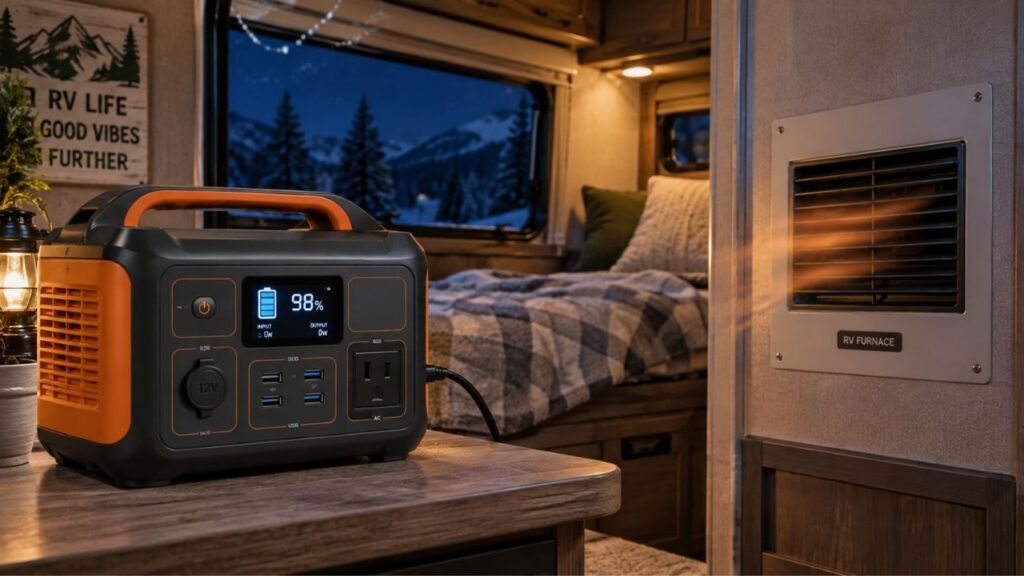
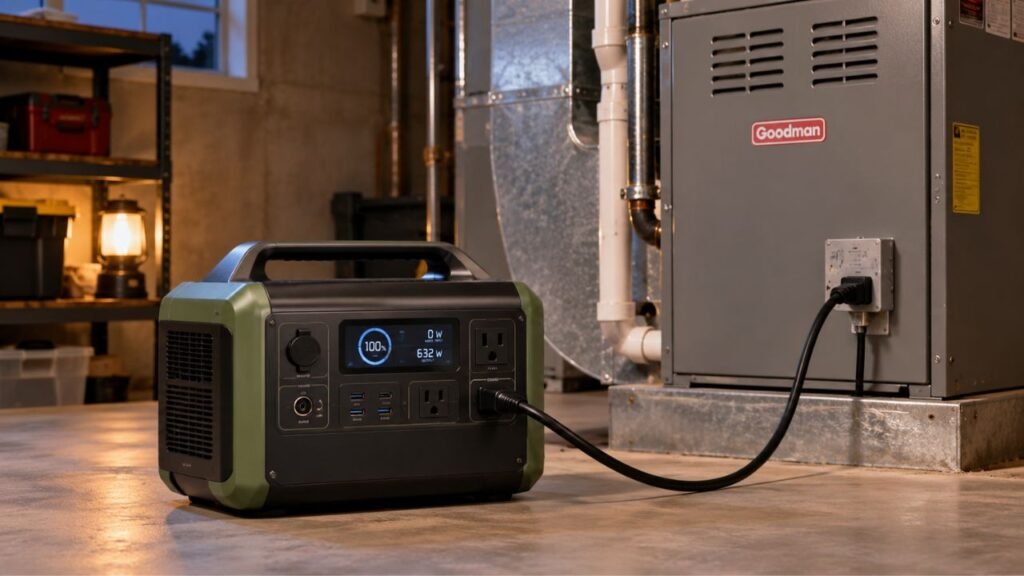
Yes, a portable power station can run many residential gas furnace blowers. The station must provide the correct voltage, enough running power, sufficient startup capacity, and compatible AC output. It also needs enough battery capacity for your desired heating time.
The tricky part is sizing everything correctly. I’ll show you how to check furnace wattage, estimate runtime, handle startup demand, and avoid connection problems during an outage.
Key Takeaways
- Many residential gas furnaces can run from portable power stations.
- Gas creates the heat, but furnace components still need electricity.
- Running watts alone cannot determine whether your furnace will work.
- Blower motors can require extra power during startup.
- Battery watt-hours determine how long the furnace can keep operating.
- Pure sine wave AC is the preferred choice for modern furnaces.
- Hardwired furnaces need a safe, approved backup connection method.
- Grounding or neutral compatibility can sometimes prevent furnace ignition.
Can a Portable Power Station Really Run a Gas Furnace Blower?
Yes, in many homes, it is completely practical. A gas furnace does not use electricity to create most of its heat. Natural gas or propane supplies that energy.
Electricity instead runs the equipment supporting the heating process. This includes the blower, controls, ignition system, and other components.
That makes a gas furnace much easier to support with battery power than an electric furnace.
However, you normally are not powering only the blower motor. You are powering the furnace’s complete electrical system.
That distinction matters when choosing your portable power station.
A blower might consume several hundred watts while operating. However, the inducer motor, control board, ignition system, and accessories can add additional demand.
Your portable power station therefore needs enough capacity for the entire operating furnace.
You also should not size your battery from the furnace’s BTU rating. A 60,000 BTU furnace does not require 60,000 watts of electricity.
BTUs describe heating capacity, not electrical consumption.
What Parts of a Gas Furnace Need Electricity?
Even though gas creates the heat, several electrical components keep everything operating safely. Your backup system must support every required component during the heating cycle.
Electrical components may include:
- Main circulating blower motor
- Draft inducer motor
- Electronic ignition system
- Furnace control board
- Gas valve controls
- Safety switches
- Flame-sensing circuit
- Thermostat transformer
- Condensate pump on some systems
- Powered dampers or zoning equipment
- Other HVAC accessories connected with the furnace
The circulating blower is often the largest sustained electrical load.
However, estimating blower watts alone can still leave you undersized. The best approach is measuring or verifying the complete furnace load.
How Many Watts Does a Gas Furnace Blower Use?
There is no single wattage number that fits every furnace. Blower electricity depends on motor design, airflow, furnace size, speed, and duct conditions.
Several hundred watts can be a reasonable preliminary planning range. However, you should verify your furnace before buying backup equipment.
Running Watts
Running watts describe the electrical power needed during normal operation.
Once the blower reaches operating speed, its electrical demand usually settles. The furnace’s other active components also contribute to this load.
For example, imagine your complete furnace draws 550 watts while heating. Your power station should comfortably handle more than 550 watts continuously.
You should avoid sizing the inverter exactly at the measured load.
Some operating headroom gives you a more forgiving backup system.
Startup Watts
A blower motor can briefly demand additional power when starting.
This startup load may only last moments. However, it can still cause an undersized portable power station to shut down.
That creates an important distinction.
A furnace might consume 550 watts while running normally. Its startup requirement could still exceed a small inverter’s capability.
Do not automatically assume every blower needs exactly twice its running wattage. Startup behavior varies considerably between furnace designs.
The safest method is checking manufacturer information or measuring actual startup demand.
PSC vs ECM Furnace Blower Motors
Your blower motor design can also influence electrical behavior.
Older furnaces commonly use permanent split capacitor, or PSC, blower motors. These motors typically operate using several fixed speed settings.
Newer furnaces often use electronically commutated motors, commonly called ECM blowers. These motors can adjust airflow more precisely.
Variable-speed ECM systems may operate differently across heating stages. Their electricity use can therefore change depending on airflow demand.
Do not assume every ECM motor is automatically low wattage.
Duct resistance, airflow settings, motor speed, and furnace operation still matter.
| Furnace Electrical Factor | What It Tells You | Why It Matters |
| Running watts | Normal furnace electrical demand | Determines continuous inverter requirements |
| Startup watts | Brief highest electrical demand | Determines whether startup can overload the inverter |
| Voltage | Required AC voltage | Must match the power station output |
| Blower motor type | Motor design and operating behavior | Helps explain changing electrical demand |
| Battery capacity | Stored energy measured in Wh | Determines approximate operating time |
| Additional loads | Inducer, controls, pumps, accessories | Must be included when sizing the system |
The takeaway is simple. Generic furnace wattage charts are useful starting points, not guarantees.
How Do You Find Your Furnace’s Actual Power Requirements?
Finding your furnace’s real electrical demand gives you much better sizing information. You do not need to guess from another homeowner’s system.
Follow these steps:
- Find the furnace model number and electrical nameplate.
- Confirm the required operating voltage.
- Check the furnace manual for electrical specifications.
- Look for blower motor information when available.
- Do not use furnace BTU output as electrical wattage.
- Do not calculate consumption from breaker size alone.
- Measure complete operating wattage when safely possible.
- Observe the furnace through several complete heating cycles.
- Record normal load and the highest startup demand.
- Ask a professional to measure hardwired equipment when necessary.
Here is another important point.
A furnace connected to a 15-amp circuit does not necessarily consume 1,800 watts continuously.
The breaker represents circuit protection and available capacity. It does not function as an electricity-use meter.
Actual furnace consumption may be considerably lower.
If your furnace is hardwired, avoid opening electrical wiring simply for measurements. An HVAC technician or electrician can safely measure the load.
What Size Portable Power Station Do You Need for a Gas Furnace Blower?
Choose the power station by checking four things in order. Start with voltage, then inverter output, startup capability, and battery capacity.
Check the AC Voltage
First, verify your furnace’s required voltage.
Many residential forced-air gas furnaces in the United States use approximately 120V AC. However, you should confirm your exact equipment.
The portable power station must provide compatible voltage and frequency.
Do not assume a standard 120V power station can support equipment requiring 240V.
Check Continuous AC Output
Next, compare the furnace’s normal operating watts with inverter output.
Suppose your complete furnace normally consumes 600 watts.
A power station rated for only 600 watts gives you virtually no margin. A higher-rated inverter gives the furnace more operating headroom.
You may also want enough output for essential secondary devices.
Those could include:
- Wi-Fi equipment
- Small LED lights
- Phone chargers
- Refrigerator
- Medical equipment
Every additional device increases the total inverter load.
Check Startup or Surge Capability
Startup capacity becomes especially important with motor-driven equipment.
The blower and inducer may create brief demand changes during startup. Your inverter needs enough capability to remain operating through those moments.
Battery capacity cannot solve an undersized inverter.
For example, a power station might contain 3,000Wh of energy. It can still shut down if its inverter cannot start the furnace.
Always separate these two questions:
Can the inverter handle the furnace?
Does the battery store enough energy?
Both answers need to be yes.
Check Battery Capacity in Watt-Hours
Battery capacity determines approximately how long you can keep heating.
A power station might advertise a 2,000W inverter and 1,000Wh battery.
Those numbers measure different things.
Watts measure power demand.
Watt-hours measure stored energy.
Your furnace might easily fit under the 2,000W inverter limit. However, the 1,000Wh battery could still run down quickly.
That is why inverter wattage and battery capacity should never be treated interchangeably.
Does a Furnace Need a Pure Sine Wave Power Station?
A pure sine wave portable power station is the preferred choice for gas furnaces. Modern furnaces contain sensitive controls and motor-driven components requiring stable AC power.
Pure sine wave output more closely resembles normal utility electricity.
That makes it more appropriate for equipment containing electronic control boards, variable-speed motors, and ignition electronics.
I would avoid choosing a modified sine wave inverter for furnace backup.
However, pure sine wave output does not automatically guarantee compatibility.
You still need compatible:
- Voltage
- Frequency
- Running wattage
- Startup capacity
- Electrical connection
- Grounding
- Neutral arrangement
- Wiring polarity
Think of pure sine wave output as one requirement rather than the complete answer.
How Long Will a Portable Power Station Run a Gas Furnace?
Battery runtime depends mainly on stored watt-hours and average furnace consumption. You should also allow for inverter losses and other real-world conditions.
A useful planning formula is:
Estimated runtime = Battery capacity in Wh × planning efficiency ÷ furnace watts
For simple planning, I like using about 85% of nominal battery capacity.
This does not mean every power station operates at exactly 85% efficiency. It simply provides a conservative planning allowance for conversion losses and other variables.
Here are several examples.
| Furnace Load While Running | 1,000Wh Station | 2,000Wh Station | 3,000Wh Station |
| 300W | About 2.8 hours | About 5.7 hours | About 8.5 hours |
| 500W | About 1.7 hours | About 3.4 hours | About 5.1 hours |
| 700W | About 1.2 hours | About 2.4 hours | About 3.6 hours |
| 900W | About 0.9 hour | About 1.9 hours | About 2.8 hours |
These examples assume continuous furnace operation and an 85% planning factor.
Your actual runtime can differ because of:
- Battery condition
- Indoor temperature
- Outdoor temperature
- Inverter losses
- Furnace operating stage
- Blower speed
- Additional appliances
- Battery temperature
- Furnace cycling
The table therefore estimates accumulated operating time, not guaranteed outage duration.
Why Furnace Duty Cycle Matters for Overnight Runtime
Your furnace usually does not run continuously all night.
It heats the home until the thermostat reaches its target. The burner and blower then stop until more heat is required.
The percentage of time your furnace operates is its duty cycle.
Suppose your furnace draws 500 watts while heating.
Imagine it operates 50% of an eight-hour night. That means about four accumulated operating hours.
The furnace would require roughly:
500W × 4 hours = 2,000Wh of usable energy
You would need more than a 2,000Wh nominal battery after considering losses and reserve capacity.
Now imagine the same furnace runs only 30% of the night. Your required stored energy drops considerably.
This explains why two homeowners can get dramatically different runtimes from identical power stations.
Several factors increase furnace duty cycle:
- Very cold weather
- Poor insulation
- Air leaks
- Higher thermostat settings
- Frequent exterior door opening
- Large home heat loss
- Furnace sizing
- Building construction
Avoid assuming your furnace always runs 15 or 20 minutes each hour.
Your home’s actual behavior gives you better planning information.
Can You Plug a Gas Furnace Directly Into a Portable Power Station?
Some gas furnaces can use backup power relatively easily, while others cannot. The correct method depends heavily on how your furnace was installed.
If the Furnace Already Has an Approved Plug
Some furnaces use an approved cord-and-plug connection.
If yours does, backup power may be relatively straightforward.
You still need to verify:
- Correct voltage
- Adequate inverter output
- Adequate startup capability
- Suitable AC waveform
- Proper grounding
- Correct cord and receptacle ratings
- Manufacturer requirements
Do not rely on one successful startup.
Test several complete furnace cycles before depending on the setup.
If the Furnace Is Hardwired
Many residential furnaces are permanently hardwired.
You should not cut the furnace wiring and attach a homemade plug during an outage.
You also should not make improvised electrical connections inside the furnace disconnect or breaker panel.
A licensed electrician can determine the proper backup arrangement.
The goal is creating a safe method that transfers the furnace between utility and backup power without creating electrical hazards.
Using a Transfer Switch or Dedicated Furnace Transfer Device
A transfer device lets equipment receive power from an alternate source while keeping utility electricity properly isolated.
Several connection options may exist depending on your home.
The correct solution depends on:
- Furnace wiring
- Electrical panel design
- Backup power equipment
- Local electrical requirements
- Power station specifications
Have permanent electrical modifications handled professionally.
Never backfeed household wiring through a wall receptacle.
Backfeeding can create serious shock, fire, and utility-worker hazards.
Why Grounding and Neutral Compatibility Can Stop a Furnace From Working
Sometimes the portable power station has plenty of wattage, yet the furnace still refuses to operate. Grounding and neutral configuration can be the missing pieces.
What a Floating Neutral Means
Some portable power stations use what is called a floating neutral.
In simple terms, neutral and ground are not internally connected inside the power station.
That design is not automatically defective.
However, certain furnaces may expect electrical conditions resembling normal household utility power.
Compatibility depends on the complete electrical setup and connection method.
This is one reason I recommend testing the exact furnace and backup configuration before winter.
Why the Burner May Ignite and Then Shut Off
Imagine this situation.
The power station turns on normally. The inducer starts. The furnace ignites. Then the burner shuts down shortly afterward.
You might immediately blame insufficient battery power.
However, flame-sensing systems can depend on proper grounding and electrical polarity.
A furnace may therefore:
- Refuse ignition
- Shut the burner down
- Enter lockout
- Display a flame-related fault
- Behave normally on utility power but fail on backup
Do not create a homemade neutral-ground bonding adapter to solve this.
The correct neutral and grounding arrangement depends on the electrical system. Have an electrician or HVAC technician identify the actual cause.
Why Does the Furnace Trip the Portable Power Station?
A power station shutting down does not automatically mean you need a bigger battery. Several different problems can create similar symptoms.
Common causes include:
- Blower startup exceeds inverter capability.
- Continuous furnace demand exceeds rated output.
- Several appliances start simultaneously.
- The battery has very little charge remaining.
- AC output does not match furnace requirements.
- The inverter enters overload protection.
- Furnace wiring has a compatibility problem.
- Grounding or neutral configuration causes furnace faults.
- The furnace blower itself has an electrical problem.
- An unsuitable extension cable creates excessive voltage drop.
- A condensate pump adds unexpected electrical demand.
- Additional HVAC accessories increase the total load.
Start by checking what the power station actually reports.
An overload warning usually points toward power demand. A furnace error code may indicate a different problem.
If the furnace repeatedly faults despite adequate output capacity, stop repeated trial-and-error troubleshooting.
Have the installation checked professionally.
What If the Blower Runs but the Gas Furnace Will Not Stay Lit?
A running blower does not prove that the entire furnace is compatible with your backup source.
Your portable power station may easily run the blower motor while another furnace component refuses normal operation.
Potential causes include:
- Incorrect line polarity
- Grounding problems
- Neutral configuration
- Flame-sensing faults
- Control board compatibility
- Furnace electrical problems
- Power station output problems
Do not repeatedly reset the furnace without understanding the fault.
Modern furnaces include safety controls for combustion problems. Bypassing those controls creates serious risks.
If the blower operates but the burner repeatedly shuts down, check the furnace fault code and involve a qualified HVAC technician when needed.
How Can You Make a Portable Power Station Run the Furnace Longer?
Getting more runtime usually means reducing unnecessary energy consumption. Small changes can preserve valuable battery capacity during a winter outage.
Try these practical steps:
- Lower the thermostat slightly during the outage.
- Avoid heating the home warmer than necessary.
- Keep exterior doors closed whenever possible.
- Reduce obvious drafts around windows and doors.
- Avoid operating high-watt appliances simultaneously.
- Do not run electric space heaters unnecessarily.
- Keep the furnace filter properly maintained.
- Run refrigerators strategically when battery capacity is limited.
- Use LED lighting instead of high-watt alternatives.
- Monitor remaining battery percentage regularly.
- Recharge from an approved source whenever available.
- Reserve extra battery capacity for colder nighttime hours.
One of the biggest mistakes is adding an electric space heater.
Many space heaters draw around 1,500 watts continuously.
That can consume 1.5kWh in approximately one hour.
Using battery power for a gas furnace can be much more efficient because the gas provides the actual heat.
How to Test Your Furnace Backup Before an Outage
Never make a major winter storm your first furnace backup test. A controlled test can expose power, connection, or compatibility problems beforehand.
After your backup connection has been installed correctly:
- Fully charge the portable power station.
- Prepare the approved backup connection.
- Start a normal thermostat heating call.
- Confirm the draft inducer starts properly.
- Confirm the ignition sequence completes normally.
- Confirm the burner remains operating.
- Wait for the main blower to start.
- Watch the power station’s displayed wattage.
- Record the highest load you observe.
- Let the furnace complete the heating cycle.
- Confirm normal blower shutdown afterward.
- Repeat the test through several cycles.
- Record how much battery capacity was consumed.
Testing multiple cycles matters because furnace power demand changes during operation.
You may see separate electrical loads during:
- Draft startup
- Ignition
- Burner operation
- Blower startup
- Full airflow
- Shutdown
Write down your observations.
Those measurements become much more useful than generic online estimates.
Gas Furnace Blower vs Electric Furnace: Don’t Confuse Them
A portable power station supporting a gas furnace is very different from powering an electric furnace.
With a gas furnace, natural gas or propane creates most of the heat.
The portable battery mainly supports electrical components.
An electric resistance furnace creates heat directly using electricity.
That can require many thousands of watts continuously, often using 240V service.
Electric heat strips can also create enormous electrical demand.
Therefore, advice in this article primarily applies to gas- or propane-fired forced-air furnaces.
Check your heating system before selecting backup equipment.
Conclusion
Yes, a portable power station can run many gas furnace blowers during an outage. It can be one of the more practical ways to maintain heat without operating a fuel generator.
However, do not choose your power station using blower wattage alone.
Verify the furnace’s voltage, normal wattage, startup demand, battery requirements, grounding needs, and connection method.
I would also test the complete setup before cold weather arrives.
That simple preparation can reveal problems while utility power and professional help remain available.
Related FAQs
Portable power stations and gas furnaces create several common questions. Here are quick answers to the ones homeowners ask most often.
Can a 1,000W Portable Power Station Run a Furnace Blower?
A 1,000W power station can run some furnace blowers, but compatibility depends on the complete furnace load and startup demand. Measure or verify your furnace before assuming 1,000 watts is sufficient.
Can a 1,500W Power Station Run a Gas Furnace?
Many residential gas furnaces may operate within a 1,500W inverter’s continuous rating. However, you still need enough startup capability, compatible voltage, proper grounding, and sufficient battery capacity.
Will a 2,000W Portable Power Station Run a Gas Furnace?
A 2,000W inverter provides useful headroom for many gas furnaces. Still, inverter wattage alone cannot guarantee operation because startup demand, grounding, voltage, and connection design also matter.
How Long Will a 1,000Wh Battery Run a Furnace Blower?
Runtime depends on the actual furnace wattage. Using an 85% planning factor, a 500W furnace could run about 1.7 accumulated hours, while normal furnace cycling may extend the elapsed outage time.
Will a Gas Furnace Work Without Electricity?
Most modern gas furnaces will not operate normally without electricity. They need electrical power for the blower, inducer motor, ignition, control board, thermostat circuit, and safety systems.
Can I Run My Furnace and Refrigerator From the Same Power Station?
You can when the combined running and startup demands remain within the inverter’s limits. Both appliances also consume battery energy, so your available furnace runtime will decrease.
Why Does My Furnace Work on Utility Power but Not My Power Station?
Possible causes include insufficient startup power, incompatible voltage, grounding differences, neutral configuration, line polarity, or furnace electronics. A qualified technician can diagnose repeated backup-power faults safely.
Does a Gas Furnace Need a Neutral-Ground Bond to Run?
Some furnace electronics can be sensitive to grounding and neutral configuration. However, the correct bonding arrangement depends on the complete electrical system, so you should not add a homemade bonding adapter.
Can a Portable Power Station Run an Electric Furnace?
A typical portable 120V station usually cannot practically support an electric resistance furnace. Electric furnaces often require much higher continuous wattage and may use 240V power.
Is a Portable Power Station Better Than a Gas Generator for Furnace Backup?
A portable power station is quiet, stores electricity, and produces no engine exhaust during operation. A fuel generator can provide longer runtime when fuel remains available but must operate safely outdoors.

Warren Turner writes practical guides and reviews on generators, portable power stations, and battery backup systems. He focuses on real-world performance, everyday power needs, and helping readers choose dependable equipment without unnecessary complexity.