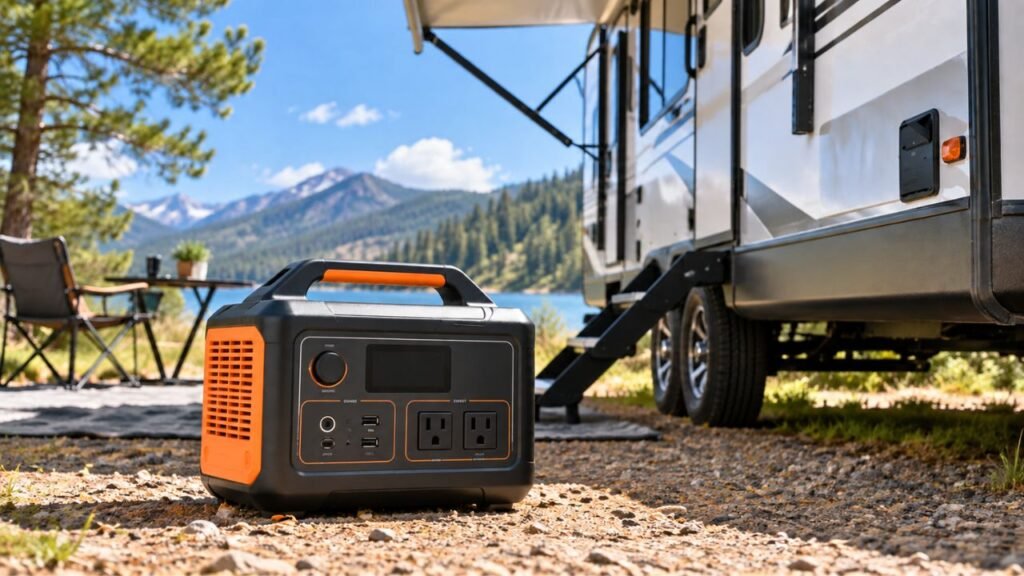
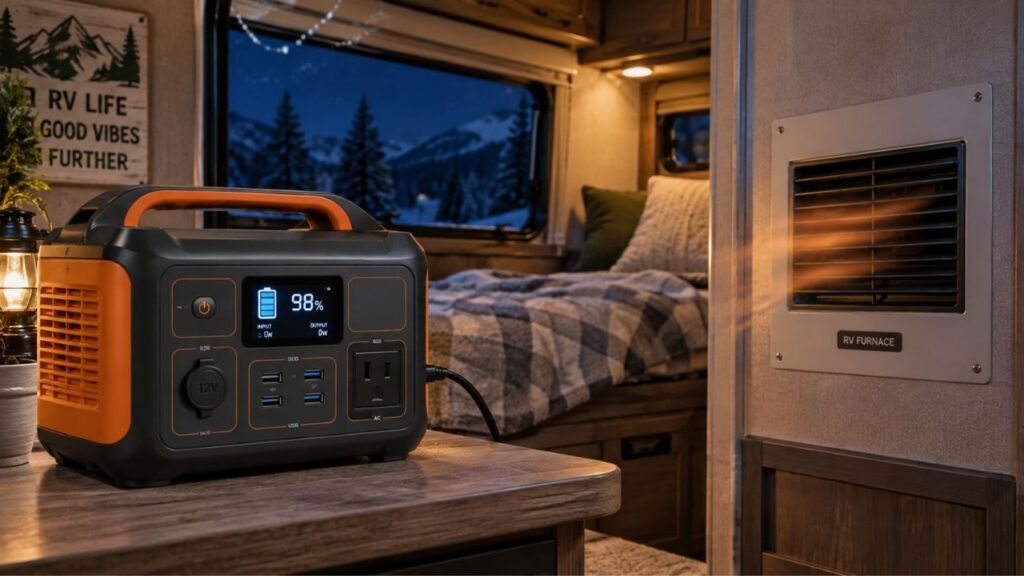
Yes, a portable power station can run most propane RV furnaces overnight. The furnace uses propane for heat while 12V electricity powers its blower, ignition, controls, and gas valve. A 500Wh station may work during mild weather, while colder nights often require closer to 1,000Wh or more.
The right size depends on your furnace’s electrical draw and cycling time. Below, I’ll show you how to calculate runtime, choose capacity, connect everything properly, and avoid waking up to a dead battery.
Key Takeaways
- Most propane RV furnaces use 12V electricity for their blower and controls.
- Furnace electrical draw commonly ranges from a few amps to over 10 amps.
- A 500Wh station may work when the furnace cycles lightly.
- Around 1,000Wh provides better overnight capacity for colder camping conditions.
- Furnace duty cycle matters more than its maximum running wattage.
- Direct 12V operation can reduce conversion losses when properly supported.
- Include lights, detectors, pumps, and other overnight loads when sizing.
- Never assume a standard 12V car outlet supports your furnace amperage.
Yes, a Portable Power Station Can Run an RV Furnace Overnight
A propane RV furnace is actually a good match for battery backup. That is because electricity does not create most of the heat.
Propane burns inside the furnace to produce heat. Electricity powers the blower motor that moves warm air around your RV.
The furnace also needs electricity for its ignition and controls. These electrical components usually require much less power than electric heating.
That makes an RV furnace very different from a space heater.
A typical electric space heater may continuously pull around 1,500 watts. Your propane furnace may need only a fraction of that electrically.
However, the exact draw varies significantly between furnace models. Smaller furnaces may use only a few amps.
Larger RV furnaces can pull more than 10 amps while operating.
That’s why I would not automatically say every 500Wh power station will last overnight.
You need to look at your actual furnace first.
How Much Electricity Does an RV Furnace Actually Use?
RV furnace electrical consumption depends mainly on the blower motor and furnace size. Knowing the amperage makes estimating your overnight battery needs much easier.
RV Furnace Amp Draw
Most RV propane furnaces operate from the RV’s 12V electrical system.
Depending on the model, the furnace may draw approximately 3 to 12 amps while operating. Some smaller units can use even less.
You can convert amperage into approximate wattage with this formula:
Watts = Volts × Amps
For a 12V furnace, that gives you examples like these:
- 5 amps × 12 volts = about 60 watts.
- 7 amps × 12 volts = about 84 watts.
- 10 amps × 12 volts = about 120 watts.
- 12 amps × 12 volts = about 144 watts.
Your furnace label or manual should provide its rated amperage.
Use that number instead of relying on a general online estimate.
Startup Current Versus Running Current
The furnace blower may briefly require extra current while starting.
Usually, this startup demand is still modest compared with large household motors. However, weak wiring or a limited 12V outlet can still cause problems.
Voltage can also drop when the blower starts.
If voltage falls too low, the furnace may fail its startup sequence. It might shut down even though your power station still shows plenty of charge.
That’s another reason watt-hours alone do not determine compatibility.
Why Furnace Cycling Matters More Than Running Watts
Your furnace normally does not run continuously all night.
The thermostat starts it when the RV gets cold. It shuts the furnace down after reaching your selected temperature.
This cycling is called the furnace’s duty cycle.
Suppose your furnace uses 90 watts while running.
If it operated continuously for eight hours:
90W × 8 hours = 720Wh
But suppose it runs only half that time.
Its actual furnace runtime becomes four hours:
90W × 4 hours = 360Wh
That difference can determine whether your power station survives until morning.
How Much Power Station Capacity Do You Need for One Night?
There is no single capacity that works for every RV furnace. Outside temperature, insulation, furnace size, and thermostat settings all change overnight consumption.
| Overnight Scenario | Furnace Draw While Running | Approx. Duty Cycle | Furnace Runs | Approx. Furnace Energy |
| Mild night | 60W | 25% | 2 hours | 120Wh |
| Cool night | 80W | 50% | 4 hours | 320Wh |
| Cold night | 100W | 75% | 6 hours | 600Wh |
| Very cold night | 120W | 75% | 6 hours | 720Wh |
| Nearly continuous heating | 120W | 100% | 8 hours | 960Wh |
These numbers are examples rather than guaranteed furnace runtimes.
Your total overnight consumption will normally be higher.
Your RV may also be powering:
- propane and carbon monoxide detectors;
- refrigerator controls;
- LED lights;
- water pump;
- thermostat;
- USB chargers;
- phones;
- CPAP equipment;
- fans;
- other standby electronics.
You may also lose some energy through conversion.
Therefore, avoid choosing a power station that exactly matches your calculated furnace consumption.
Leave yourself some reserve.
Is a 500Wh Portable Power Station Enough for an RV Furnace?
A 500Wh portable power station can run an RV furnace overnight under favorable conditions. However, I would not consider 500Wh a guaranteed all-night capacity.
Imagine your furnace draws 80 watts while operating.
If it runs for only three hours throughout an eight-hour night:
80W × 3 hours = 240Wh
That leaves reasonable capacity for conversion losses and smaller RV loads.
Now imagine colder weather causes six hours of furnace operation:
80W × 6 hours = 480Wh
You have already reached almost the entire advertised battery capacity.
Additional loads could drain the station before morning.
Also remember that advertised battery capacity and usable output are not always identical.
The power station itself consumes some energy while operating. Inverter conversion can consume additional capacity when using AC.
Therefore, a 500Wh power station works best for light or moderate furnace cycling.
It becomes less comfortable as your primary backup during freezing conditions.
Is a 1,000Wh Portable Power Station Enough Overnight?
A 1,000Wh power station is a more practical starting point for dependable overnight furnace backup.
It gives you more room for furnace cycling and smaller RV loads.
For example, suppose your furnace consumes 400Wh overnight.
You would still have capacity available for lights, detectors, controls, and occasional water-pump use.
You also have more room for normal power losses.
However, even 1,000Wh does not guarantee unlimited overnight heating.
If a large furnace runs almost continuously during extreme cold, it could consume most of that capacity.
Other electrical loads can then push total consumption even higher.
I would treat 1,000Wh as comfortable for many situations rather than an absolute rule.
How to Calculate How Long Your Power Station Will Run the Furnace
You can get a much better estimate using your furnace’s actual amperage. You only need its voltage, amp draw, expected duty cycle, and sleeping time.
Start by calculating furnace wattage:
Watts = Volts × Amps
Then estimate overnight furnace energy:
Energy Used = Running Watts × Hours × Duty Cycle
Let’s say your furnace draws 7 amps.
At approximately 12 volts:
12V × 7A = 84W
Suppose you expect the furnace to run half the night.
For an eight-hour period:
8 hours × 50% = 4 running hours
Now calculate the energy:
84W × 4 hours = 336Wh
Your furnace would therefore consume approximately 336Wh.
But don’t stop there.
Add your other overnight RV loads and some extra capacity for losses.
If everything combined reaches around 450Wh, a 500Wh station becomes tight.
A 1,000Wh unit gives you considerably more breathing room.
How Should You Connect a Portable Power Station to an RV Furnace?
There are several ways a power station can support your RV furnace. The best approach depends on your RV electrical system and power station outputs.
Option 1: Plug the RV Shore Cord Into the Power Station
This is usually the easiest method when the station has AC outlets.
You connect your RV shore power cord to the power station using the appropriate connection.
The energy path looks roughly like this:
Power station battery → inverter → 120V AC → RV converter → 12V DC → furnace
This method requires little involvement with the furnace wiring.
Your RV converter supplies the normal 12V electrical system. The furnace continues operating through that system as usual.
However, this setup can waste some battery capacity.
The portable power station converts battery DC into AC power. Your RV converter then turns that AC back into 12V DC.
Every conversion loses some energy.
The converter may also start charging your RV house battery.
That means your portable station could provide more energy than the furnace itself requires.
Option 2: Use a Dedicated High-Current 12V Output
Direct DC operation can eliminate some inverter and converter losses.
However, compatibility becomes extremely important here.
Many portable power stations have a 12V cigarette-lighter-style output.
A common limitation is around 10 amps.
That may comfortably support a small furnace drawing five or six amps.
But a furnace drawing 11 or 12 amps could exceed that outlet’s rating.
The power station may shut the DC port down.
The furnace could also receive insufficient voltage.
Check both specifications before making any connection:
- your furnace’s maximum 12V amperage;
- your power station’s continuous 12V output rating.
Some RV-oriented power stations provide higher-current DC outputs specifically for RV use.
Those can be more suitable than a basic car socket.
Option 3: Use the Power Station With the RV Battery System
Another option is using the portable station to support or recharge your existing house battery system.
Your RV battery then continues supplying the furnace normally.
This approach can work well because RV furnaces are designed around the 12V battery system.
However, use properly rated charging equipment and fused wiring.
Avoid improvising a direct connection with undersized cables.
For permanent electrical modifications, having an RV technician or qualified electrician handle the setup is the safer choice.
Why Plugging the Whole RV Into the Power Station Uses More Energy
Plugging your RV into the AC outlet is convenient, but it can introduce additional losses. Understanding the energy path helps explain unexpectedly fast battery drain.
The portable power station stores electricity inside a DC battery.
Its inverter changes that energy into 120V AC electricity.
Your RV receives the AC power through its shore connection.
Then the RV converter changes part of that electricity back into 12V DC.
Your furnace finally uses that 12V supply.
You are essentially converting:
DC → AC → DC
Neither conversion is perfectly efficient.
Your converter may also detect that the RV battery needs charging.
It can then pull extra power while the furnace is running.
For example, you might expect an 80W furnace load.
But the power station screen might temporarily show several hundred watts.
That does not necessarily mean the furnace is using all that energy.
Your converter may be charging the house battery simultaneously.
If maximizing overnight runtime matters, account for this additional consumption.
What Makes an RV Furnace Drain More Battery Overnight?
The same furnace can use dramatically different amounts of electricity on different nights. Several conditions determine how frequently it needs to run.
- Lower outdoor temperatures: Greater heat loss makes the furnace run longer.
- Higher thermostat settings: Warmer indoor temperatures increase furnace cycling.
- Poor insulation: Thin walls and weak insulation lose heat faster.
- Drafts: Door and window gaps increase heat loss.
- Strong wind: Wind can increase heat loss through exposed RV surfaces.
- Open slides: Larger interior volume can require more heating.
- Frequent door opening: Warm air escapes whenever you enter or leave.
- Large furnace blower: Larger motors generally consume more electricity.
- Blocked airflow: Poor duct or return airflow can hurt furnace performance.
- Other 12V equipment: Pumps, lights, fans, and electronics add battery demand.
- Conversion losses: AC operation usually consumes more stored energy.
- Cold batteries: Low temperatures can reduce available battery performance.
The important lesson is simple.
You cannot predict overnight runtime from furnace wattage alone.
You need to estimate how often the furnace will actually run.
Cold Weather Can Reduce Portable Power Station Performance
Cold weather affects more than your furnace’s duty cycle. It can also affect the portable power station providing the electricity.
Lithium batteries generally perform differently at low temperatures.
You may notice reduced available capacity as temperatures fall.
Charging restrictions can also become important.
Many lithium power stations will restrict or stop battery charging when the battery becomes too cold.
Discharging may still be allowed at lower temperatures.
However, every manufacturer sets its own operating limits.
Check your power station’s:
- charging temperature range;
- discharging temperature range;
- storage temperature range;
- battery heating features, if included.
Keep the station somewhere dry and within its approved operating range.
Do not place it directly beside a furnace outlet for warmth.
It still needs proper ventilation.
Don’t Forget Propane When Planning Overnight Heat
Your power station is only one part of overnight furnace operation.
A propane RV furnace needs both electricity and propane.
The power station supplies electricity for the blower and controls.
Propane supplies the heat.
You could have 80% battery remaining and still lose heat after running out of propane.
The opposite can also happen.
You might have a full propane cylinder but no furnace operation because electrical power is gone.
Cold weather increases both demands.
The furnace cycles more often, which consumes more propane and electricity.
Check your propane supply before going to sleep during cold-weather camping.
Having enough battery alone does not guarantee an entire warm night.
Can You Run the Furnace and Other RV Appliances at the Same Time?
Yes, but you should separate low-power overnight loads from high-power appliances. Small 12V devices usually matter far less than large heating or cooking appliances.
Lower-power loads commonly include:
- LED lighting;
- phone charging;
- Wi-Fi equipment;
- propane refrigerator controls;
- water pump use;
- USB-powered equipment;
- detectors and monitors.
High-power appliances require more attention:
- microwave;
- coffee maker;
- toaster;
- hair dryer;
- electric water heater;
- electric fireplace;
- induction cooker;
- air conditioner;
- electric space heater.
Imagine your furnace averages only 50 watts after cycling.
A 1,500W electric heater can consume more energy in one hour than that furnace needs for much of the night.
That is why propane heat works so much better with portable battery power.
Use the propane furnace for heating.
Save your battery capacity for its blower and essential RV equipment.
RV Furnace vs Electric Space Heater on a Portable Power Station
Both appliances can warm your RV, but their battery requirements are completely different. A propane furnace is generally far more practical for overnight portable power.
| Feature | Propane RV Furnace | Electric Space Heater |
| Main heat source | Propane | Electricity |
| Electrical supply | Usually 12V DC | Usually 120V AC |
| Electrical demand | Relatively low | Very high |
| Typical use pattern | Cycles on and off | Often high continuous draw |
| Overnight battery operation | Often practical | Usually difficult |
| Best portable power use | Furnace blower and controls | Short heating periods |
A standard space heater often consumes around 1,500 watts on high.
Run that continuously for eight hours and the theoretical consumption becomes:
1,500W × 8 hours = 12,000Wh
That’s before power losses.
By comparison, a propane furnace might consume only several hundred watt-hours of electricity.
Propane provides most of its heating energy.
For overnight boondocking, that difference is enormous.
How to Make Your Power Station Last Longer Through the Night
Small changes can significantly reduce furnace cycling and battery consumption. The goal is to keep heat inside your RV without compromising furnace airflow or safety.
- Fully charge the portable power station before bedtime.
- Start the night with enough propane for expected conditions.
- Lower the thermostat slightly when comfortable doing so.
- Seal drafts around doors and windows.
- Use insulated window coverings during cold nights.
- Close unused areas when your RV layout allows it.
- Use warm bedding to reduce your heating requirement.
- Turn off unnecessary lights and electronics.
- Disable high-power appliances before sleeping.
- Avoid using an electric space heater from the station.
- Check whether your converter is unnecessarily charging batteries.
- Leave some battery capacity available for morning startup needs.
- Recharge through solar or vehicle charging during daylight.
- Keep furnace intake and return-air openings completely clear.
You do not need to make the RV uncomfortable.
Even lowering your thermostat a few degrees can reduce furnace cycling.
The colder the weather becomes, the more useful these small improvements become.
Is It Safe to Run an RV Furnace Overnight From a Power Station?
A properly operating RV propane furnace is designed to heat the RV while occupied. Still, overnight operation requires working safety equipment and unobstructed furnace ventilation.
Furnace Safety
Keep the furnace’s exterior intake and exhaust openings clear.
Never block them with:
- snow;
- mud;
- storage items;
- camping equipment;
- covers;
- debris.
Also keep interior furnace airflow openings unobstructed.
Restricted airflow can cause overheating or furnace shutdowns.
Do not ignore unusual smells, visible soot, repeated ignition failures, or abnormal furnace sounds.
Those symptoms deserve inspection before extended overnight use.
Carbon Monoxide and Propane Detectors
Your RV should have functioning safety detectors while using propane appliances.
Check your:
- carbon monoxide detector;
- propane or LP gas detector;
- smoke alarm.
Replace batteries when required.
Also replace detectors that have reached their manufacturer-specified service life.
Never disable an alarm because it repeatedly activates.
Find and correct the reason instead.
Portable Power Station Placement
A portable power station produces no combustion exhaust during normal battery operation.
However, it still requires appropriate placement.
Keep it:
- dry;
- uncovered;
- properly ventilated;
- away from direct furnace heat;
- away from exterior furnace exhaust;
- within its approved temperature range.
Do not bury it under blankets to keep the battery warm.
Blocking ventilation can cause the station to overheat.
Why Your RV Furnace May Stop Even When the Power Station Still Has Charge
Seeing 40% or 50% battery remaining does not guarantee the furnace has usable power. Voltage, amperage, wiring, and furnace faults can still stop operation.
Possible causes include:
- power station 12V port current limit;
- low voltage reaching the furnace;
- undersized wiring;
- excessive voltage drop;
- loose DC connections;
- overloaded DC outlet;
- power station protection shutdown;
- weak RV house battery;
- converter problems;
- low propane supply;
- closed propane valve;
- ignition failure;
- furnace lockout;
- blocked intake or exhaust;
- blower or sail-switch problems.
Start by checking whether the furnace receives proper 12V power.
Then confirm the propane supply.
If the blower starts but ignition never occurs, the problem might be inside the furnace rather than the power station.
Repeated furnace lockouts deserve proper troubleshooting.
Do not keep resetting a furnace with an unresolved ignition problem.
How to Check Whether Your Power Station Will Last Tonight
You can make a reasonable overnight estimate before going to sleep. A few minutes of calculation can prevent a very cold surprise later.
- Find your furnace model number. Check the furnace label or owner’s manual.
- Find its rated amperage. Look for the 12V DC current specification.
- Calculate running watts. Multiply approximately 12 volts by rated amps.
- Estimate furnace duty cycle. Consider temperature and previous cycling behavior.
- Estimate total running hours. Multiply sleeping hours by the duty cycle.
- Calculate furnace watt-hours. Multiply watts by expected running hours.
- Add other overnight loads. Include lights, detectors, pumps, and electronics.
- Consider conversion losses. Add more margin when powering through AC.
- Check your 12V output limit. This matters with direct DC connections.
- Confirm your propane level. Electricity alone cannot create furnace heat.
- Leave a battery reserve. Avoid planning around using exactly 100%.
If your estimate comes very close to the station’s rated capacity, go larger.
Cold nights rarely reward extremely tight battery planning.
Example: Running a 7-Amp RV Furnace for Eight Hours
Let’s walk through one example because it makes the sizing process much clearer.
Suppose your furnace draws 7 amps at approximately 12 volts.
Calculate its running wattage:
12V × 7A = 84W
Now assume the furnace runs 50% of an eight-hour night.
That equals four hours of actual blower operation.
Calculate furnace consumption:
84W × 4 hours = 336Wh
Your furnace alone would need approximately 336Wh.
Now imagine your lights, detectors, refrigerator controls, phone charging, and other loads consume another 80Wh.
That brings the total to:
336Wh + 80Wh = 416Wh
You still need to consider conversion and operating losses.
A nominal 500Wh power station now looks fairly tight.
A 1,000Wh station provides much more margin.
Now consider a colder night.
If that same furnace runs 75% of eight hours, it operates for six hours.
84W × 6 hours = 504Wh
That’s already more than a 500Wh station’s advertised capacity.
And you haven’t added any other loads yet.
This example shows why duty cycle matters so much.
So, What Size Portable Power Station Is Best for an RV Furnace?
Power station size should reflect your furnace draw, weather, and additional loads. These ranges can help with planning, but they should not replace your own calculation.
- 300–500Wh: Best for mild conditions and light furnace cycling.
- 500–750Wh: Better for moderate cycling and limited extra loads.
- 750–1,000Wh: A practical range for more dependable overnight backup.
- 1,000–1,500Wh: Provides stronger cold-weather and accessory margin.
- 2,000Wh or more: Better for longer stays and heavier electrical use.
I would generally avoid buying solely from these capacity ranges.
Check the furnace amperage first.
Then calculate your expected overnight watt-hours.
Finally, add your additional RV loads and reserve capacity.
That approach gives you a much more dependable answer.
Conclusion
Yes, a portable power station can run an RV propane furnace overnight. The furnace itself usually needs relatively little electricity because propane produces the heat.
Your actual battery requirement depends on furnace amperage, cycling time, temperature, insulation, connection losses, and other overnight loads. A 500Wh station can work during lighter use, while around 1,000Wh provides considerably better flexibility.
The safest way to size your backup is simple. Check your furnace’s 12V amp rating, calculate expected overnight energy use, then add additional loads and a comfortable reserve.
Related FAQs
Here are quick answers to common questions about powering an RV furnace overnight. Actual consumption still depends on your furnace model and camping conditions.
How Many Watts Does an RV Furnace Use?
Many propane RV furnaces use roughly 40 to 150 watts electrically while operating, depending on the blower and furnace model. Check the furnace’s rated amperage and multiply it by approximately 12 volts for a more accurate estimate.
How Many Amp-Hours Does an RV Furnace Use Overnight?
An RV furnace might consume roughly 20 to 60 amp-hours overnight, depending on its amperage and cycling frequency. Very cold temperatures can increase consumption significantly because the blower runs more often.
Will a 500Wh Power Station Run an RV Furnace Overnight?
A 500Wh power station can run some RV furnaces overnight when temperatures are moderate and cycling is limited. It may not provide enough capacity during colder weather or when several other RV devices remain powered.
Will a 1,000Wh Power Station Run an RV Furnace All Night?
A 1,000Wh power station can support many RV furnaces through an eight-hour night. However, unusually high furnace duty cycles, conversion losses, and other electrical loads can reduce the actual runtime.
Can I Plug My RV Directly Into a Portable Power Station?
Yes, many RVs can connect to a sufficiently capable portable power station through the shore cord and proper adapter. The RV converter then provides 12V electricity to the furnace and other DC systems.
Can I Run an RV Furnace Directly From a Power Station’s 12V Outlet?
Possibly, but the power station’s 12V output must support the furnace’s required current. A 10-amp car socket may not safely support a furnace requiring more than 10 amps.
Does an RV Furnace Run on 12V or 120V?
Most propane RV furnaces operate their blower, ignition, gas valve, and controls from 12V DC power. Propane supplies the heat, so the furnace normally does not require 120V electricity directly.
Does an RV Furnace Use Propane and Electricity at the Same Time?
Yes. The furnace burns propane to produce heat while electricity powers its blower, ignition system, control board, and related components. Both energy sources are necessary for normal furnace operation.
How Long Will an RV Furnace Run on a Battery?
Runtime depends on battery capacity, furnace amperage, and cycling frequency. A furnace drawing 80 watts for four total hours would consume about 320Wh before accounting for other loads and power losses.
Why Does My RV Furnace Drain the Battery Overnight?
Cold weather, frequent cycling, a high thermostat setting, poor insulation, large blower motors, and other 12V loads can increase overnight drain. Converter and inverter losses may also increase consumption.
Can I Run an RV Furnace Without the House Battery?
It depends on your electrical setup. Some systems can receive suitable 12V power from another regulated source, but RV furnaces require stable voltage and sufficient current. Keeping the normal house battery system involved is often simpler.
Does an RV Furnace Use More Electricity When It Is Colder Outside?
The furnace’s blower may use roughly similar power whenever operating, but colder weather makes it run more frequently. Therefore, total overnight electrical consumption usually increases as outside temperatures fall.
Is It Safe to Leave an RV Furnace Running While Sleeping?
A properly maintained RV furnace can operate overnight when installed and used correctly. Keep intake and exhaust vents clear, maintain working carbon monoxide and propane detectors, and address unusual furnace behavior immediately.
Is an RV Furnace More Efficient Than an Electric Heater on a Power Station?
For conserving battery energy, yes. A propane furnace gets its heating energy from propane and uses electricity mainly for the blower and controls. A 1,500W electric heater creates all its heat from stored electricity.

Warren Turner writes practical guides and reviews on generators, portable power stations, and battery backup systems. He focuses on real-world performance, everyday power needs, and helping readers choose dependable equipment without unnecessary complexity.