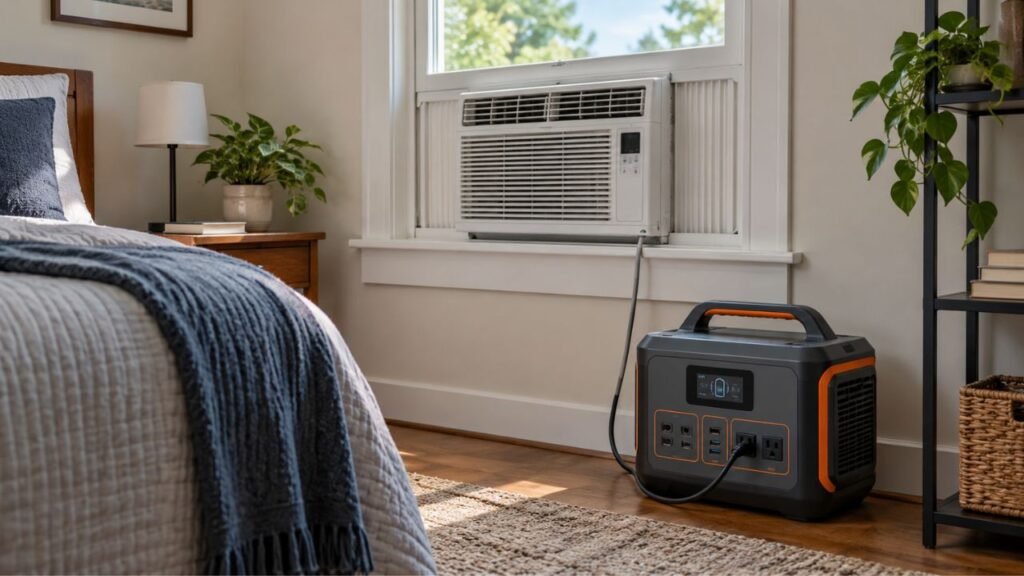
Yes, a portable power station can run many window air conditioners. The station must match the AC’s voltage, running watts, startup demand, and required runtime. Smaller 120V window units are generally much easier to support.
This guide explains how to check compatibility before connecting anything. You will also learn sizing, runtime, surge power, solar charging, and troubleshooting.
Key Takeaways
- Many 120V window air conditioners can run from portable power stations.
- Check voltage compatibility before comparing wattage or battery capacity.
- Continuous output must comfortably handle the AC’s normal running watts.
- Compressor startup can require significantly more power than normal operation.
- Battery watt-hours determine runtime, while inverter watts determine load capability.
- Efficient variable-speed window ACs can work especially well with battery power.
- Actual AC specifications matter more than its BTU rating alone.
Can a Portable Power Station Run a Window Air Conditioner?
A portable power station can run a window AC when properly matched. However, simply having a large battery does not guarantee compatibility.
You need to check three different things before connecting the AC.
First, the power station must provide the correct output voltage. Most smaller American window units operate from standard 115V or 120V outlets.
Second, its inverter must handle the air conditioner’s electrical load. That includes both normal operation and compressor startup.
Third, the battery needs enough stored energy for your target runtime.
These requirements solve different problems.
A 3,000Wh power station could have plenty of stored energy. However, an undersized inverter might still fail during compressor startup.
The opposite situation can also happen.
A powerful inverter may start your AC without any problem. However, a small battery could provide only an hour of cooling.
That distinction matters when choosing backup power for air conditioning.
What Size Portable Power Station Do You Need for a Window AC?
Choosing the right size requires more than comparing two wattage numbers. Start with voltage, then check running watts, surge demand, and battery capacity.
Check the Window AC Voltage First
Start by checking the voltage printed on your air conditioner.
Many residential window AC units in the United States use 115V or 120V. These can potentially work with portable stations providing standard 120V AC outlets.
Some larger window air conditioners use 230V or 240V instead.
A normal 120V power station cannot directly operate those larger units. Having more battery capacity does not solve that voltage mismatch.
Check the AC’s specification label before looking at anything else.
You can usually find electrical information near the power cord. It may also appear inside the owner’s manual.
Then compare that voltage with your power station’s AC output specifications.
Never rely on improvised adapters to solve an incompatible voltage requirement.
Find the AC’s Running Watts
Next, determine how much electricity the AC normally consumes.
Do not calculate electrical watts directly from the AC’s BTU rating.
BTU describes how much cooling capacity the air conditioner provides. It does not directly tell you its electrical consumption.
Two 8,000 BTU window air conditioners can use different electrical power. Their efficiency, compressor technology, and operating conditions can all differ.
Look for actual electrical information from these places:
- The air conditioner’s specification label.
- The manufacturer’s owner’s manual.
- Official technical specifications.
- A properly rated plug-in energy meter.
- Your power station’s live output display.
Some labels provide watts directly.
Others provide volts and amps instead.
If necessary, you can estimate electrical power using:
Watts ≈ Volts × Amps
However, manufacturer-rated watts or actual measurements are generally more useful.
Check Startup or Compressor Surge Power
Window air conditioners contain compressors that require extra startup power.
A conventional compressor does not immediately settle into normal operation. It may briefly draw substantially more power when starting.
This surge can trigger an overload on an undersized power station.
That means you need to check two inverter specifications:
- Continuous AC output.
- Short-term peak or surge output.
Do not assume every window AC requires exactly double its running watts. Likewise, do not automatically assume a three-times startup multiplier.
Startup behavior varies between models.
Variable-speed and inverter-style AC units can behave very differently. Conventional fixed-speed compressors can also have different startup characteristics.
Use manufacturer data whenever startup requirements are available.
Otherwise, practical measurement gives you a better real-world picture.
Add Some Output Headroom
Avoid sizing your power station exactly to the AC’s running load.
For example, suppose your AC normally consumes around 900 watts. A power station rated for exactly 900 watts leaves almost no margin.
A larger continuous output provides more breathing room during operation.
Additional headroom can help accommodate:
- Compressor restarts.
- Fan speed changes.
- Temporary power fluctuations.
- Other small connected devices.
- High-temperature operating conditions.
A reasonable margin also keeps the inverter from constantly operating near maximum output.
You still need enough surge capacity for compressor startup.
Calculate the Battery Capacity You Need
Inverter output determines whether your AC can operate.
Battery capacity determines how long it can keep operating.
Portable power station batteries are generally rated in watt-hours, or Wh.
You can estimate the needed capacity using:
Required battery capacity = Average AC watts × desired hours ÷ usable battery factor
Suppose your window AC averages about 500 watts.
You want approximately four hours of battery-powered cooling.
Using an 85% usable-energy estimate:
500W × 4 hours ÷ 0.85 = about 2,353Wh
You would therefore want roughly 2,350Wh or more available nominal capacity.
This remains an estimate rather than a guaranteed runtime.
Air conditioners cycle, temperatures change, and inverter losses also vary.
Window AC Power Requirements and Portable Power Station Size
Window air conditioner consumption varies considerably between models and efficiencies. Use this table for rough planning before checking your exact AC specifications.
| Window AC Size | Approximate Running Power | Common Voltage | Startup Concern | Power Station Consideration |
| 5,000–6,000 BTU | About 450–700W | Usually 115V/120V | Moderate | Midsize station may work |
| 8,000 BTU | About 600–900W | Usually 115V/120V | Moderate to high | Strong midsize station |
| 10,000 BTU | About 800–1,100W | Often 115V/120V | Higher | Larger inverter recommended |
| 12,000 BTU | About 900–1,400W | Model-dependent | Significant | Large station usually practical |
| 14,000 BTU+ | About 1,200–1,800W+ | Model-dependent | High | Large or expandable system |
These ranges are planning estimates rather than universal specifications.
A newer high-efficiency 10,000 BTU AC might use surprisingly little electricity. An older unit with similar cooling capacity may consume much more.
Always prioritize your AC’s actual electrical requirements over this table.
How Long Will a Portable Power Station Run a Window AC?
Battery runtime depends on stored energy and average AC consumption. The compressor’s cycling pattern also has a major effect on actual results.
Simple Window AC Runtime Formula
You can estimate runtime using this basic formula:
Runtime = Battery capacity × usable-energy factor ÷ average AC watts
An 85% usable-energy assumption works reasonably for simple planning.
Consider a 1,000Wh portable power station and 500W AC load:
1,000Wh × 0.85 ÷ 500W = about 1.7 hours
This assumes the AC averages 500 watts throughout that period.
Actual runtime could be noticeably different.
1,000Wh vs 2,000Wh vs 3,000Wh Power Station
Here are simple comparisons using the same 500W average load:
- 1,000Wh power station: approximately 1.7 hours.
- 2,000Wh power station: approximately 3.4 hours.
- 3,000Wh power station: approximately 5.1 hours.
- 4,000Wh power station: approximately 6.8 hours.
These examples assume roughly 85% usable battery energy.
They also assume the AC averages 500 watts continuously.
Your air conditioner probably will not behave exactly this way.
Why Real Runtime Can Be Longer or Shorter
Air conditioners do not necessarily pull full running power continuously.
Several conditions influence average consumption:
- Outdoor temperature.
- Starting room temperature.
- Thermostat setting.
- Indoor humidity.
- Direct sunlight.
- Room insulation.
- Window sealing.
- AC efficiency.
- Compressor cycling.
- Variable-speed operation.
- Battery temperature.
- Inverter efficiency.
- Other connected appliances.
Imagine cooling a shaded bedroom on a mild summer evening.
The compressor may run hard initially, then cycle less frequently. Average consumption could therefore fall after reaching the desired temperature.
Now imagine the same unit during extreme afternoon heat.
The compressor may stay active almost continuously.
The second situation could drain your battery much faster.
Does BTU Tell You How Many Watts a Window AC Uses?
No, BTU alone does not tell you electrical power consumption.
A BTU rating describes cooling capacity.
Electrical watts describe how much input power the appliance consumes.
These measurements describe different sides of the air conditioner’s operation.
For example, two units can both provide 8,000 BTU of cooling. One might consume less electricity because it operates more efficiently.
That difference becomes extremely important with portable battery power.
More efficient cooling means fewer watt-hours consumed during an outage.
You may also see an efficiency rating called CEER.
A higher-efficiency room AC can deliver similar cooling using less electricity. That helps extend battery runtime without increasing power station capacity.
For sizing your power station, use actual electrical specifications first.
Think of BTU mainly as a measure of cooling capability.
Conventional vs Inverter Window AC for a Portable Power Station
Compressor design can significantly change how an AC uses battery power. Conventional and variable-speed units behave differently during ordinary cooling.
Conventional Window AC
Traditional window air conditioners commonly use fixed-speed compressors.
The compressor turns on when cooling is needed.
It then switches off after reaching the thermostat setting.
Each new compressor startup creates another high-demand event.
That repeated cycling can matter when using a portable power station.
The AC may operate perfectly during steady running conditions. However, another compressor start could trigger the station’s overload protection.
This becomes more likely when other appliances share the same inverter.
Inverter or Variable-Speed Window AC
Variable-speed window ACs can adjust compressor output during operation.
Instead of repeatedly running only at full power, they can modulate output. This can make their power consumption smoother under lighter cooling loads.
Once the room becomes comfortable, electrical demand may decrease considerably.
That can make efficient variable-speed models attractive for battery backup.
However, do not assume every inverter AC automatically uses little electricity.
Cooling demand still matters.
An undersized AC running continuously may consume substantial energy regardless.
Also remember that two different “inverters” are being discussed here.
An inverter window AC controls compressor operation electronically.
A power station inverter converts battery DC electricity into AC electricity.
They perform completely different jobs.
How to Measure Your Window AC’s Actual Power Consumption
Measuring your own AC gives you much better sizing information. One instant wattage reading alone may not represent real operating consumption.
Use this practical approach:
- Confirm your AC uses a compatible standard 120V connection.
- Use a properly rated plug-in electricity monitoring meter.
- Begin testing while the room still needs significant cooling.
- Watch the normal wattage after the compressor starts.
- Observe startup demand if your meter records peak power.
- Measure total watt-hours across complete cooling cycles.
- Continue testing for at least one representative hour.
- Repeat during hotter conditions when practical.
- Use conservative results when sizing emergency backup.
Your power station may already display live wattage.
That display can be useful for basic testing.
However, average watt-hours over time matter more for runtime planning.
For example, an AC might show 650W while the compressor runs.
It could then fall dramatically when only the fan operates.
Using 650W continuously would underestimate possible runtime.
Using the low fan-only number would overestimate it.
Average consumption over realistic cooling cycles gives better results.
Can a Portable Power Station Run a Window AC Overnight?
Yes, but overnight operation often requires substantial battery capacity.
Starting the AC is only the first challenge.
Keeping it running for six, eight, or ten hours requires much more stored energy.
Suppose your AC averages 500 watts during overnight operation.
Eight hours would require:
500W × 8 hours = 4,000Wh of delivered energy
After accounting for inverter losses and battery reserve, you could need considerably more than 4,000Wh of nominal storage.
However, real AC consumption often changes throughout the night.
An efficient unit may initially work hard, then reduce output later.
Overnight runtime improves when:
- The bedroom is appropriately sized.
- The AC has high energy efficiency.
- Outdoor temperatures fall overnight.
- Windows and doors remain closed.
- Direct sunlight is no longer heating the room.
- The thermostat uses a moderate setting.
- The AC uses variable-speed technology.
- Unnecessary appliances remain disconnected.
A 1,000Wh power station should not automatically be considered overnight AC backup.
For many window units, that battery is better suited to shorter cooling periods.
Can Solar Panels Keep a Window AC Running?
Solar panels can extend AC runtime, but energy balance still matters.
Suppose your window AC currently draws 700 watts.
Your solar panels are producing 400 watts into the power station.
The battery still needs to supply the remaining load.
Ignoring smaller conversion losses:
700W AC load – 400W solar input = 300W battery deficit
In that situation, solar power slows battery depletion.
It does not completely eliminate it.
Solar production also changes throughout the day.
Actual input depends on:
- Available sunlight.
- Cloud cover.
- Panel orientation.
- Shading.
- Panel temperature.
- Solar controller limits.
- Power station input limits.
- Time of day.
A 400W solar panel does not provide 400 watts continuously.
Likewise, a 1,000W solar array does not automatically produce 1,000 watts all day.
Solar works best as an energy supplement during daylight.
It can meaningfully extend runtime with an efficient window AC.
How to Make a Window AC Run Longer on Battery Power
Reducing the room’s cooling load directly improves battery runtime. Several simple changes can save substantial energy during an outage.
- Pre-cool the room before grid power goes out.
- Cool one closed room instead of several spaces.
- Close doors leading into unused rooms.
- Keep exterior windows fully closed.
- Block direct sunlight with curtains or shades.
- Seal gaps surrounding the window AC installation.
- Choose a reasonable thermostat setting.
- Clean or replace dirty air filters.
- Avoid cooking with heat-producing appliances nearby.
- Turn off unnecessary electronics inside the room.
- Disconnect other large loads from the power station.
- Use a ceiling or portable fan for air circulation.
- Consider an efficient variable-speed window air conditioner.
Setting the thermostat extremely low rarely provides instant cooling.
It can simply make the compressor run longer.
During an outage, conserving battery capacity matters more than aggressive cooling.
Focus on maintaining one comfortable room instead.
Why Does a Window AC Trip a Portable Power Station?
Several different problems can cause an immediate shutdown or overload. Identifying when the failure happens usually points toward the likely cause.
Compressor Startup Exceeds Surge Capacity
This is one of the most common explanations.
The fan may start normally before the compressor engages.
When the compressor starts, electrical demand rises sharply.
If the station cannot handle that momentary demand, protection activates.
You may see an overload warning or immediate AC-output shutdown.
Running Watts Exceed Continuous Output
Startup may not always be the problem.
Your AC could simply draw more continuous power than allowed.
For example, a station rated for 800W continuous output cannot reliably support a 1,000W continuous AC load.
A large advertised surge rating does not fix that mismatch.
Peak output is intended for brief demand.
Continuous output determines sustained operation.
Other Appliances Are Using the Same Power Station
Remember to calculate the entire connected load.
Suppose your AC consumes 700 watts while operating.
Your refrigerator might use another 150 watts while running.
Add a television, router, lights, and device chargers.
The total could move surprisingly close to the inverter limit.
Now imagine both refrigerator and AC compressors starting together.
Their combined startup demand can overload the power station.
Disconnect unnecessary devices before assuming your AC is incompatible.
The AC Requires 230V or 240V
A larger window AC may require higher voltage.
Connecting it to an ordinary 120V power station will not work.
This is a compatibility issue rather than a battery-size problem.
Check voltage before purchasing additional battery capacity.
Power Station Protection Is Activating
Portable power stations include protective systems for several operating conditions.
These may respond to:
- Excessive inverter load.
- High internal temperature.
- Low battery level.
- Short circuits.
- Abnormal connected equipment.
- Other electrical protection conditions.
Read the displayed error message when available.
The error code often identifies the actual problem.
The AC or Connection Has a Problem
Do not assume every shutdown means your power station is undersized.
The AC itself might have an electrical or mechanical problem.
Stop operating the setup if you notice:
- Excessively hot plugs.
- Damaged cords.
- Burning smells.
- Repeated unusual shutdowns.
- Crackling connections.
- Unusual compressor sounds.
- Discolored outlets.
Increasing inverter size does not solve damaged electrical equipment.
When a Portable Power Station Is Not a Good Match
Portable power stations are useful, but they are not universal solutions. Some window air conditioners simply require a different backup approach.
A portable station may be unsuitable when:
- The AC requires 240V but the station provides only 120V.
- The air conditioner consistently exceeds continuous inverter output.
- Startup demand repeatedly triggers overload protection.
- Battery capacity provides too little useful cooling time.
- Several large appliances must operate simultaneously.
- The setup depends on questionable adapters or wiring modifications.
- The unit has damaged plugs, wiring, or electrical components.
- Cooling must remain uninterrupted for critical medical reasons.
A larger expandable battery system may sometimes make more sense.
For very short outages, a smaller cooling strategy can also work.
Instead of powering the largest AC, create one comfortable cooling room.
That approach greatly reduces the required backup capacity.
Safety Tips for Running a Window AC From a Power Station
Air conditioners place sustained loads on electrical equipment. A few basic precautions can help keep your setup dependable and safe.
- Follow instructions from both equipment manufacturers.
- Confirm the AC and power station use compatible voltage.
- Use the correct AC outlet on the power station.
- Avoid improvised voltage adapters.
- Avoid cheap or undersized extension cords.
- Connect the AC directly whenever practical.
- Keep the power station dry during operation.
- Keep it away from window AC condensate.
- Maintain required ventilation around the station.
- Never cover cooling vents during operation.
- Stop using connections that become unusually hot.
- Never backfeed electricity into household wiring.
The power station also needs airflow while powering large loads.
Its cooling fan may run frequently during AC operation.
That behavior is generally normal during high inverter demand.
Is a Portable Power Station Practical for Window AC Backup?
Yes, window AC backup can be very practical with proper sizing.
The best setup usually focuses on cooling one important room.
That might be a bedroom during an overnight outage.
It could also be a home office during summer utility interruptions.
Renters and apartment residents may also find this approach useful.
A small efficient 120V window AC greatly reduces backup requirements.
Trying to duplicate whole-home air conditioning is much more demanding.
Think about your backup objective before choosing equipment.
If you only need four hours of bedroom cooling, size accordingly.
If you expect ten hours every summer night, battery needs increase dramatically.
Start with the AC’s actual electrical requirements.
Then work backward from your desired runtime.
That approach prevents both undersizing and unnecessary overspending.
Conclusion
So, can a portable power station run a window air conditioner? Yes, many properly sized stations can power compatible window AC units successfully.
Check four things before deciding: voltage, running watts, startup power, and battery capacity. Never choose a power station using BTU size alone. Your AC’s actual electrical specifications provide much better sizing information.
For short outages, cooling one room can be remarkably practical. For overnight use, expect much larger battery requirements and careful energy management.
Related FAQs
Can a 1,000W Portable Power Station Run a Window AC?
A 1,000W power station can run some smaller window AC units, provided their continuous draw remains below 1,000W and compressor startup stays within the station’s surge capability. Always check both ratings before connecting the AC.
Can a 1,000Wh Power Station Run a Window AC?
Yes, but 1,000Wh describes battery capacity rather than inverter output. A 500W average AC load might receive roughly 1.7 hours using an 85% usable-energy estimate, while actual runtime depends heavily on compressor cycling.
Can a 2,000W Portable Power Station Run a Window AC?
A 2,000W continuous-output station can support many smaller and midsize 120V window air conditioners. However, you still need compatible voltage, sufficient startup capability, and enough battery watt-hours for your desired runtime.
What Size Power Station Do I Need for a 5,000 BTU Window AC?
Many 5,000 BTU window units consume roughly 450–700W while running, but specifications vary. Check your exact AC’s wattage and startup demand, then choose a station with comfortable continuous-output headroom and sufficient battery capacity.
Can a Portable Power Station Run an 8,000 BTU Window AC?
Yes, many sufficiently powerful stations can operate an 8,000 BTU window AC. Actual electrical consumption varies between models, so use the AC’s nameplate or measured wattage rather than choosing solely from BTU capacity.
Can a Portable Power Station Run a 10,000 BTU Window AC?
Yes, depending on the particular AC and power station. Many 10,000 BTU units require considerably more inverter output and battery capacity than small bedroom units, making startup demand and runtime especially important.
Can a Portable Power Station Run a 12,000 BTU Window AC?
Some large portable power stations can run compatible 12,000 BTU window air conditioners. Check voltage carefully because larger room AC models can have different electrical requirements, including higher-voltage configurations.
Does a Window AC Need a Pure Sine Wave Power Station?
A pure sine wave power station is generally the preferred choice for window air conditioners. It provides clean AC power similar to household electricity and is better suited to compressors and modern electronic controls.
Can a 120V Power Station Run a 240V Window AC?
No, a standard 120V power station output cannot directly power a 240V window air conditioner. You need a power system specifically designed to provide the voltage and outlet configuration required by that AC.
Can You Run a Window AC and Refrigerator From One Power Station?
Yes, if their combined running and startup loads remain within the station’s limits. Compressor startups can overlap, however, so both the AC and refrigerator surge requirements must be considered together.
Will an Inverter Window AC Run Longer on a Power Station?
It often can because variable-speed compressors can reduce output after reaching the desired temperature. Actual runtime still depends on room conditions, AC efficiency, thermostat settings, and available battery capacity.
Can You Leave a Window AC Connected to a Power Station During an Outage?
Yes, when the AC and power station are fully compatible and properly connected. Keep the station ventilated and dry, stay within output limits, and follow both manufacturers’ operating instructions.

Warren Turner writes practical guides and reviews on generators, portable power stations, and battery backup systems. He focuses on real-world performance, everyday power needs, and helping readers choose dependable equipment without unnecessary complexity.