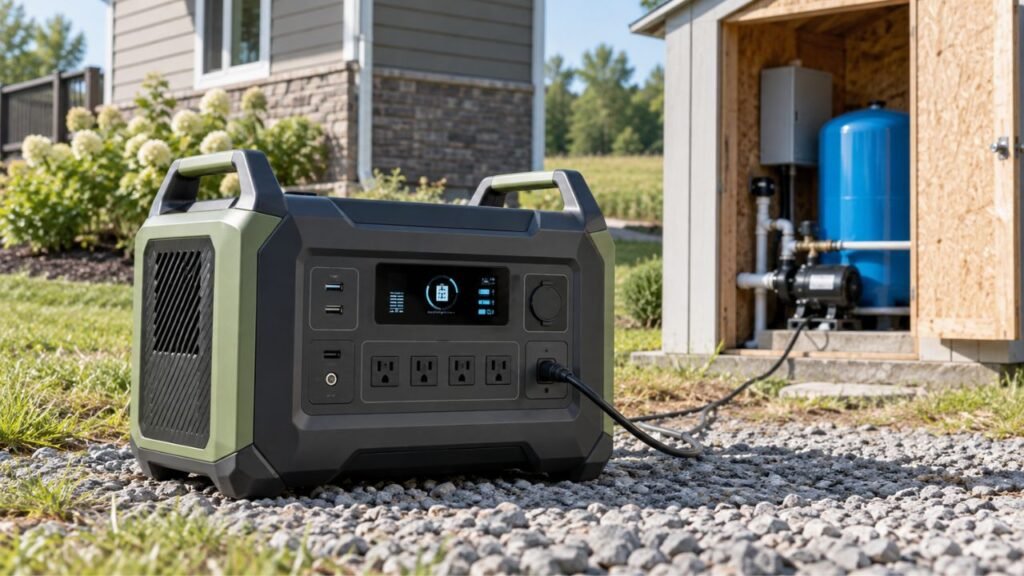
Yes, a portable power station can run many residential well pumps. However, its voltage, inverter output, startup capability, and battery capacity must match the pump.
The tricky part is that well pumps are motor-driven loads. This guide explains sizing, voltage, startup power, runtime, connections, and troubleshooting.
Key Takeaways
- Many residential submersible well pumps require 230V or 240V power.
- A 120V power station cannot directly operate a 240V pump.
- Well pumps can demand several times normal power during startup.
- Horsepower alone cannot tell you the required power station size.
- Continuous inverter output must cover the pump’s normal running load.
- Battery watt-hours determine runtime after the pump successfully starts.
- Hardwired well pumps need a safe, properly designed connection method.
- Check your actual pump specifications before buying backup equipment.
Can a Portable Power Station Run a Well Pump?
A portable power station can run a well pump when everything matches correctly. The most important factors are voltage, startup demand, and continuous output.
Smaller 120V pumps are usually easier to power during outages. They may work with moderately sized portable power stations.
A conventional submersible pump can be more challenging. Many residential models operate from a 230V or 240V circuit.
These pumps require a power station offering compatible 240V output.
They also need enough inverter strength for the motor’s startup demand.
Battery size becomes important only after these requirements are satisfied.
A huge battery will not help when voltage is incorrect. Likewise, extra battery capacity cannot compensate for a weak inverter.
Why Well Pumps Are Difficult for Portable Power Stations
Well pumps behave differently from lights, televisions, and electronic devices. Their electric motors create much heavier loads during startup.
Well Pumps Use Electric Motors
A well pump relies on an electric motor moving water upward.
Once spinning normally, the motor may consume fairly predictable power. Starting that stationary motor requires considerably more electrical current.
That short startup period creates problems for smaller power stations.
The inverter may detect an overload and immediately shut down.
Running Power Is Only Part of the Requirement
Running watts describe power used after the motor reaches speed.
Suppose your pump normally consumes around 1,000 watts while operating. A 1,200-watt inverter might appear sufficient at first glance.
However, that comparison ignores the pump’s startup demand.
The power station must first get the motor moving successfully.
Startup Current Can Be Much Higher
Well pump motors can draw several times normal current during startup.
The exact increase varies between different pumps and motor designs.
That is why universal rules like “multiply watts by three” fail. One pump could start easily while another overloads that same inverter.
A better approach uses the actual motor specifications whenever possible.
Look for starting current or locked-rotor amperage information.
Power Factor Also Affects Motor Loads
AC motors make watt calculations slightly more complicated than resistive appliances.
Multiplying volts by amps gives volt-amperes, commonly called VA.
That number does not always equal the motor’s actual watt consumption.
You do not need to calculate motor engineering details yourself.
The important lesson is simple: use manufacturer motor data whenever available.
Do Well Pumps Use 120V or 240V?
Well pumps can operate at different voltages depending on their design. Checking voltage should always be your first sizing step.
120V Well Pumps
Some shallow-well pumps operate from standard 120V household power.
You may also find smaller jet pumps using this voltage.
These pumps are usually easier to pair with portable power stations. Most larger power stations already provide standard 120V AC outlets.
However, you still need enough startup and running power.
A 120V outlet alone does not guarantee pump compatibility.
230V and 240V Well Pumps
Many residential submersible pumps operate at approximately 230V or 240V.
You may see 230V written on the pump documentation. Meanwhile, your electrical panel may be described as supplying 240V.
Those descriptions normally refer to the same residential voltage class.
These pumps usually connect through a double-pole breaker.
A standard 120V portable power station cannot directly run them.
Why a 120V Power Station Cannot Run a 240V Pump
Voltage must match before inverter wattage even becomes relevant.
Imagine having a 3,000-watt station that only provides 120V output. It still cannot directly supply a conventional 240V well pump.
More battery capacity does not change the available AC voltage.
Also, two ordinary 120V outlets do not automatically create 240V.
The power station must specifically support the required 240V configuration.
How Much Power Does a Well Pump Actually Need?
Well pump consumption varies with horsepower, voltage, motor design, and installation. The following numbers work only as general planning examples.
| Pump Size | Common Voltage | Approximate Running Input | Startup Requirement |
| 1/3 HP | 120V or 230V | About 500-800W | Often several times running demand |
| 1/2 HP | 120V or 230V | About 700-1,000W | Check actual starting current |
| 3/4 HP | Usually 230V | About 900-1,300W | Can require substantial inverter headroom |
| 1 HP | Usually 230V | About 1,200-1,800W | Often challenging for smaller stations |
| Above 1 HP | Commonly 230V | Varies widely | Large inverter may be required |
These ranges should never replace your pump’s actual specifications.
Two pumps with identical horsepower can have different electrical requirements.
Motor efficiency, design, controller type, and starting method all matter.
That difference becomes especially important when sizing startup capability.
What Size Portable Power Station Do You Need for a Well Pump?
You can narrow down the required size using several simple checks. Work through them before comparing individual power station models.
Step 1: Find Your Pump Voltage
Start by determining whether your pump uses 120V or 240V.
Check places such as:
- Pump documentation
- Motor model information
- Pump control box
- Electrical panel
- Existing pump circuit
- Installation paperwork
If you cannot identify the voltage safely, contact an electrician.
Do not remove energized electrical covers simply to check specifications.
Step 2: Find the Pump’s Running Demand
Next, determine the motor’s normal operating power or current.
The documentation may provide watts, amps, or full-load current.
Avoid estimating electrical input from horsepower alone.
One horsepower equals approximately 746 watts of mechanical output. That does not mean a 1 HP motor consumes exactly 746 watts.
Electrical motors have efficiency losses and other operating characteristics.
Actual electrical input will therefore be higher.
Step 3: Find the Starting Requirement
Look for locked-rotor amps, startup current, or motor-start information.
This specification matters because your pump starts under motor load.
The power station must tolerate this brief surge without shutting down.
Do not depend only on a generic horsepower-based surge chart.
Whenever possible, use specifications for your exact pump motor.
Step 4: Match Continuous Inverter Output
Your power station’s inverter must exceed normal pump consumption.
For example, a 1,200-watt pump should not depend on an inverter rated exactly 1,200 watts.
Leaving some headroom generally provides more reliable operation.
Other household loads may also use inverter capacity simultaneously.
Step 5: Check Motor-Starting Capability
This is where many power stations fail with well pumps.
A manufacturer may advertise an impressive peak or surge wattage figure. However, surge ratings can work differently between power station brands.
One inverter may sustain extra power for several seconds.
Another could allow only a very brief peak.
Motor-start performance therefore matters more than headline marketing numbers.
Step 6: Leave Reasonable Headroom
Avoid designing your backup system exactly at maximum capacity.
Pump condition, battery charge, temperature, and simultaneous loads can matter.
A little inverter headroom reduces nuisance overload shutdowns.
It also gives you more flexibility during real outages.
Does Horsepower Tell You What Size Power Station You Need?
Horsepower can provide a starting point, but it cannot determine compatibility.
Two 1/2 HP well pumps may use different voltages. They can also have different starting and running currents.
Their electrical requirements depend on several factors, including:
- Motor design
- Pump type
- Operating voltage
- Motor efficiency
- Starting method
- Pump controller
- Well depth and installation
- Motor condition
That is why I would never choose your power station from horsepower alone.
Use the motor data whenever you can find it.
How Long Will a Portable Power Station Run a Well Pump?
Battery capacity determines how long your pump can operate after starting. Actual outage duration can be much longer than continuous runtime suggests.
Battery Capacity vs Inverter Output
Power stations normally list both watts and watt-hours.
These measurements describe completely different things.
Watts tell you how much power the inverter can deliver.
Watt-hours tell you how much energy the battery stores.
A 3,000W inverter does not necessarily have a 3,000Wh battery.
You must check both specifications separately.
Simple Well Pump Runtime Formula
A basic runtime estimate looks like this:
Runtime = Usable battery capacity ÷ Pump running watts
Remember that you cannot usually use every advertised battery watt-hour.
Some energy is lost through the inverter and internal electronics.
A reasonable rough estimate might assume around 80% to 90% availability. Real efficiency varies between systems and operating conditions.
Example Runtime Calculation
Imagine your portable power station stores 2,048Wh.
Assume roughly 85% becomes usable AC energy.
2,048Wh × 0.85 = about 1,741Wh
Now suppose the pump consumes approximately 900 watts while running.
1,741Wh ÷ 900W = about 1.9 hours
That does not mean your water stops after 1.9 hours.
It means the battery supports roughly 1.9 cumulative pumping hours.
Your well pump normally operates only when pressure falls.
That cycling can stretch backup operation over many outage hours.
Why a Well Pump May Last Much Longer Than Runtime Suggests
A well pump does not normally run continuously throughout an outage. Your pressure tank and household water habits heavily affect battery life.
Well Pumps Cycle On and Off
A pressure switch controls most conventional residential well systems.
The pump starts when system pressure drops below its cut-in point.
It shuts down after reaching the higher cut-out pressure.
Therefore, water use determines how often the pump starts.
Your Pressure Tank Stores Pressurized Water
Your pressure tank provides usable water between pump cycles.
This reduces how often the electric motor must start.
However, tank capacity can be confusing.
A 40-gallon pressure tank does not provide 40 gallons of drawdown.
Actual usable water depends on tank design and pressure settings.
Proper tank condition can significantly affect pump cycling frequency.
Household Water Use Determines Battery Consumption
During an outage, reducing water use extends backup duration considerably.
Higher-demand activities include:
- Long showers
- Laundry
- Dishwashers
- Outdoor irrigation
- Filling large tubs
- Frequent toilet flushing
- Livestock watering
- Washing vehicles
Essential drinking and cooking water require much less pump operation.
That makes smart water management very valuable during long outages.
Can a Portable Power Station Run a 1/2 HP Well Pump?
Yes, some portable power stations can run a 1/2 HP pump. However, you should not choose a station from horsepower alone.
First determine whether the pump operates at 120V or 240V.
Then compare running current and startup requirements with inverter limits.
A 1/2 HP 120V jet pump may be relatively manageable.
A 230V submersible motor may require a larger 240V-capable system.
Two pumps carrying the same horsepower label can behave differently.
Check the specific motor information before purchasing backup equipment.
Can a Portable Power Station Run a 3/4 HP or 1 HP Well Pump?
Large portable power stations can run certain 3/4 HP and 1 HP pumps.
These sizes often require more serious motor-starting capability.
Many also operate from a 230V or 240V circuit.
That usually eliminates smaller 120V-only portable stations immediately.
Do not assume every 1 HP pump needs one fixed surge wattage.
Actual startup demand can vary significantly between motor designs.
Check locked-rotor or starting specifications whenever they are available.
Can You Run a 240V Well Pump From a Portable Power Station?
Yes, but your backup system needs true compatible 240V output. Several requirements must be checked before connecting the pump.
You should verify:
- Proper 240V AC output
- Correct output configuration
- Enough continuous inverter power
- Adequate motor-starting capability
- Suitable outlet current capacity
- Enough battery storage
- Compatible home connection equipment
- Proper grounding and bonding requirements
A station advertising high wattage may still provide only 120V.
Always check voltage before comparing battery size.
How Do You Connect a Portable Power Station to a Well Pump?
Connection methods depend on whether your pump uses a plug or hardwiring. Hardwired systems deserve extra attention because unsafe connections create serious hazards.
Plug-In 120V Well Pump
Some shallow-well pumps use a regular cord-and-plug connection.
A compatible power station may operate these pumps directly.
Make sure the outlet voltage and current rating are suitable.
Also follow the pump manufacturer’s requirements for cords and grounding.
Avoid undersized extension cords, especially for high-current motor loads.
Hardwired Well Pump
Many residential submersible pumps are permanently wired into the home.
You cannot simply unplug them and connect an extension cord.
Supplying these circuits from backup power requires proper electrical equipment.
The exact arrangement depends on your panel and power station.
Transfer Switch or Approved Interlock Setup
A transfer switch can isolate selected circuits from utility power.
Certain properly designed interlock arrangements can serve similar purposes.
Your equipment must also match the power station’s output configuration.
A licensed electrician should design or verify hardwired installations.
This is especially important with 240V pump circuits.
Never Backfeed Through a Dryer or Range Outlet
Never send portable power into home wiring through an improvised outlet connection.
Improper backfeeding can energize wiring unexpectedly.
That creates electrocution, fire, equipment, and utility-worker hazards.
Use approved transfer equipment designed for backup power connections.
Can You Run Other Appliances While the Well Pump Runs?
Possibly, but every additional appliance reduces available inverter capacity. Motor loads can become especially challenging when they start simultaneously.
Pay close attention to appliances such as:
- Refrigerator
- Freezer
- Furnace blower
- Sump pump
- Window air conditioner
- Garage door opener
- Additional water pumps
Suppose your well pump and refrigerator start simultaneously.
Both motors may briefly draw much more than normal running power.
The combined surge can overload an otherwise adequate power station.
You can sometimes avoid this by managing loads manually.
Run unnecessary appliances after the pump finishes its cycle.
Can a Soft Starter Help a Portable Power Station Run a Well Pump?
Sometimes, but a soft starter is not a universal solution.
Compatible starting equipment can reduce the motor’s sudden electrical demand.
That can make certain pumps easier for inverters to start.
However, not every well pump accepts aftermarket starting equipment.
Some systems already contain specialized motor controls.
Using incompatible equipment can cause poor operation or motor damage.
Check compatibility with the pump or controller manufacturer first.
For permanent wiring changes, use a qualified professional.
What About Variable-Speed Well Pumps?
Variable-speed well pumps behave differently from traditional fixed-speed motors.
These systems use electronic drives to control motor speed and pressure.
Some can start more gradually than conventional pump motors.
That may reduce certain startup problems.
However, their electronic controls introduce different compatibility concerns.
They may have particular voltage, waveform, grounding, or power-quality needs.
Do not apply traditional motor surge rules automatically.
Check the controller manufacturer’s backup power requirements first.
Why Does My Portable Power Station Shut Off When the Well Pump Starts?
Startup shutdowns usually point toward compatibility or load problems. Work through these possibilities before assuming the power station is defective.
The Pump Startup Demand Is Too High
This is one of the most common causes.
The motor may briefly exceed the inverter’s overload capability.
The power station detects the surge and protects itself.
A higher continuous rating alone may not solve this problem.
You also need stronger motor-start performance.
The Power Station Has the Wrong Voltage
A 120V station cannot directly power a 240V well pump.
Trying unsuitable adapters does not solve the basic voltage mismatch.
Verify voltage before troubleshooting wattage.
The 240V Outlet Has a Lower Current Limit
Some large power stations have powerful inverters overall.
However, individual outlets can still have their own current limits.
Check the rating of the actual outlet feeding your pump.
Do not compare only the station’s total inverter wattage.
Other Appliances Are Already Using the Inverter
Existing loads reduce available power for the pump’s startup.
Disconnect unnecessary devices and test the pump again.
If it starts successfully, simultaneous loading was likely contributing.
Voltage Drop Is Making Startup Harder
Long or undersized cables can cause significant voltage drop.
Motors are especially sensitive during high-current startup.
Keep connections appropriately sized and as short as practical.
Follow manufacturer recommendations for any permitted extension wiring.
The Pump Is Short-Cycling
A failing pressure tank can make a pump start repeatedly.
Frequent starting wastes battery energy and stresses the inverter.
It can also shorten pump motor life.
Check your pressure system if cycling seems unusually frequent.
The Surge Rating Is Too Brief
A power station might advertise high peak wattage.
However, that peak may last only briefly.
Your motor could require extra current for longer.
That explains why some impressive specifications still fail in practice.
How Can You Make Well-Pump Backup Last Longer?
Small changes in water use can dramatically improve battery runtime.
- Avoid unnecessary showers during longer outages.
- Postpone laundry until utility power returns.
- Turn off outdoor irrigation temporarily.
- Repair dripping faucets and leaking toilets.
- Keep the pressure tank correctly maintained.
- Store drinking water before severe weather arrives.
- Recharge the power station whenever electricity becomes available.
- Use compatible solar charging during extended daytime outages.
- Add expansion batteries when your system supports them.
- Avoid unnecessary electrical loads while the pump starts.
- Fill important water containers while battery charge remains high.
Portable Power Station vs Gas Generator for a Well Pump
Both solutions can run suitable well pumps when properly sized. Their advantages become very different during extended outages.
| Factor | Portable Power Station | Gas or Propane Generator |
| 240V availability | Available on selected larger systems | Common on larger generators |
| Startup capability | Depends heavily on inverter | Often strong on larger models |
| Stored energy | Limited by battery capacity | Limited by available fuel |
| Noise | Very low | Noticeably louder |
| Exhaust | No engine exhaust | Produces dangerous exhaust |
| Indoor use | Follow battery system instructions | Never run combustion units indoors |
| Maintenance | Usually minimal | Engine maintenance required |
| Recharging | Grid, solar, or other supported source | Requires refueling |
| Long outages | Needs ongoing recharging | Practical with enough stored fuel |
| Daily convenience | Very easy | Requires setup and fuel handling |
A portable power station works especially well for quieter backup operation.
A fuel generator can be easier during very long outages.
The best choice depends on your pump and outage conditions.
When a Portable Power Station Is Not a Good Choice
Battery backup is useful, but it does not fit every well system.
A portable power station may be unsuitable when:
- Your pump exceeds available 240V inverter capacity.
- Motor startup repeatedly overwhelms the power station.
- You operate a large agricultural well pump.
- Your installation uses three-phase power.
- Household water demand remains extremely high.
- Long outages occur without practical recharging options.
- Specialized controllers require specific power characteristics.
- Several large 240V appliances need backup simultaneously.
In those cases, another backup solution may make more sense.
A generator or permanent home battery system could be better suited.
Checklist Before Buying a Portable Power Station for Your Well Pump
Collecting a few details can prevent an expensive compatibility mistake.
Check these items before choosing your backup system:
- Pump horsepower: Find the actual motor or pump rating.
- Operating voltage: Confirm whether it uses 120V or 240V.
- Running amps: Check full-load current when available.
- Running watts: Use manufacturer input specifications when possible.
- Starting current: Look for startup or locked-rotor information.
- Pump type: Identify submersible, jet, or another design.
- Motor configuration: Note fixed-speed or variable-speed operation.
- Wiring method: Determine whether it is plugged or hardwired.
- Existing breaker: Note the pump circuit’s breaker configuration.
- Pressure tank: Make sure the tank operates correctly.
- Daily water demand: Estimate necessary pump operating time.
- Other backup loads: Include refrigerators, furnaces, and sump pumps.
- Power station voltage: Verify true compatible AC output.
- Continuous inverter rating: Leave reasonable running headroom.
- Startup capability: Confirm suitability for motor starting.
- Battery capacity: Size watt-hours for your desired runtime.
- Connection equipment: Plan safe transfer equipment when required.
If several specifications remain unclear, get professional help.
That is cheaper than buying an incompatible backup system.
Conclusion
Yes, a portable power station can run many well pumps. The key is matching the system to your actual pump.
Start with voltage before worrying about battery size. Then check running power, startup current, inverter capacity, and connection requirements.
For a hardwired 240V pump, use properly designed transfer equipment. Avoid improvised connections or assumptions based only on horsepower.
Once those basics match, battery capacity determines your usable runtime.
Related FAQs
Will a 2,000-Watt Portable Power Station Run a Well Pump?
A 2,000-watt station may run some smaller well pumps. However, it must also match voltage and handle the motor’s startup demand. A 2,000W 120V-only station cannot directly run a typical 240V pump.
Can a 2,000Wh Battery Run a Well Pump?
Yes, if its inverter can successfully start and operate the pump. A 2,000Wh battery might provide roughly one to several cumulative pumping hours, depending on pump consumption and inverter losses.
Does a Well Pump Need 240V?
Not every well pump requires 240V. Some smaller jet pumps use 120V, while many residential submersible pumps operate around 230V or 240V. Check your actual pump before choosing backup power.
Can a 120V Power Station Run a 240V Well Pump?
No, not directly. A power station must specifically provide compatible 240V output for a 240V pump. Extra battery capacity or higher 120V wattage cannot replace the required voltage.
How Many Starting Watts Does a Well Pump Need?
There is no single starting-watt number for every well pump. Startup demand varies by horsepower, voltage, motor design, and controller. Check the motor’s actual starting or locked-rotor specifications whenever possible.
How Long Will a 4kWh Power Station Run a Well Pump?
Runtime depends on the pump’s running consumption and battery efficiency. A 4kWh station powering a 1,000W pump could provide several cumulative pumping hours, although actual elapsed outage coverage may be much longer.
Does a Pressure Tank Work During a Power Outage?
Yes. A properly pressurized tank can continue supplying stored water after power fails. Once tank pressure falls to the pump’s cut-in point, however, backup electricity is required for another pump cycle.
Can Solar Panels Recharge a Power Station While Running a Well Pump?
Many power stations support charging while powering appliances. Whether solar can keep pace depends on panel output, weather, battery state, and pump use. Always stay within the station’s solar input limits.
Can You Plug a Well Pump Directly Into a Portable Power Station?
You may directly connect certain cord-and-plug 120V pumps when ratings match. Most hardwired submersible systems require properly designed transfer or connection equipment instead of a simple extension cord.
Will a Portable Power Station Damage a Well Pump?
A correctly sized and compatible power station should not normally damage the pump. Problems can arise from wrong voltage, poor wiring, inadequate starting performance, or incompatible electronic controls.

Warren Turner writes practical guides and reviews on generators, portable power stations, and battery backup systems. He focuses on real-world performance, everyday power needs, and helping readers choose dependable equipment without unnecessary complexity.