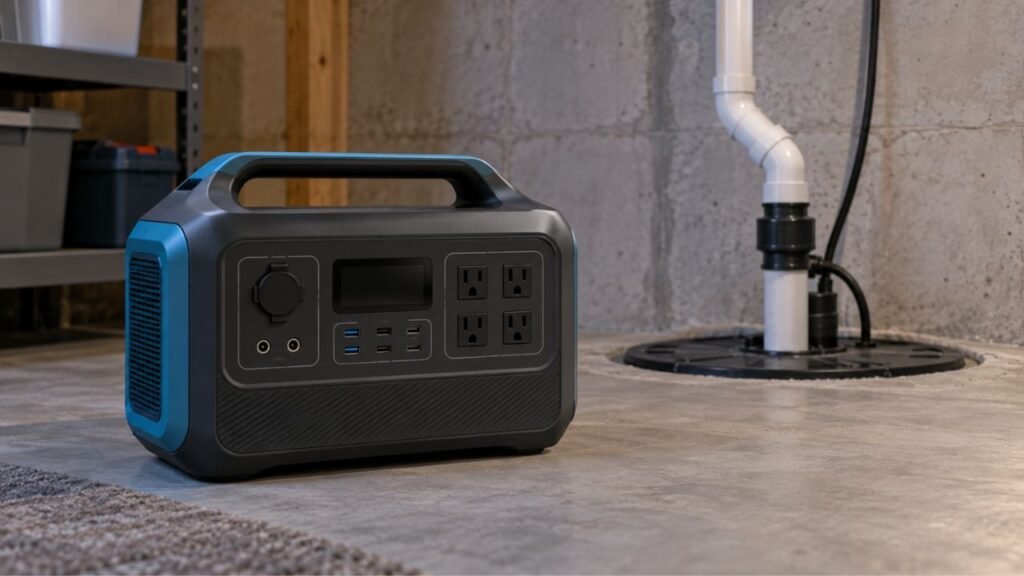
Yes, a portable power station can run many residential sump pumps. However, it must handle the pump’s running watts and startup surge.
The battery must also provide enough capacity during longer power outages. Below, I’ll show you how to size everything correctly and safely.
Key Takeaways
- A portable power station can power many common residential sump pumps.
- Starting surge matters more than normal running watts during initial startup.
- Check your exact pump specifications instead of relying on horsepower alone.
- Inverter wattage determines compatibility, while battery capacity determines runtime.
- Sump pumps usually cycle, so actual outage coverage may be longer.
- Automatic backup requires compatible UPS, EPS, or pass-through functionality.
- Keep the power station elevated and protected from possible floodwater.
Can a Portable Power Station Run a Sump Pump?
A portable power station can successfully run most smaller residential sump pumps. The important part is matching the station to your specific pump.
Your power station must satisfy four basic electrical requirements.
First, its continuous AC output must exceed the pump’s running demand. Second, its surge output must handle the motor’s starting demand.
The station must also provide the correct voltage and frequency. Most household sump pumps in the United States use 120V AC power.
Finally, the battery must hold enough energy for your expected outage.
This last requirement determines how long your basement remains protected.
A common mistake is choosing a station based only on battery capacity. A large battery does not automatically mean a powerful inverter.
For example, a 2,000Wh battery may store plenty of energy. However, the inverter could still fail when the pump motor starts.
That is why output watts and battery watt-hours require separate consideration.
How Much Power Does a Sump Pump Use?
Sump pump electricity consumption varies considerably between different pump designs. Horsepower provides a useful estimate, but it cannot guarantee exact wattage.
Running Watts vs Starting Watts
Running watts describe how much electricity the pump normally consumes.
Once the motor reaches operating speed, electrical demand usually drops considerably. This steady demand determines the necessary continuous inverter output.
Starting watts are different.
A sump pump motor needs considerably more power when starting. That brief demand is commonly called startup surge or starting wattage.
The surge may last only seconds, but it matters greatly.
If your power station cannot supply it, the inverter may overload. The pump might hum, fail to start, or immediately shut down.
This can happen even when the listed running watts appear compatible.
For sump pumps, always check both numbers before choosing backup power.
Typical Sump Pump Wattage by Horsepower
The following numbers provide general planning ranges for common residential pumps. Your actual pump can fall outside these estimates.
| Sump Pump Size | Approximate Running Watts | Possible Starting Watts | Best Way to Confirm |
| 1/4 HP | 400–600W | 900–1,500W+ | Pump label or manual |
| 1/3 HP | 500–800W | 1,300–3,000W+ | Manufacturer specifications |
| 1/2 HP | 700–1,100W | 2,000–4,100W+ | Manufacturer specifications |
| 3/4 HP | 1,000–1,500W | 3,000–4,500W+ | Exact electrical specifications |
| 1 HP | 1,500–2,000W+ | 4,000W+ | Exact electrical specifications |
These numbers should only serve as initial estimates.
Two 1/3 HP pumps can have noticeably different electrical requirements. Motor efficiency, pump design, discharge conditions, and manufacturer specifications all matter.
Therefore, never buy a power station using horsepower alone.
Check the electrical information printed directly on your sump pump.
How Do You Find Your Sump Pump’s Actual Power Requirements?
Before choosing a power station, identify your pump’s real electrical requirements. This prevents unnecessary oversizing and reduces the risk of overload problems.
Check the Pump Nameplate and Manual First
Start with the manufacturer’s label attached directly to your sump pump.
Look for these specifications:
- Voltage
- Amperage
- Rated watts, when provided
- Horsepower
- Frequency
- Starting current or inrush current
- Locked rotor amps, when provided
The owner’s manual can provide additional startup information.
If your pump lists watts directly, sizing becomes considerably easier. However, many sump pumps list voltage and amperage instead.
You may see people multiply volts by amps immediately.
That calculation can provide useful electrical sizing information, but AC motors complicate things. Motor power factor means volts multiplied by amps does not always equal true watts.
Therefore, manufacturer wattage specifications remain preferable whenever available.
Measure the Pump If Startup Power Is Unknown
Sometimes manufacturers provide running amperage without startup wattage.
In that situation, testing the actual pump provides useful information.
A power meter capable of recording peak or inrush demand works best. Basic meters may display normal consumption while missing the startup spike.
Some portable power stations also display current output wattage.
That feature can help during testing, but displays may update slowly. A brief startup surge might therefore disappear before appearing clearly.
The most practical approach is testing the exact pump and station together.
Do this before severe weather arrives.
Let the pump start several times during controlled conditions. Confirm that the station does not overload, shut down, or hesitate.
What Size Portable Power Station Do You Need for a Sump Pump?
Choosing the correct size requires checking power output and stored energy. I recommend working through these requirements separately instead of guessing from capacity.
Step 1: Match Continuous Output to Running Load
Start with your sump pump’s normal running wattage.
Your power station’s continuous AC output should exceed that number.
Suppose your pump normally draws approximately 750 watts.
A power station rated for exactly 750 watts offers little headroom. Motor loads, operating conditions, and other electrical losses can increase demand.
Choosing additional inverter headroom provides a more reliable setup.
For example, a 1,500W or 2,000W inverter gives considerably more flexibility.
However, continuous wattage is only your first compatibility check.
Step 2: Make Sure Surge Output Can Start the Motor
Next, compare the pump’s startup demand with inverter surge capacity.
Suppose your pump needs 750W while running but 2,200W starting.
A 1,000W inverter may run the pump after startup. Unfortunately, it could never successfully start the motor.
Your station’s surge rating should comfortably exceed startup demand.
Also remember that advertised peak wattage can have time limits.
One inverter may supply its peak rating for several seconds. Another may only tolerate that level extremely briefly.
Motor startup behavior can therefore differ between seemingly similar stations.
This is why testing your exact setup remains extremely valuable.
Step 3: Choose Enough Battery Capacity
Once output requirements are covered, calculate how much energy you need.
Portable power station batteries are measured in watt-hours, or Wh.
Think about the difference this way:
Watts tell you how much power the station can provide.
Watt-hours tell you how long that power can continue.
A 2,000Wh station stores roughly twice the energy of 1,000Wh.
However, you cannot normally use every advertised watt-hour through AC outlets. The inverter itself consumes energy while converting battery power to AC.
Battery management systems and operating conditions also create additional losses.
For practical planning, account for some conversion loss.
Step 4: Check Voltage, Frequency, and Inverter Output
Before buying anything, confirm the complete electrical compatibility.
Check these items:
- Correct AC voltage for your sump pump
- Correct 60Hz frequency for most U.S. household pumps
- Pure sine wave inverter output
- Adequate continuous inverter wattage
- Adequate motor startup surge
- Proper grounded outlet configuration
- Sufficient UPS or EPS output when using backup mode
- Appropriate behavior during long periods without pump activity
Most household sump pumps use approximately 115V or 120V AC.
However, never assume every pump follows the same specification.
A 240V sump pump requires a station offering proper 240V output.
How Long Will a Portable Power Station Run a Sump Pump?
Runtime depends on battery capacity, inverter losses, pump wattage, and cycling. The good news is sump pumps rarely operate continuously during normal conditions.
Calculate Continuous Pump Runtime
A simple planning formula looks like this:
Estimated runtime = usable battery capacity ÷ running watts
Suppose your station contains a 2,000Wh battery.
For this example, assume approximately 85% becomes usable AC energy.
That gives:
2,000Wh × 0.85 = 1,700Wh usable energy
Now suppose your sump pump consumes 800 watts continuously.
1,700Wh ÷ 800W = approximately 2.1 hours
That means roughly two hours of nonstop pumping.
However, this calculation describes an unusually demanding continuous-load situation.
Actual outage coverage could be considerably longer because pumps normally cycle.
Sump Pumps Usually Run in Cycles
Your sump pump does not normally run every minute.
Water enters the sump pit until the float reaches activation height. The pump turns on, removes water, and then shuts off.
Suppose an 800W pump runs ten minutes every hour.
During one hour, it operates for one-sixth of that hour.
Its pumping energy consumption becomes approximately:
800W × 0.167 hours = about 134Wh per hour
A 1,700Wh usable battery could theoretically cover many more hours.
However, real storms rarely maintain a perfectly predictable duty cycle.
Heavy rainfall can cause your pump to operate much more frequently.
Groundwater conditions can also continue worsening after rainfall ends.
Therefore, calculate runtime using realistic worst-case cycling when possible.
What Can Shorten Runtime?
Several factors can make your actual runtime lower than expected:
- Frequent sump pump cycling
- Near-continuous operation during severe rainfall
- Additional appliances connected simultaneously
- Inverter conversion losses
- Power station standby consumption
- Repeated motor startup surges
- Battery aging
- Extreme temperatures
- Higher pumping head
- Restricted or inefficient discharge plumbing
Because these conditions vary, avoid treating runtime calculators as guarantees.
Use them as planning tools instead.
Can a Portable Power Station Automatically Back Up a Sump Pump?
Some portable power stations can switch automatically during utility outages. However, the specific UPS or EPS implementation must support your pump.
UPS or EPS Mode Can Provide Automatic Switchover
A compatible setup typically works like this:
Wall outlet → portable power station → sump pump
Under normal conditions, utility electricity powers the connected system.
When utility power disappears, the power station switches to battery operation.
This arrangement can be extremely helpful during overnight storms.
You do not need to enter the basement manually during blackout conditions.
However, automatic switchover alone does not guarantee compatibility.
The backup circuit must still handle your pump’s startup surge.
Check the UPS or EPS Output Limit
Some power stations advertise impressive standalone inverter wattage.
Their pass-through or backup-mode limits can sometimes be different.
For example, a station may offer high standalone AC output. Its backup function might support a smaller pass-through load.
That difference becomes important when powering motor-driven equipment.
Always check the specifications specifically for UPS or EPS operation.
Make sure that mode supports both normal pump demand and startup demand.
Disable Auto-Off or Eco Mode If Necessary
This is an easy problem to overlook.
Your sump pump may remain completely idle for several hours.
Some portable power stations automatically disable AC output after detecting no load.
That feature saves battery during normal portable use.
Unfortunately, it can create problems for unattended sump pump backup.
When the float later activates, the AC outlet might already be disabled.
Check your station’s settings before depending on automatic operation.
Verify that:
- AC output remains available while the pump sits idle.
- The station responds properly when the pump suddenly starts.
- Utility failure automatically activates battery backup.
- Grid restoration returns the system to normal operation.
- Overload shutdown does not require manual recovery unexpectedly.
Testing these behaviors beforehand can prevent a serious surprise later.
How to Connect a Sump Pump to a Portable Power Station Safely
Water and electricity create serious risks when combined incorrectly. Keep your entire power setup dry, elevated, grounded, and properly connected.
Follow these practical precautions:
- Test your setup before severe weather reaches your area.
- Place the station well above potential floodwater levels.
- Keep it on a stable and dry elevated surface.
- Never place the station directly beside the sump pit.
- Keep plugs and electrical connections completely protected from moisture.
- Use the pump’s grounded plug exactly as designed.
- Never remove or bypass the grounding pin.
- Plug directly into the station whenever manufacturer instructions require it.
- Avoid connecting unnecessary high-wattage appliances simultaneously.
- Follow both equipment manufacturers’ operating instructions.
- Keep ventilation openings clear around the power station.
- Never modify permanent household wiring without qualified electrical help.
Be especially careful about extension cords.
Some sump pump manufacturers specifically advise against using extension cords.
If your pump cord cannot reach the power station safely, check its manual. Installing a properly located receptacle may be safer than improvising connections.
Never route electrical connections through standing water.
How Should You Test the Backup Before a Storm?
Testing should confirm startup, cycling, runtime, and automatic transfer behavior. One successful startup does not prove your system is storm-ready.
Follow this basic testing process:
- Fully charge your portable power station before testing.
- Connect only the sump pump during the first test.
- Activate the pump using the manufacturer’s recommended testing method.
- Watch carefully for overload warnings or startup hesitation.
- Allow several complete pump cycles before ending testing.
- Simulate a utility outage when testing automatic backup mode.
During testing, watch several things closely.
Check how much power the pump consumes while running.
Observe whether the station handles startup without overload errors.
Make sure AC output remains enabled while the pump sits idle.
If using UPS or EPS mode, disconnect utility input temporarily.
The pump should remain available through battery power afterward.
Reconnect grid electricity and confirm normal charging resumes automatically.
Also check battery percentage changes across multiple cycles.
That information helps estimate realistic outage coverage for your basement.
Can You Recharge the Power Station During a Long Outage?
Several charging methods can extend sump pump backup during longer outages. However, available charging power may change significantly during severe weather.
Possible recharge options include:
- Solar panels
- Vehicle charging
- Alternator-based charging systems
- Expansion batteries
- Gas or propane generator charging
- Utility charging when grid power temporarily returns
Solar charging can provide valuable additional energy during long outages.
However, do not assume solar panels guarantee uninterrupted sump pump operation.
Storms often bring heavy clouds exactly when pumping demand increases.
Solar production can therefore fall considerably during severe weather.
The safer strategy is beginning the storm with a fully charged battery.
Expansion batteries can also extend runtime considerably.
Remember that additional battery capacity does not increase inverter output.
If the station cannot start your pump originally, adding batteries changes nothing.
You would need a stronger inverter or different power station instead.
Portable Power Station vs Dedicated Battery Backup Sump Pump
These two backup approaches solve different problems inside your basement. Choosing between them depends on the type of protection you need.
A portable power station keeps your existing primary sump pump operating.
That works well when the main problem is utility power failure.
However, your primary pump remains a single mechanical point of failure.
Suppose the motor fails while utility electricity remains available.
Your portable power station cannot repair that failed motor.
The same limitation applies to several other mechanical problems:
- Failed float switch
- Jammed impeller
- Blocked discharge line
- Burned-out primary pump
- Damaged pump wiring
- Mechanical pump failure
A dedicated battery backup sump system generally uses another pump.
That creates redundancy beyond simply providing another electricity source.
For homes with finished basements or frequent groundwater problems, redundancy matters.
You may even decide that both systems make sense together.
A portable power station can provide flexible household backup electricity.
A secondary battery-powered sump pump provides additional flood protection.
When a Portable Power Station May Not Be Enough
Portable stations work well for many homes, but not every situation. Certain conditions require more backup capacity or additional flood protection.
A portable power station may be insufficient when:
- Pump startup exceeds the inverter’s surge capability.
- Your sump pump requires unsupported 240V power.
- Water inflow causes almost continuous pump operation.
- Two pumps may start simultaneously from one station.
- The station automatically shuts down during long idle periods.
- The station requires manual restart following an overload.
- Your basement has a history of serious flooding.
- The primary sump pump has reliability problems.
- No safe elevated location exists for the power station.
- Outages regularly last longer than your available battery capacity.
High-risk homes should consider backup beyond electrical power alone.
A secondary pump can protect against mechanical failure simultaneously.
Common Mistakes When Using a Power Station for a Sump Pump
Most problems happen because one important specification gets overlooked. Avoiding these mistakes makes your backup system considerably more dependable.
Choosing by Battery Capacity Alone
Large battery capacity does not guarantee enough motor-starting power.
A 3,000Wh battery can still sit behind an undersized inverter.
Check output watts before becoming impressed by battery size.
Choosing by Horsepower Alone
Horsepower helps estimate demand, but it cannot provide exact requirements.
Two similarly rated pumps may use very different electrical current.
Always prioritize actual specifications from your exact model.
Ignoring Startup Surge
Startup surge causes many unexpected power station overloads.
Your pump might consume moderate power after reaching normal operating speed.
However, its brief startup demand can be several times higher.
Always confirm surge capacity before relying on the station.
Assuming Advertised Surge Watts Guarantee Startup
A large advertised surge number does not guarantee motor compatibility.
Peak duration and inverter protection behavior also affect successful startup.
Real-world testing gives you much stronger confidence.
Leaving Eco Mode Enabled Without Testing It
Energy-saving modes can disable AC output during long idle periods.
That is useful when camping but problematic for unattended sump pumps.
Make sure AC remains available when the pump needs restarting.
Putting the Power Station on the Basement Floor
Never assume water will remain below its previous highest level.
A severe storm can overwhelm previously adequate drainage systems.
Place the power station safely above possible water intrusion.
Depending Entirely on Solar Recharging
Solar panels are helpful, but storms can sharply reduce production.
Clouds and heavy rainfall may arrive during peak pumping demand.
Treat solar charging as useful support, not guaranteed emergency generation.
Conclusion
A portable power station can provide excellent sump pump backup power. The key is matching your exact pump instead of guessing.
Start by checking running wattage, startup surge, voltage, and frequency.
Then choose enough battery capacity for realistic pump cycling conditions.
If unattended backup matters, carefully test UPS or EPS operation.
Make sure AC output stays active while the pump remains idle.
Most importantly, keep the station elevated and away from possible water.
For homes facing serious flood risks, consider mechanical redundancy too.
A backup electricity source cannot help if the primary pump fails mechanically.
Test everything before storm season, rather than during an actual emergency.
That preparation can make the difference between inconvenience and basement flooding.
Related FAQs
Can a 1,000W Portable Power Station Run a Sump Pump?
A 1,000W station may run some smaller sump pumps normally. However, its surge output must also handle the pump’s startup demand.
What Size Power Station Do I Need for a 1/3 HP Sump Pump?
Many 1/3 HP pumps need moderate running power but higher startup power. Check your exact model’s electrical specifications before selecting inverter size.
What Size Power Station Do I Need for a 1/2 HP Sump Pump?
A 1/2 HP pump generally requires a stronger inverter and surge rating. Exact requirements vary considerably, so confirm specifications from your specific pump.
How Long Will a 2,000Wh Power Station Run a Sump Pump?
Runtime depends on pump wattage, inverter losses, and how frequently it cycles. Continuous operation may last only hours, while intermittent cycling can last considerably longer.
Can I Leave My Sump Pump Plugged Into a Power Station?
Yes, when the station supports appropriate UPS or pass-through operation. Confirm that its AC output remains active while the pump sits idle.
Does a Sump Pump Need a Pure Sine Wave Power Station?
Pure sine wave output is the better choice for motor-driven sump pumps. It provides cleaner AC power and generally supports motors more reliably.
Can Solar Panels Keep a Sump Pump Running During an Outage?
Solar panels can extend available runtime by recharging the power station. However, storm clouds and rainfall may significantly reduce available solar input.
Can One Power Station Run Two Sump Pumps?
It can if continuous output and simultaneous startup surge remain supported. Two motors starting together can require considerably more inverter capacity.
Is a Portable Power Station Better Than a Sump Pump Battery Backup?
Neither option is automatically better for every basement. A power station supports your existing pump, while dedicated backup systems can add a second pump.
Will a Portable Power Station Automatically Start During an Outage?
Some models can automatically switch through UPS or EPS functionality. You should test this feature with your exact sump pump before depending on it.

Warren Turner writes practical guides and reviews on generators, portable power stations, and battery backup systems. He focuses on real-world performance, everyday power needs, and helping readers choose dependable equipment without unnecessary complexity.