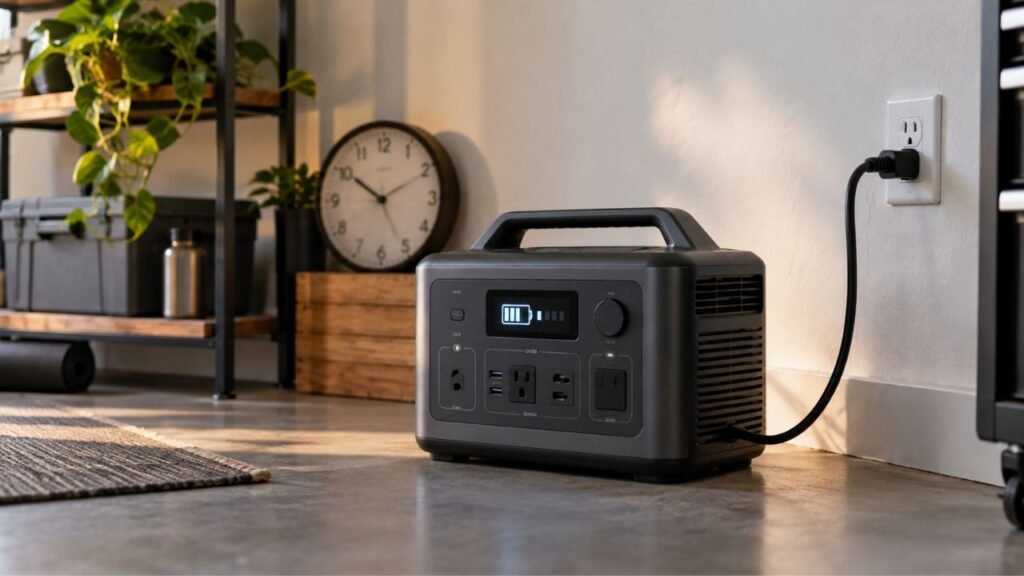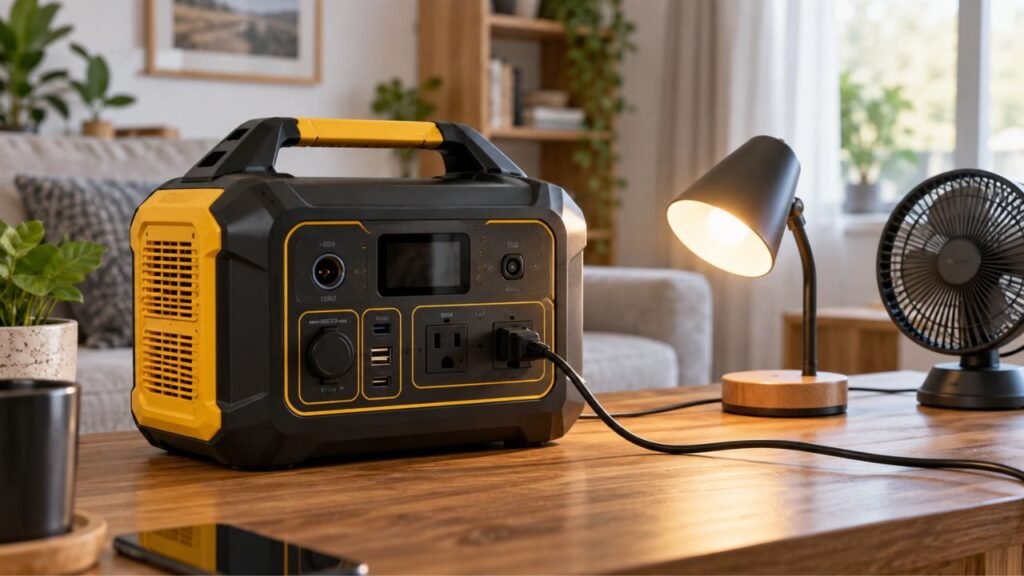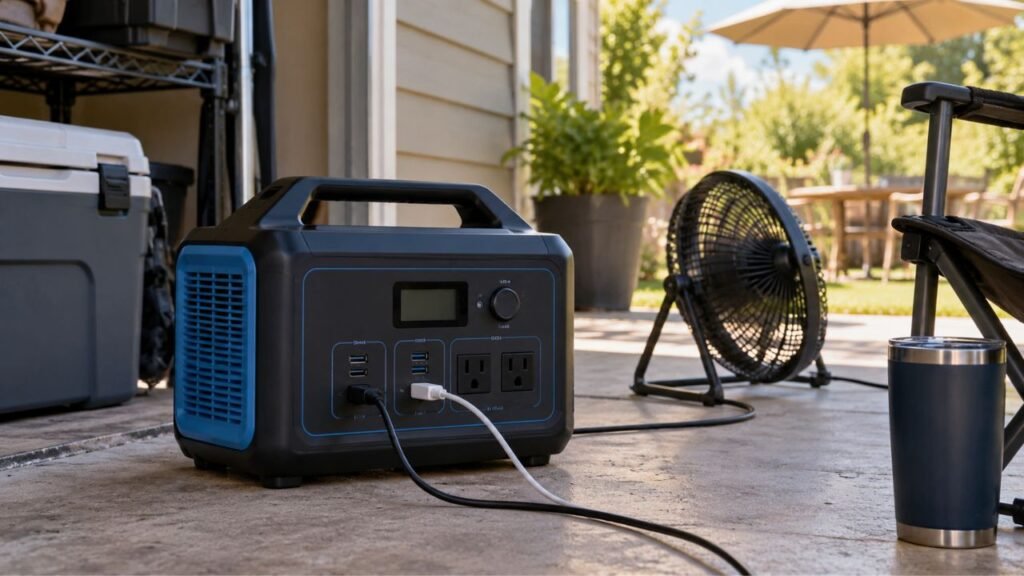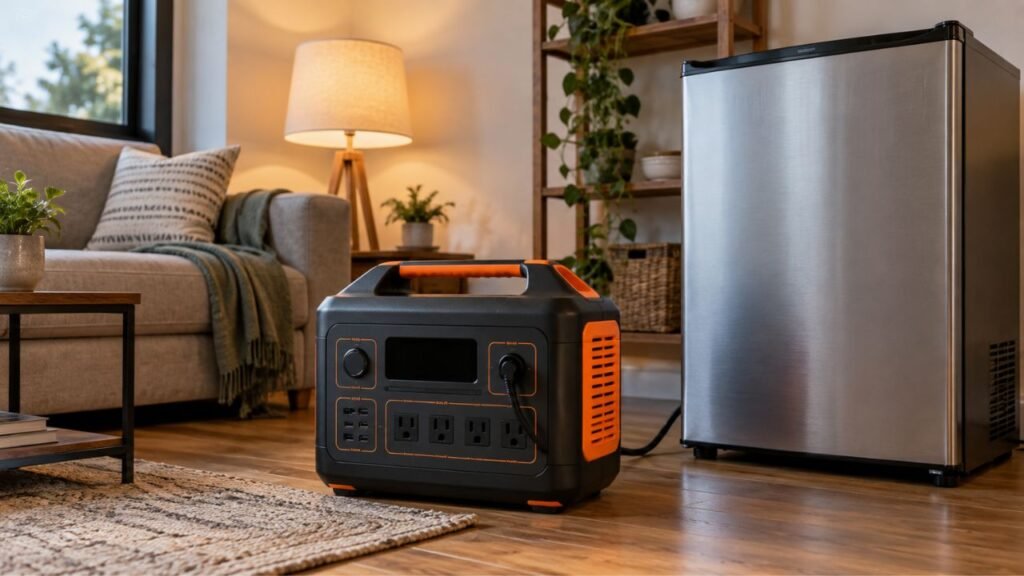
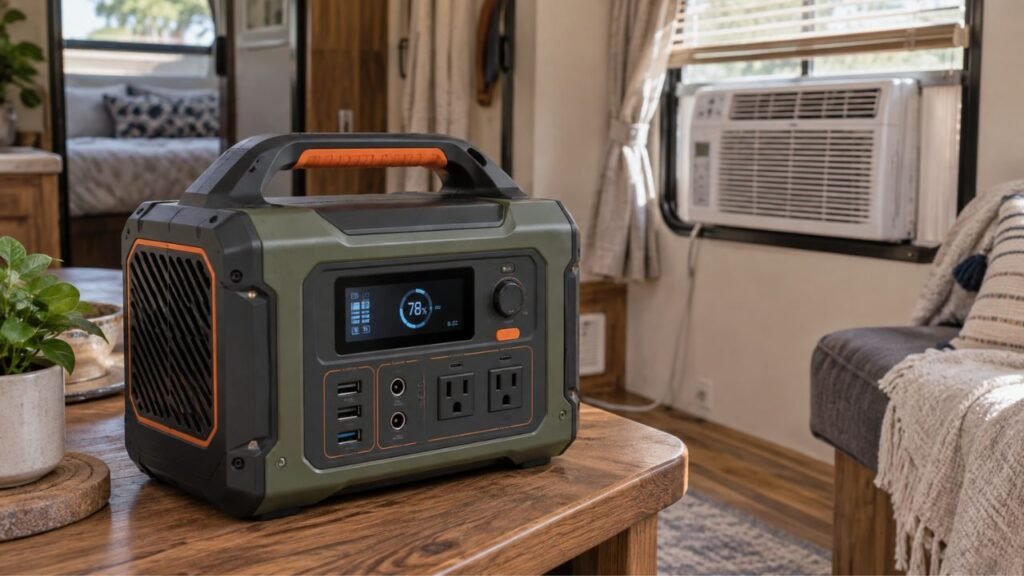
AC compressors overload portable power stations because they need a large burst of power when starting. That brief startup demand can exceed the station’s inverter surge limit, even when the air conditioner’s normal running wattage looks completely safe.
But startup surge is not the only possible cause. Battery charge, temperature, voltage drop, other connected appliances, and compressor problems can also trigger an overload. Here, I’ll help you understand each cause and show you how to troubleshoot the problem safely.
Key Takeaways
- AC compressors can draw several times their normal current during startup.
- Running wattage alone cannot confirm power station compatibility.
- Continuous output and surge output are two different limits.
- Battery capacity in watt-hours mainly determines runtime, not starting ability.
- Low battery charge and high temperatures can reduce available output.
- Repeated compressor failures may indicate an air conditioner problem.
- A compatible soft starter can significantly reduce startup demand.
Why Does an AC Compressor Overload a Portable Power Station?
An AC compressor contains an electric motor that needs extra power to start. When the compressor is stationary, the motor can demand far more current than it needs once running.
Your portable power station must supply that sudden electrical demand immediately.
For example, an air conditioner might normally consume 800 watts. However, its compressor could briefly demand 2,000 watts or considerably more during startup.
If your power station can only provide a 1,800-watt surge, its protection system may shut the AC output down.
The sequence usually looks like this:
Compressor starts → current rises sharply → inverter limit is reached → overload protection activates → AC output shuts off.
That shutdown does not necessarily mean something is wrong with your power station. Its protection system may simply be preventing excessive electrical stress.
What Happens Electrically When an AC Compressor Starts?
Starting an AC compressor involves more than its normal running wattage. Understanding a few basic terms makes power station compatibility much easier.
Startup Inrush Current
An AC compressor motor requires strong initial current before it starts turning.
This temporary electrical demand is called inrush current.
Inrush current lasts briefly, but that does not make it harmless. The power station still needs enough instantaneous output to supply it.
Some compressors may draw several times their normal operating current during startup.
This is why an AC rated around 900 running watts can still overwhelm a 1,500-watt power station.
Locked Rotor Amps
You may find a specification called LRA on your air conditioner.
LRA means Locked Rotor Amps.
It represents the high current associated with a compressor motor that is not yet rotating. It helps indicate how demanding the compressor can be during startup.
You may find LRA information on:
- The outdoor condenser data plate
- The compressor label
- The air conditioner specification sheet
- Manufacturer service documentation
Do not confuse LRA with normal operating amperage.
Your compressor should not continuously operate anywhere near its locked-rotor current.
Why Current Falls After Startup
Once the compressor motor begins rotating, its electrical conditions quickly change.
The current then falls toward its normal operating level.
That explains something that often confuses power station owners.
Your AC might run perfectly at 700 watts after starting. Yet the same unit may require several times that amount for a moment.
That brief moment determines whether your power station survives compressor startup.
Running Watts vs. Surge Watts: Which Rating Causes the Overload?
Running watts determine whether the station can continuously operate your AC. Surge capability determines whether it can successfully start the compressor.
| Rating | Where You Find It | What It Means | Why It Matters |
| AC running watts | AC label or manual | Normal operating demand | Must stay within continuous output |
| Running amps | AC or compressor label | Normal operating current | Helps estimate steady electrical load |
| LRA | Compressor or unit label | High startup-related current | Shows potential startup stress |
| Continuous output | Power station specifications | Long-term inverter limit | Must support normal AC operation |
| Surge output | Power station specifications | Short-term high-output capability | Helps start compressor motors |
| Battery capacity | Power station specifications | Stored energy in watt-hours | Mainly determines operating runtime |
One important distinction deserves extra attention.
A larger battery does not automatically mean stronger compressor-starting performance.
A 2,000Wh station could have weaker AC output than another station containing only 1,500Wh.
Battery capacity tells you how much stored energy is available.
The inverter, battery discharge capability, and internal electronics determine how much power can be delivered at once.
That distinction matters greatly when running air conditioners.
Why Can an AC Overload the Power Station Even When the Wattage Looks Safe?
Sometimes the numbers appear compatible, yet your station still overloads. Several less obvious conditions can explain why this happens.
The Compressor Surge Exceeds Peak Output
This remains the most common reason.
Suppose your power station provides:
- 1,800W continuous output
- 2,700W surge output
Your AC might only consume 1,000 watts while operating.
That looks comfortable.
However, the compressor could momentarily require more than 2,700 watts.
The station sees excessive demand and immediately protects itself.
This is why comparing only running wattage can produce misleading results.
The Surge Lasts Too Long
Peak wattage is only part of the surge specification.
Duration also matters.
A power station might advertise impressive peak wattage but only support that level very briefly.
Meanwhile, the compressor needs enough current for enough time to accelerate.
If the inverter stops providing peak output too quickly, the compressor may never reach normal operating speed.
The power station can then enter overload protection.
Do not assume two stations with identical advertised surge wattages perform identically.
Their surge duration and protection behavior can differ.
Other Appliances Are Using Your Available Headroom
Remember to calculate everything connected to the inverter.
Imagine your AC needs a 2,200-watt startup surge.
Your station supports 2,400 surge watts.
That appears workable.
However, your refrigerator is already consuming 200 watts. Your television and router are using another 100 watts.
Now the compressor starts.
The combined load reaches approximately 2,500 watts and trips the station.
When troubleshooting, test your air conditioner by itself first.
That removes simultaneous loads from the equation.
Battery Voltage Sags During Startup
Your power station stores electricity as DC energy inside its battery.
The inverter converts that energy into household AC power.
When the compressor suddenly demands high output, the battery must provide strong current immediately.
That demand can temporarily pull battery voltage downward.
This effect is commonly called voltage sag.
If voltage falls beyond the system’s acceptable limit, protective electronics may shut the inverter down.
Low battery charge can make this situation more noticeable.
Cold battery temperatures can also reduce available discharge performance.
This explains why an AC sometimes starts at 90% charge but struggles near 15%.
High Temperature Reduces Available Headroom
Portable power stations generate heat while supplying heavy AC loads.
Air conditioners also tend to operate during hot weather.
That combination can create difficult operating conditions.
A power station sitting inside a hot vehicle or unventilated compartment may already be warm before the compressor starts.
Blocked cooling vents can make things worse.
When internal temperatures become excessive, the station may reduce power or shut down.
Keep your station:
- Out of direct sunlight
- Away from enclosed hot compartments
- Clear of walls blocking cooling vents
- Within the manufacturer’s operating temperature range
Never cover the power station while running an air conditioner.
Voltage Drop Makes Compressor Starting Harder
Long or undersized extension cords can create another problem.
Every cord has electrical resistance.
A long, thin cable can reduce the voltage reaching your air conditioner.
Lower startup voltage may prevent the compressor motor from accelerating quickly.
The compressor then remains in its high-current starting condition longer.
That can make the power station overload.
Use an appropriately rated extension cord when one is necessary.
Shorter and properly sized cords usually perform better with heavy loads.
The Compressor Restarts Too Quickly
Air conditioner compressors do not always restart easily immediately after shutting down.
Refrigerant pressures may still be unequal inside the system.
Restarting against that pressure can place additional demand on the compressor.
This can happen after:
- A brief power interruption
- Rapid thermostat cycling
- Turning AC output off and immediately back on
- A power station temporarily shutting down
- Repeated manual restart attempts
Many air conditioners include built-in restart delays for this reason.
If your AC shuts down, avoid repeatedly switching it back on immediately.
Allow its normal restart delay to complete.
Could the Air Conditioner Itself Be Causing the Overload?
Not every overload means your portable power station is undersized. Sometimes the air conditioner itself is becoming difficult to start.
Possible AC-related causes include:
- Weak start or run capacitor
- Dirty condenser coil
- Condenser fan problems
- Low supply voltage
- Frequent short cycling
- Compressor starting-component failure
- Abnormal refrigerant-system pressures
- Compressor mechanical problems
A healthy compressor should quickly move through its startup period.
A struggling compressor can remain near high starting current longer.
Your power station may then shut down even though it previously operated the same AC successfully.
Pay attention when the behavior suddenly changes.
For example, suppose your station ran the AC normally all summer. Now the compressor hums and immediately causes an overload every time.
That deserves investigation before buying a larger power station.
Have a qualified HVAC technician inspect persistent compressor-starting problems.
Do not open HVAC electrical compartments or test capacitors unless qualified. Dangerous voltage may remain present even after power is disconnected.
How Can You Tell What Is Causing the Overload?
The timing of the shutdown provides valuable troubleshooting clues.
| What Happens | What You Should Check First |
| Station trips exactly when compressor starts | Compressor startup surge |
| Fan runs, then station shuts off | Compressor startup demand |
| AC runs alone but fails with other devices | Combined electrical load |
| AC starts at full charge but fails when battery is low | Battery-side limitation |
| Station trips after prolonged operation | Continuous load or heat |
| Compressor hums without starting | AC starting system or compressor |
| AC runs for several minutes before overload | Heat or abnormal operating current |
| AC also struggles on utility power | Possible AC equipment problem |
Start with the easiest test.
Disconnect every other AC appliance and operate only the air conditioner.
If the compressor starts normally, your problem may simply be combined load.
If it still trips immediately, investigate the startup demand next.
How Do You Size a Portable Power Station for an AC Compressor?
Proper sizing requires more than matching one wattage number. Check voltage, running demand, startup demand, and inverter capability together.
Check the AC Voltage First
Start with voltage before discussing watts.
Many smaller U.S. air conditioners operate from standard 120V power.
Examples include:
- Window air conditioners
- Portable room air conditioners
- Many RV rooftop air conditioners
Many larger central air conditioners operate at 208V, 230V, or 240V.
A standard 120V-only portable power station cannot directly operate a 240V central air conditioner.
You would need equipment providing the correct voltage configuration.
Find the Running Power
Check the air conditioner label or owner’s manual.
Look for:
- Input watts
- Rated current
- Operating amps
- Cooling-system electrical specifications
If wattage is listed directly, use that number.
If you only have volts and amps, multiplying them provides useful electrical information. However, compressor motors involve power factor, so volts multiplied by amps should not always be treated as exact real watts.
Manufacturer wattage data is preferable when available.
Find the Compressor Startup Requirement
Next, determine how demanding the compressor is during startup.
Use information in this order whenever possible:
- Manufacturer-listed starting watts
- Manufacturer startup-current specifications
- Compressor LRA information
- Measured startup current
- Rough estimates when no better information exists
Avoid relying automatically on a simple “running watts × 3” formula.
It might work as a rough planning estimate for some appliances.
However, compressor startup behavior varies considerably between systems.
Compare Both Power Station Ratings
Now examine your portable power station.
Check:
- Continuous AC output
- Surge or peak AC output
- Surge duration
- Output voltage
- Motor-load recommendations
- Temperature-related limitations
Your station must support normal running demand continuously.
It must also handle the brief compressor startup event.
Both conditions need to be satisfied.
Leave Practical Headroom
Avoid designing your setup around the absolute maximum ratings.
Some extra output headroom helps accommodate:
- Compressor startup variations
- Fan motors
- Hot operating conditions
- Additional small appliances
- Battery charge changes
- Brief electrical fluctuations
This does not mean one fixed percentage works for every setup.
Think of headroom as practical reliability rather than wasted capacity.
Example: Why a Power Station Can Run an AC but Still Trip at Startup
Consider a simple hypothetical setup.
Your air conditioner normally consumes 800 watts.
Your portable power station provides 1,500 watts continuously.
At first glance, everything looks excellent.
However, imagine the compressor briefly requires 2,400 watts while starting.
Your power station only provides 2,000 surge watts.
The AC therefore looks compatible using running wattage alone.
But the compressor asks for more startup power than the inverter can deliver.
The station shuts down before the compressor reaches normal speed.
If the compressor somehow started successfully, the station could comfortably support its 800-watt running load.
That is why compressor startup deserves separate consideration.
Does LRA × Voltage Equal the Exact Compressor Startup Watts?
No. Multiplying LRA by voltage does not necessarily give exact startup watts.
The result represents volt-amperes, or apparent electrical power.
AC motors have characteristics including power factor that affect real wattage.
The actual startup waveform also changes quickly while the compressor accelerates.
This means you should not automatically calculate:
LRA × voltage = exact compressor starting watts
Use manufacturer-provided starting-power information whenever possible.
Actual inrush measurements can also help professionals diagnose difficult startup problems.
LRA remains valuable because it shows how electrically demanding a stalled or starting compressor can become.
Just do not treat it like ordinary running wattage.
Can a Soft Starter Stop an AC Compressor From Overloading a Power Station?
A compatible soft starter can reduce compressor starting demand substantially. However, it cannot compensate for an undersized continuous power source.
How a Soft Starter Reduces Startup Demand
A conventional compressor may attempt to start very quickly.
That produces a sharp electrical demand.
A soft starter manages the startup process more gradually.
This can significantly reduce the peak current demanded from your power station.
That makes soft starters especially useful where startup power is limited.
They are commonly considered for:
- RV air conditioners
- Generator-powered cooling
- Inverter-powered compressors
- Certain home air-conditioning systems
- Off-grid electrical systems
The exact reduction varies between compressors and soft-start devices.
Soft Starter vs. Hard-Start Kit
These two devices are not interchangeable.
A soft starter is designed to manage and reduce compressor starting current.
A hard-start kit helps a compressor produce additional starting torque.
A hard-start kit may help a difficult compressor start faster, but it does not perform the same function as a soft starter.
Do not install either simply because your power station trips.
The correct solution depends on the compressor and electrical system.
When a Soft Starter Makes Sense
A soft starter makes the most sense when your air conditioner runs comfortably after starting, but its initial surge approaches the power station’s limit.
That situation indicates startup demand is the main obstacle.
A soft starter cannot solve every overload problem.
Your power station must still provide enough continuous output for normal AC operation.
Professional installation may also be appropriate depending on your equipment.
Do Inverter Air Conditioners Have the Same Startup Surge Problem?
Inverter-driven air conditioners often behave differently from traditional fixed-speed compressors.
Traditional compressors commonly switch on at full starting demand.
An inverter-driven compressor can often increase motor speed more gradually.
That smoother startup may substantially reduce the sudden surge placed on your power station.
However, do not assume every inverter AC works with every power station.
You still need to verify:
- Required voltage
- Maximum input power
- Continuous station output
- Startup characteristics
- Other connected loads
- Manufacturer requirements
“Inverter AC” does not automatically mean “low-power AC.”
Large systems can still require substantial electrical output.
What Should You Do After Your Power Station Trips While Running an AC?
Once an overload occurs, avoid repeatedly restarting everything. Work through the setup methodically instead.
- Turn off the power station’s AC output.
- Disconnect the air conditioner and other AC appliances.
- Allow the station to reset and cool if necessary.
- Check the remaining battery charge.
- Confirm the station is operating within its temperature range.
- Verify the AC running and startup requirements.
- Disconnect unnecessary high-wattage appliances.
- Inspect extension cords and adapters for proper ratings.
- Test the air conditioner by itself.
- Allow the compressor’s normal restart delay.
- Stop testing if the compressor repeatedly hums without starting.
- Request HVAC service if abnormal startup continues.
Do not repeatedly force the compressor to restart after unsuccessful attempts.
Finding the actual cause is safer than repeatedly triggering protection.
How Can You Prevent AC Compressor Overloads?
Most compressor overloads can be prevented with proper sizing and setup. Focus on the entire electrical system instead of one wattage number.
- Confirm the air conditioner’s required voltage.
- Check its normal running demand.
- Find compressor startup information whenever possible.
- Check power station continuous output.
- Check actual surge capability and duration.
- Avoid unnecessary simultaneous heavy loads.
- Keep cooling vents completely unobstructed.
- Keep the station out of direct summer sunlight.
- Use properly rated extension cords when necessary.
- Maintain adequate battery charge for demanding starts.
- Avoid rapid compressor restart cycles.
- Consider a compatible soft starter when appropriate.
- Test your setup before depending on it during outages.
That last point is especially important.
Do not wait until a summer blackout to discover your compressor cannot start.
Run a controlled test beforehand while utility power remains available.
When Is a Larger Power Station the Better Solution?
A larger power station makes sense when your AC consistently exceeds your current station’s output capability.
But make sure you are upgrading the correct specification.
If the problem is compressor startup, simply purchasing more watt-hours may accomplish nothing.
Look for greater:
- Continuous inverter output
- Surge output
- Surge duration
- Battery discharge capability
Voltage matters too.
A large 240V central air conditioner requires a very different backup setup than a 120V window unit.
Some larger home-backup power stations support split-phase 120/240V operation when configured correctly.
Smaller portable stations often provide only 120V AC.
Your backup system needs the right electrical architecture before capacity matters.
Conclusion
AC compressors overload portable power stations mainly because compressor startup requires much more electrical power than normal operation. When that demand exceeds the inverter’s available surge capability, the station safely shuts its AC output down.
However, do not assume every overload means your station is simply too small. Combined loads, voltage drop, temperature, low battery charge, difficult restarts, and AC equipment problems can produce similar symptoms. Match voltage, running demand, and real startup requirements before deciding what needs upgrading.
Related FAQs
Why Does My Portable Power Station Shut Off When the AC Compressor Starts?
The compressor probably demands more startup current than the power station can provide. Its inverter detects the excessive load and activates overload protection before the compressor reaches normal operating speed.
Can an AC Compressor Draw More Than Three Times Its Running Watts?
Yes. Compressor starting demand varies by motor design and operating conditions. Some compressors can experience startup current several times higher than normal operating current, so three times running watts should not be treated as a universal maximum.
Is Surge Wattage More Important Than Battery Capacity for Starting an AC?
Surge output is generally more important for getting the compressor started. Battery capacity in watt-hours mainly determines how long the power station can operate your air conditioner afterward.
Will a Soft Starter Let a Smaller Power Station Run an Air Conditioner?
Possibly. A compatible soft starter can significantly reduce compressor startup demand. However, your power station must still provide enough continuous output to operate the air conditioner after startup.
Why Does My AC Start Sometimes but Overload the Power Station Other Times?
Battery charge, station temperature, other connected appliances, extension-cord voltage drop, outdoor conditions, and compressor restart pressure can change between attempts. Any of these factors can reduce your available startup margin.
Can a 2,000W Power Station Run a 1,500W Air Conditioner?
It may, but running wattage does not provide enough information. You must also check compressor startup demand, station surge output, voltage compatibility, and any other loads connected simultaneously.
Does a Pure Sine Wave Inverter Prevent AC Compressor Overload?
No. Pure sine wave output is generally suitable for motor-driven appliances, but it cannot overcome insufficient inverter capacity. The station still needs enough continuous and surge output for the compressor.
Can Repeatedly Overloading a Portable Power Station Damage It?
Modern stations normally shut down before serious overload damage occurs. However, repeatedly forcing overload conditions is unnecessary stress. Diagnose the compressor demand or system mismatch instead of repeatedly resetting the station.

Warren Turner writes practical guides and reviews on generators, portable power stations, and battery backup systems. He focuses on real-world performance, everyday power needs, and helping readers choose dependable equipment without unnecessary complexity.