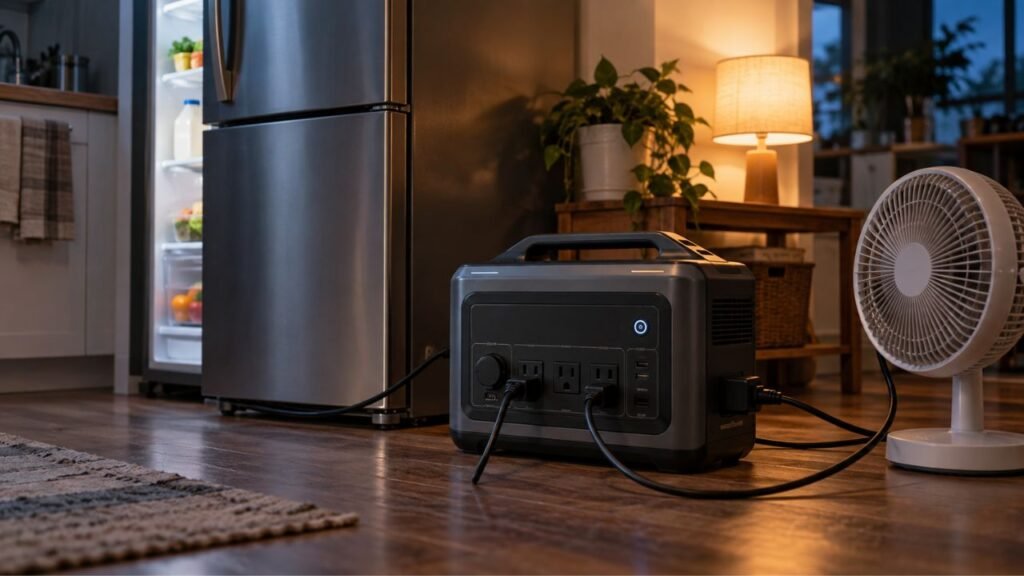
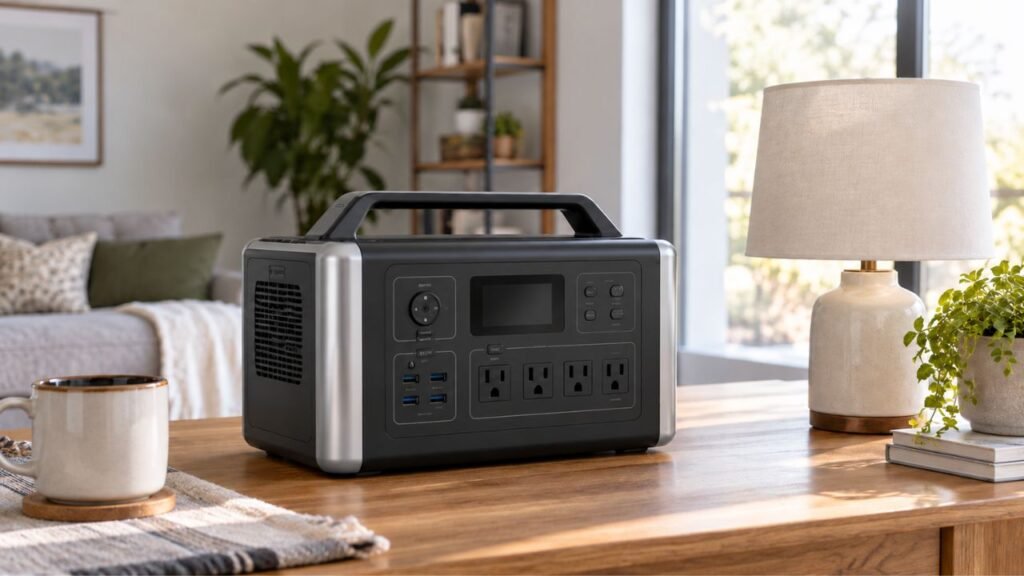
A soft starter helps a portable power station by reducing motor startup demand. It limits the sudden inrush current that can overload the station’s inverter. This can help air conditioners, compressors, pumps, and similar appliances start successfully.
However, a soft starter does not make your power station more powerful. It mainly changes what happens during the appliance’s startup period. Below, I’ll explain how it works, which appliances benefit, and how to check compatibility.
Key Takeaways
- A soft starter reduces high startup current from compatible motor loads.
- Lower startup demand can prevent portable power station overload shutdowns.
- It does not significantly reduce an appliance’s normal running wattage.
- Your station must still support the appliance’s continuous running load.
- Correct voltage remains necessary, even after adding a soft starter.
- Not every compressor or motor supports an external soft starter.
How Does a Soft Starter Help a Portable Power Station?
A soft starter makes a motorized appliance easier for your station to start. It reduces the sudden electrical demand created during motor acceleration.
Suppose your air conditioner normally uses 1,200 watts while running. Your portable power station supplies 2,000 watts continuously without any trouble.
The problem may appear when the compressor first switches on.
That compressor could briefly demand much more than 1,200 watts. If that startup demand exceeds your station’s inverter limit, protection circuitry may shut everything down.
That is where a soft starter becomes useful.
Instead of allowing the compressor to demand maximum starting current immediately, the device controls its startup. The motor accelerates more gradually, reducing the peak demand seen by the inverter.
Your power station itself has not gained additional watts. The appliance has simply become easier for the inverter to start.
This distinction matters when deciding whether a soft starter can actually help.
Why Do Motorized Appliances Need So Much Power at Startup?
Motors behave differently when starting compared with normal operation. Understanding that difference makes soft starters much easier to understand.
What Is Inrush Current?
Inrush current is the brief current spike occurring during startup.
An electric motor is not already spinning when power arrives. It needs additional current and torque to begin moving.
Compressors can create particularly demanding starting conditions.
You may see several electrical values listed on appliance labels, including:
- Running amps
- Rated amps
- Starting amps
- Locked Rotor Amps, commonly called LRA
- Running watts
- Starting or surge watts
LRA is especially useful when checking conventional compressor startup demand.
It describes how much current the compressor may draw while stationary.
That number can be considerably higher than normal running current.
Why Does the Portable Power Station Shut Down?
Portable power stations contain an inverter that converts battery power into AC electricity.
Every inverter has operating limits.
The two most important limits are usually:
- Continuous AC output
- Short-term surge or peak output
Continuous output tells you what the inverter can supply normally.
Surge output describes additional power available for short startup events.
However, the advertised surge number does not tell the entire story.
Surge duration also matters.
One station may provide its peak output for several seconds. Another may allow maximum overload only briefly before shutting down.
A motor could therefore exceed the inverter’s supported surge duration.
This explains an otherwise confusing situation.
Your appliance runs perfectly after starting, yet repeatedly trips the station during startup.
How Does a Soft Starter Reduce Startup Surge?
A soft starter controls the motor during its most demanding moment. Instead of an abrupt start, it creates a more controlled acceleration.
It Controls Voltage During Motor Startup
Traditional motors can receive full line voltage immediately during startup.
That creates a large electrical and mechanical demand.
A soft starter uses electronic switching components to control that startup process. Many designs use components such as SCRs, also called thyristors.
The starter controls voltage delivery as the motor begins accelerating.
This helps prevent one extremely sharp startup event.
The Motor Reaches Operating Speed More Smoothly
Lower startup current allows the motor to accelerate more progressively.
That can reduce the peak power requested from your inverter.
Imagine pushing a heavy cart.
Trying to launch it instantly requires much more force. Getting it moving gradually makes the initial effort easier.
A soft starter applies a similar principle electrically.
The appliance still reaches its intended operating speed afterward.
Normal Power Takes Over After Startup
The startup control only lasts during the acceleration period.
Once the motor reaches normal operation, full operating conditions return.
This is why a soft starter does not dramatically reduce running wattage.
If your compressor needs 1,200 watts while running, expect similar consumption afterward.
The main benefit is lowering the difficult startup event.
How Much Can a Soft Starter Reduce Startup Power?
Soft-start performance varies between appliances, compressors, and starter designs. You should never assume one reduction percentage applies everywhere.
Several conditions affect the result:
- Compressor or motor design
- Soft starter model
- Supply voltage
- Motor condition
- Ambient temperature
- Compressor pressure
- Recent shutdown conditions
- Appliance control electronics
Some HVAC soft starters advertise very large startup-current reductions. Real-world results can still vary from one installation to another.
Here is a simple hypothetical example.
A conventional air conditioner might require 4,000 watts during startup. Assume a compatible soft starter reduces that event to 1,700 watts.
If your station supports 2,400 surge watts, the original startup fails.
After soft starting, the 1,700-watt demand falls within that limit.
The exact numbers are only examples.
Use manufacturer specifications or measured startup current whenever possible.
Before and After a Soft Starter: Portable Power Station Example
The table below shows why running watts cannot determine compatibility alone. Startup requirements can completely change the result.
| Check | Without Soft Starter | With Soft Starter | Why It Matters |
| Appliance running power | 1,200W | 1,200W | Running consumption remains similar |
| Example startup demand | 3,500W | 1,500W | Startup becomes easier |
| Station continuous output | 2,000W | 2,000W | Must support normal operation |
| Station surge output | 2,400W | 2,400W | Must handle startup |
| Likely result | Overload | May operate successfully | Startup demand now fits |
These numbers are illustrative rather than guaranteed performance figures.
Notice something important in the example.
The soft starter never changed the station’s specifications.
Continuous output remained 2,000 watts. Surge capability remained 2,400 watts.
Only the appliance’s startup behavior changed.
That is the easiest way to understand the relationship.
Which Appliances Can Benefit From a Soft Starter?
Soft starters mainly help appliances containing compatible motors or compressors. These loads can create substantial startup current.
Possible examples include:
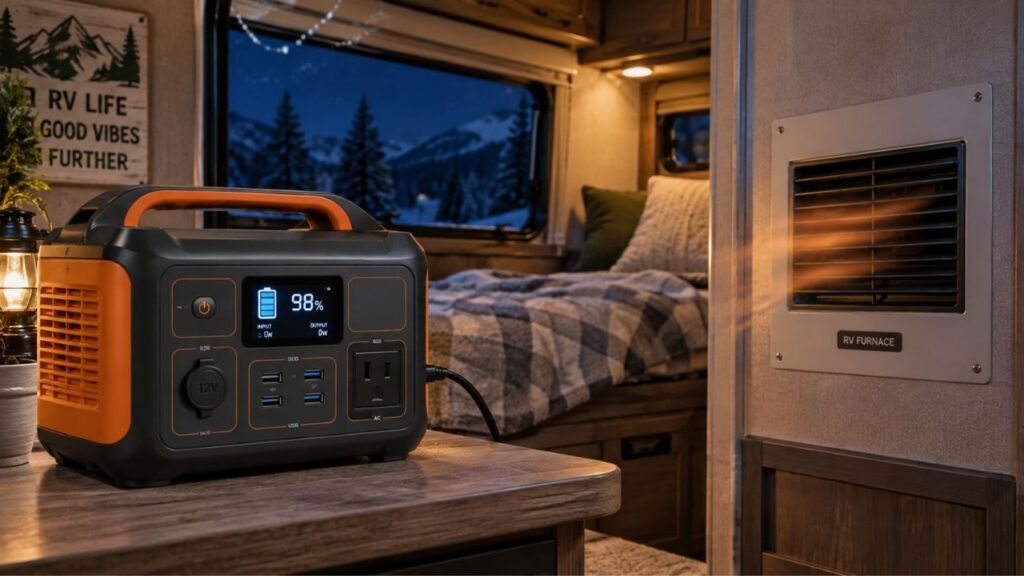
- RV air conditioners
- Conventional central air conditioners
- Certain heat pumps
- Air compressors
- Some well pumps
- Certain sump pumps
- Refrigeration compressors
- Other compatible AC motors
However, a motorized appliance is not automatically compatible.
The starter must support that particular compressor, voltage, current, and control system.
You should always check the starter manufacturer’s compatibility information first.
This becomes especially important with modern electronically controlled appliances.
Which Appliances Will Not Benefit From a Soft Starter?
A soft starter cannot reduce every type of electrical load. It specifically addresses certain motor-starting problems.
It generally will not help ordinary loads such as:
- Space heaters
- Electric kettles
- Toasters
- Coffee maker heating elements
- Electric resistance heaters
- Televisions
- Laptops
- Phone chargers
- LED lights
- Most small electronic devices
A space heater provides a useful example.
Suppose it continuously consumes 1,500 watts.
Its problem is not compressor startup current.
The heater simply needs approximately that much power whenever operating.
Adding a motor soft starter cannot change that requirement.
You would instead need a power station with enough continuous output.
Does an Inverter Air Conditioner Need a Soft Starter?
Many inverter air conditioners already control compressor startup electronically.
These systems operate differently from traditional fixed-speed compressors.
Instead of instantly switching a compressor to full operating speed, an inverter system can increase compressor speed gradually.
That usually produces a much smoother startup profile.
For this reason, you should not automatically add an external soft starter.
Some external soft starters may be unsuitable for inverter-driven compressors.
The two electronic control systems could also be incompatible.
Check your air conditioner’s technical information before adding anything.
If it already uses a variable-speed compressor, external soft starting may be unnecessary.
Soft Starter vs Hard-Start Kit: What’s the Difference?
These two devices are often confused, particularly around air conditioners. They address startup differently and should not be treated interchangeably.
Soft Starter
A soft starter controls how the motor accelerates.
Its goal is to reduce the harsh startup event.
For portable power station users, this can mean lower peak inverter demand.
The motor gradually reaches normal operating conditions.
Hard-Start Kit
A hard-start kit serves another purpose.
It typically provides additional starting assistance through capacitor-based components.
The goal is usually helping a struggling compressor start successfully.
That is different from deliberately limiting startup current.
Therefore, buying a hard-start kit does not automatically solve inverter overload problems.
Which One Helps a Portable Power Station?
When high compressor startup current overloads your station, soft starting is usually relevant.
You want to reduce the startup demand reaching the inverter.
A hard-start device and soft-start device should not be considered substitutes.
Always choose equipment designed for your actual electrical problem.
Soft Starter vs Power Station Surge Mode
A soft starter and inverter surge capacity solve opposite sides of one problem.
Think about them this way.
The portable power station’s surge rating answers this question:
How much temporary power can my inverter provide?
A soft starter addresses another question:
How much startup power will my appliance request?
Increasing inverter capability gives you more available startup power.
Soft starting reduces how much startup power the appliance demands.
Both can improve compatibility.
However, they do it differently.
A powerful station might start the appliance without any additional equipment.
A smaller station may require reduced compressor startup demand.
Neither approach eliminates the need for adequate continuous output.
How to Know Whether You Need a Soft Starter
Before buying anything, identify what actually causes the shutdown. This prevents spending money on equipment that cannot solve your problem.
Follow these checks:
- Find the appliance’s operating voltage.
- Check its running watts or rated current.
- Find available LRA or startup-current information.
- Check your station’s continuous AC output.
- Check the station’s surge or peak rating.
- Check how long peak output can be sustained.
- Verify that your appliance supports soft starting.
- Find expected or measured reduced startup current.
- Leave practical operating headroom where possible.
- Test everything before depending on emergency backup.
Start by checking running watts.
If normal running demand already exceeds the station’s continuous output, stop there.
A soft starter cannot solve that problem.
If continuous power fits but startup does not, investigate soft starting.
That is where these devices provide the greatest value.
Can You Calculate Whether a Soft Starter Will Make Your Setup Work?
You need to pass three separate compatibility checks. Passing only the startup test is not enough.
Check Continuous Output
Your appliance’s normal running demand must fit within inverter capacity.
A basic relationship is:
Appliance running watts < Power station continuous output
For example:
Appliance running load = 1,400 watts
Power station continuous rating = 2,000 watts
That basic continuous load fits.
Leaving additional capacity is still preferable, especially with other devices connected.
Check Reduced Startup Demand
Next, compare startup demand with the station’s temporary output capability.
You want:
Reduced startup demand < Supported inverter surge capability
Suppose the appliance originally needs 3,800 startup watts.
Your station supports only 2,500 surge watts.
Without soft starting, that combination likely fails.
Now suppose manufacturer-supported testing shows 1,800 watts after soft starting.
The startup demand may now fit within the inverter’s capability.
You still need to consider surge duration and operating conditions.
Do not blindly multiply startup watts by one universal percentage.
Check Voltage
Voltage compatibility is equally important.
A 120V appliance needs compatible 120V AC output.
A 240V appliance needs an appropriate 240V power setup.
A soft starter cannot convert 120V electricity into 240V electricity.
This often matters with larger:
- Central air conditioners
- Well pumps
- Heat pumps
- Workshop equipment
Always check voltage before comparing wattage numbers.
When a Soft Starter Still Will Not Make the Power Station Work
Soft starting solves one particular problem: excessive compatible motor startup demand. Several other limitations can still prevent operation.
A soft starter may not solve the problem when:
- Appliance running watts exceed continuous inverter capacity.
- Reduced startup demand still exceeds surge output.
- The appliance requires unsupported 240V power.
- The station cannot sustain surge power long enough.
- Multiple large appliances start simultaneously.
- The motor does not support that soft starter.
- The appliance already uses incompatible inverter controls.
- Extension cords create excessive voltage drop.
- Transfer equipment cannot support the required current.
- Other connected appliances consume available inverter capacity.
Consider a 3,000-watt continuous load connected to a 2,000-watt station.
Even a perfect startup would not solve the problem.
The station remains undersized for normal operation.
That is why I recommend checking continuous watts first.
Does a Soft Starter Increase Portable Power Station Runtime?
A soft starter normally provides little direct improvement to overall runtime.
Remember, its main job occurs during startup.
That event lasts only a short period compared with total appliance operation.
Once your compressor reaches normal speed, normal consumption resumes.
Power station runtime depends much more heavily on:
- Battery capacity in watt-hours
- Appliance running wattage
- Compressor duty cycle
- Inverter efficiency
- Other connected loads
- Temperature
- Power station operating losses
Suppose your air conditioner consumes around 1,000 watts while running.
Adding a soft starter does not suddenly turn it into a 500-watt appliance.
Your battery still supplies roughly its normal operating demand.
The starter simply makes each compressor start easier.
Does a Soft Starter Protect the Portable Power Station?
A soft starter can reduce repeated high startup demands reaching the inverter.
That can prevent unnecessary overload shutdowns when correctly matched.
However, I would avoid treating it as battery-protection equipment.
Its primary purpose is motor startup control.
You should not assume that adding one automatically extends battery lifespan.
The clearer benefit is reducing startup stress on the electrical supply.
For portable power stations, that means fewer inverter overload events.
It can also improve reliability when a compatible compressor cycles repeatedly.
Where Is a Soft Starter Installed?
Most appliance-specific soft starters are installed at the motorized equipment. They normally do not increase or modify the power station itself.
Common installation locations may include:
- RV rooftop air conditioner electrical compartments
- Residential HVAC condenser units
- Compatible compressor equipment
- Certain motor control compartments
Exact wiring depends entirely on the starter and appliance.
Do not assume installation instructions from one product apply to another.
Some installations involve compressor wiring and capacitors carrying dangerous voltage.
Always disconnect the equipment before servicing it.
Capacitors may also retain electrical charge after power disconnection.
For residential HVAC equipment, professional installation is often the safer choice.
An HVAC technician or qualified electrician can confirm compatibility and wiring.
You should also review warranty requirements before making modifications.
What Should You Check Before Buying a Soft Starter?
A compatible starter must match both your appliance and electrical system. Do not buy solely because its packaging mentions air conditioners.
Check these details first:
- Appliance type
- Compressor or motor design
- Fixed-speed or inverter-driven operation
- Operating voltage
- Rated current
- Locked Rotor Amps, when available
- Soft starter current limits
- Supported compressor size
- Manufacturer compatibility information
- Power station continuous output
- Power station surge output
- Available surge duration
- Warranty requirements
- Installation requirements
The power station side is only half the compatibility check.
Your soft starter must also work correctly with the appliance.
This is particularly important with larger residential HVAC equipment.
Is a Soft Starter Worth Using With a Portable Power Station?
A soft starter can be extremely useful in the right situation.
The best scenario looks like this:
Your portable power station comfortably supports normal running wattage.
However, the compressor’s startup surge exceeds the inverter’s temporary capability.
A compatible soft starter reduces that startup requirement enough to fit.
In that situation, the starter could make an otherwise unusable combination practical.
It may also save you from buying a much larger power station.
However, do not install one simply because an appliance contains a motor.
If your station already starts the appliance comfortably, you may gain little.
Likewise, soft starting cannot correct insufficient continuous wattage.
It cannot provide missing 240V output either.
Identify the actual limitation before deciding.
Conclusion
A soft starter helps a portable power station by making compatible motors easier to start.
It reduces the brief startup demand that can trigger inverter overload protection.
This is especially useful for conventional compressors in air conditioners and similar equipment.
However, a soft starter does not increase inverter capacity or battery size.
Your setup still needs enough continuous power for normal appliance operation.
It must also provide the correct voltage and sufficient surge duration.
Remember these three checks before relying on any setup:
Running watts, reduced startup demand, and correct voltage.
If all three fit, a soft starter can make a major difference.
Related FAQs
Can a Soft Starter Make a Smaller Portable Power Station Run an Air Conditioner?
It sometimes can when compressor startup surge is the main limitation. The station must still provide enough continuous wattage after the air conditioner starts.
Does a Soft Starter Reduce Running Watts?
A soft starter mainly reduces electrical demand during motor startup. Once the motor reaches normal operating speed, running consumption remains relatively similar.
How Much Does a Soft Starter Reduce AC Startup Current?
The reduction depends on the compressor, starter, voltage, temperature, and operating conditions. Some compatible HVAC systems can achieve substantial reductions, but results should never be assumed universally.
Can You Plug a Soft Starter Directly Into a Portable Power Station?
Most HVAC-specific soft starters install at the appliance rather than plugging directly into the station. Installation style depends on the particular starter and equipment.
Does a Soft Starter Work With a 240V Appliance?
Yes, compatible soft starters exist for certain 240V equipment. However, your portable power setup must still provide the required 240V supply.
Can You Use a Soft Starter With an Inverter Air Conditioner?
Not automatically. Inverter air conditioners already electronically control compressor startup, so an external starter may be unnecessary or incompatible with the existing system.
Is a Soft Starter the Same as a Hard-Start Capacitor?
No. A soft starter controls motor acceleration to reduce startup demand, while a hard-start device generally provides additional assistance to help a compressor start.
Will a Soft Starter Stop a Portable Power Station From Overloading?
It can prevent overload caused by compatible motor startup current. It cannot prevent overload when the appliance’s continuous power demand exceeds the station’s normal inverter rating.
Can a Soft Starter Help an RV Air Conditioner Run on a Power Station?
Yes, compatible RV air conditioners are common soft-start applications. The station must still meet the AC’s normal running watts, voltage, and reduced startup requirements.
Does a Soft Starter Increase a Portable Power Station’s Wattage?
No. The portable power station keeps the same inverter specifications. The soft starter lowers the motor’s startup demand instead of increasing available output.

Warren Turner writes practical guides and reviews on generators, portable power stations, and battery backup systems. He focuses on real-world performance, everyday power needs, and helping readers choose dependable equipment without unnecessary complexity.