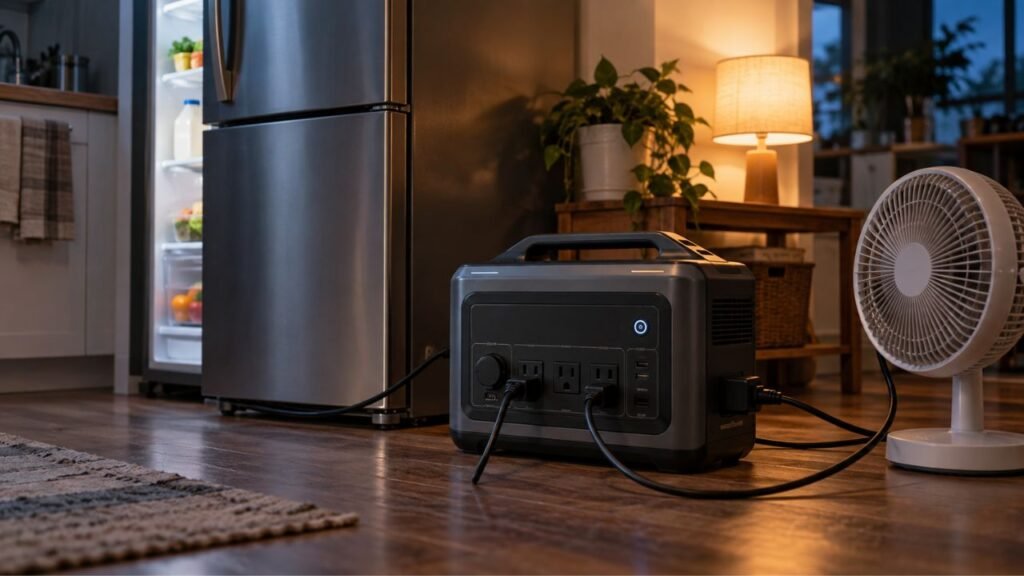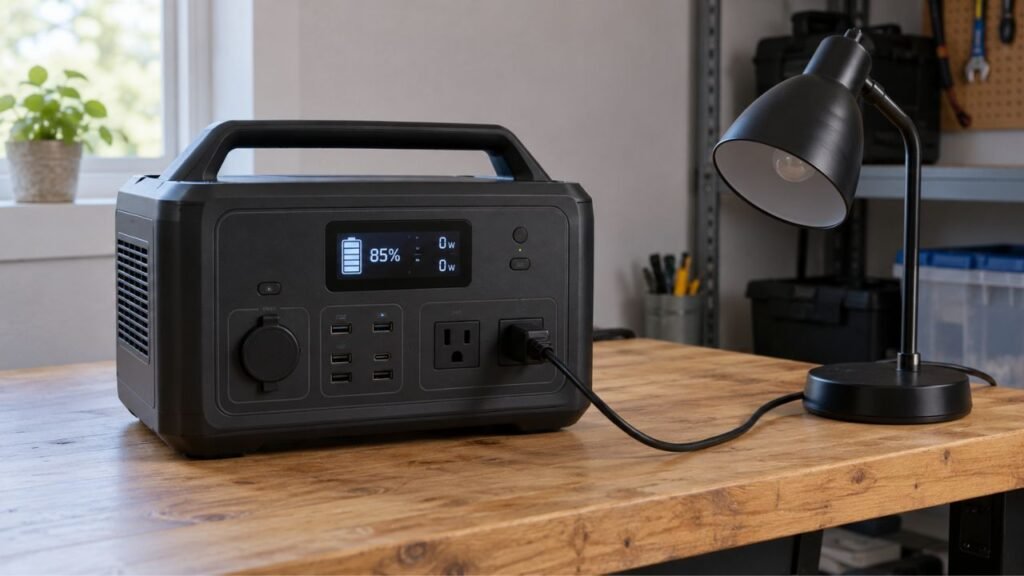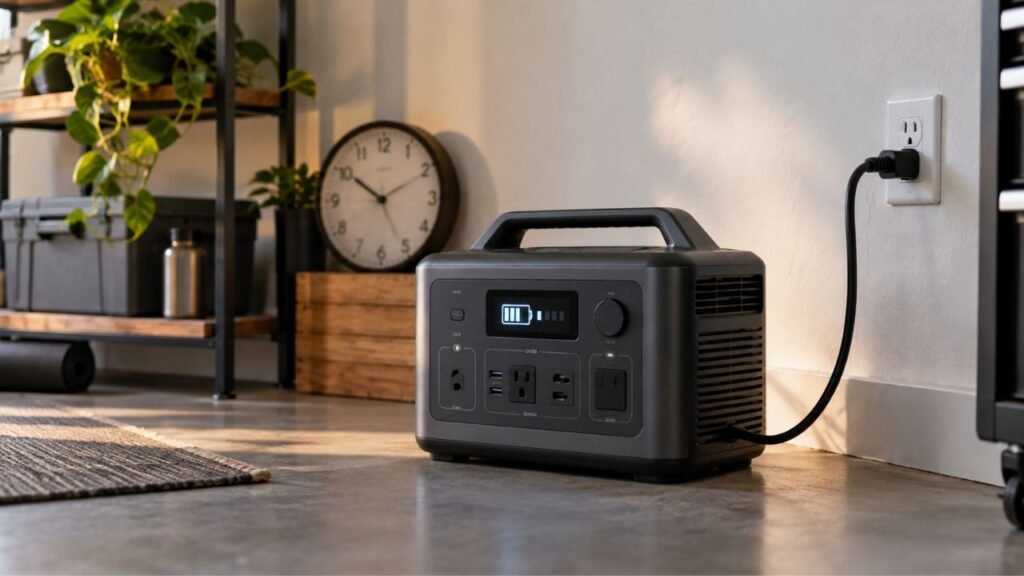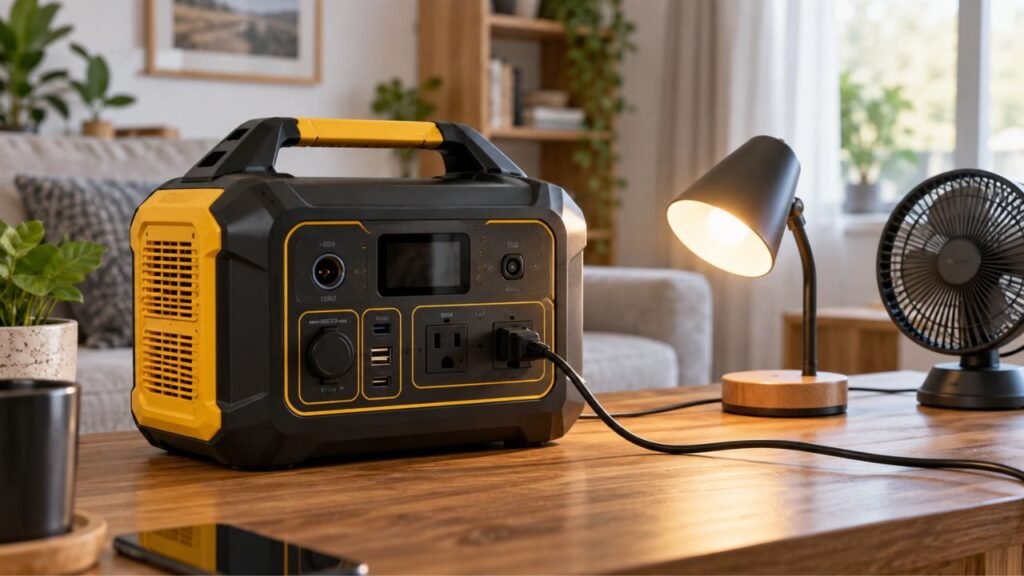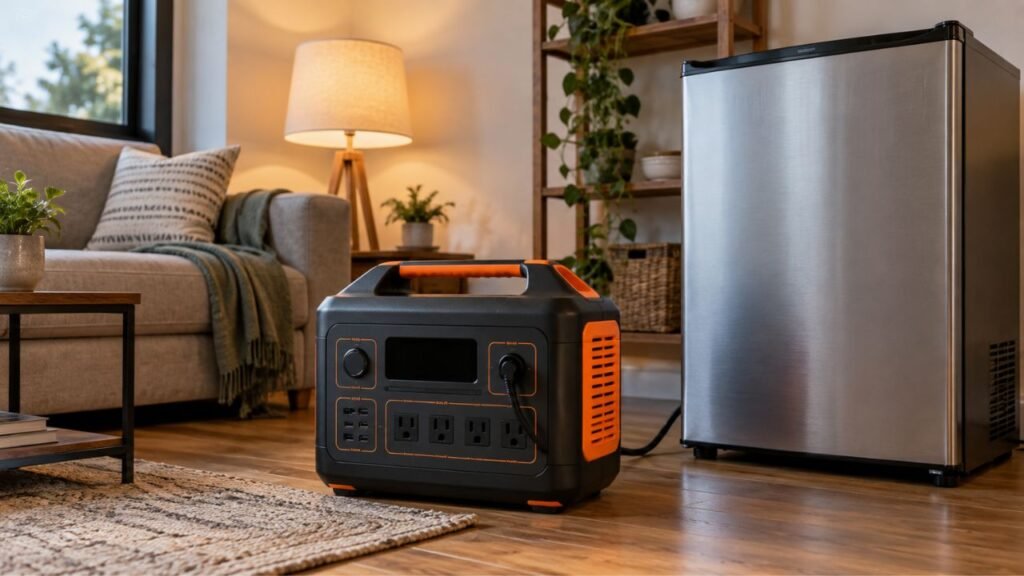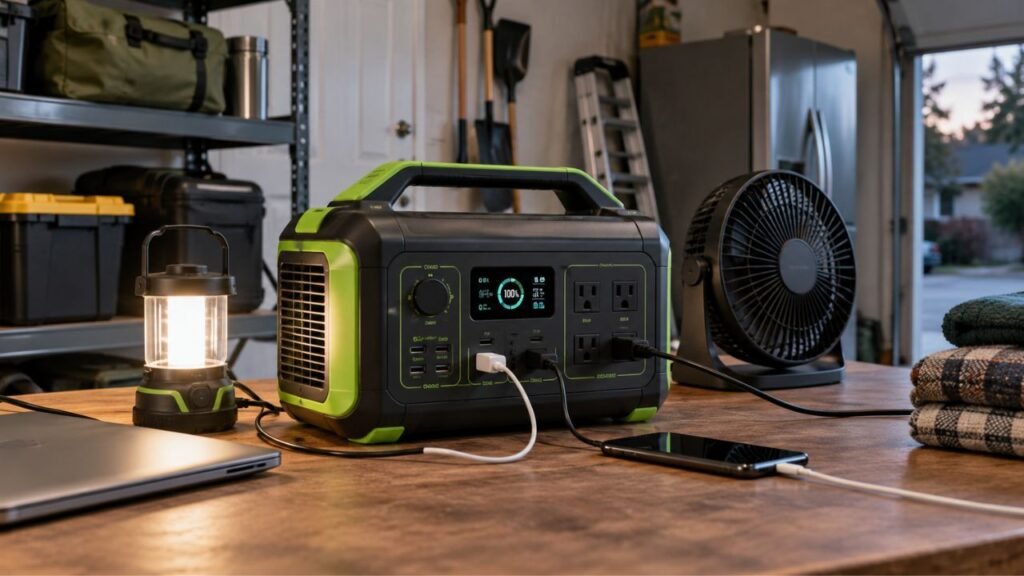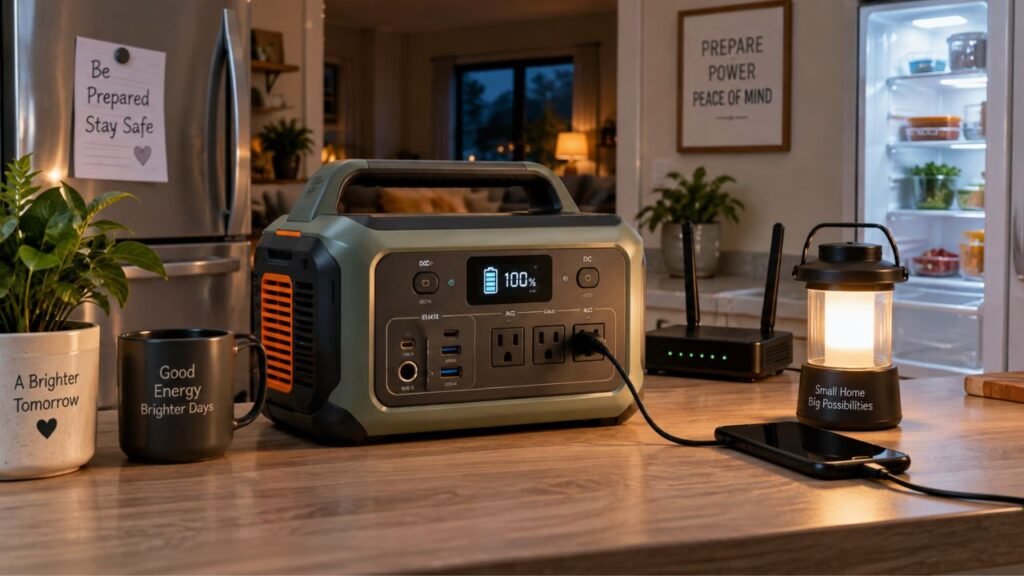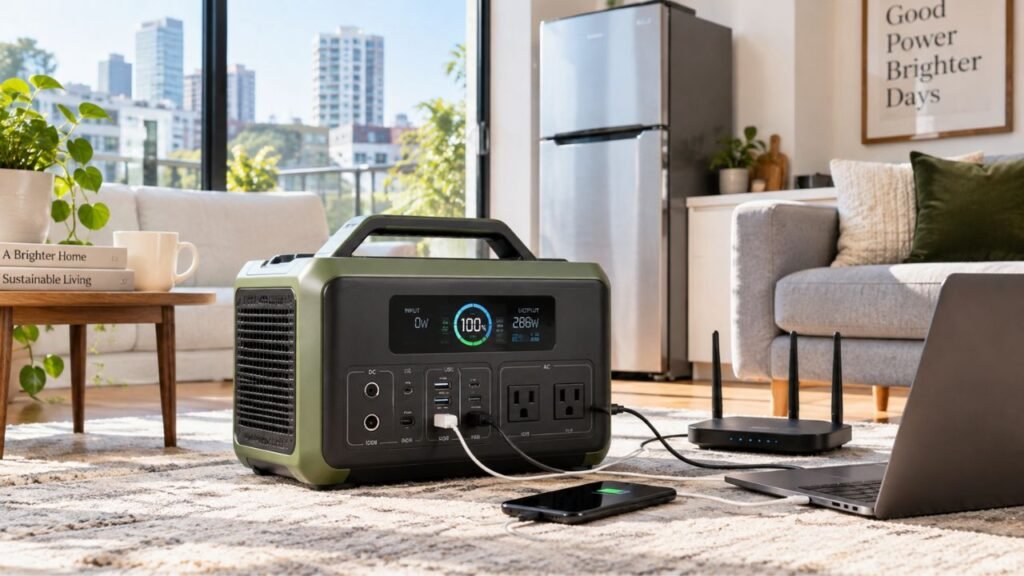
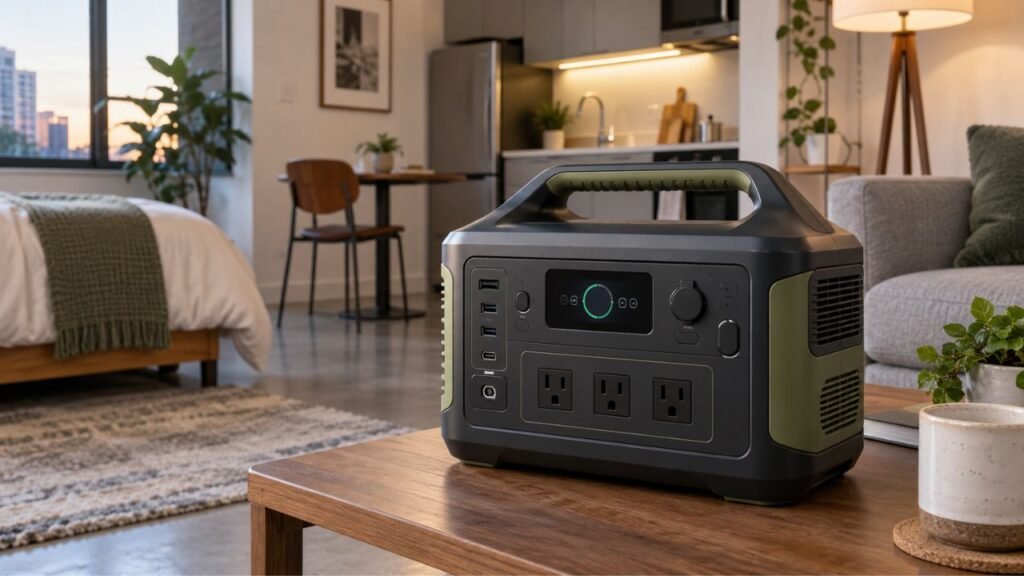
A studio apartment usually needs 500Wh to 1,000Wh for basic emergency backup. Consider 1,000Wh to 2,000Wh if you want refrigerator backup, overnight medical equipment, or longer runtime during an outage.
The right size depends more on your appliances than apartment square footage. Below, I’ll help you calculate your needs, compare capacity ranges, and avoid buying too little or too much battery storage.
Key Takeaways
- 300Wh to 500Wh works for phones, Wi-Fi, lights, and light laptop use.
- 500Wh to 1,000Wh suits most basic studio apartment backup plans.
- 1,000Wh to 1,500Wh gives more room for refrigerator backup.
- 1,500Wh to 2,000Wh makes sense for longer outages and multiple essentials.
- Battery capacity in Wh determines runtime, while inverter watts determine supported loads.
- Your appliance list matters more than your studio apartment’s square footage.
- Always leave some extra capacity instead of sizing your battery exactly.
How Much Portable Power Station Capacity Does a Studio Apartment Actually Need?
For most studio apartments, I would start around the 500Wh to 1,000Wh range. That provides enough stored energy for communication devices, lighting, internet, laptop use, and several other small essentials.
| Portable Power Station Capacity | Best Studio Apartment Use | Typical Loads | Main Limitation |
| 300–500Wh | Short emergency backup | Phones, router, LED lights, laptop | Limited refrigerator runtime |
| 500–750Wh | Basic essentials | Electronics, lights, fan, laptop | Tight for refrigeration |
| 750–1,000Wh | Typical studio backup | Router, office equipment, fan, limited fridge use | Longer outages require careful load management |
| 1,000–1,500Wh | Refrigerator-focused backup | Fridge, Wi-Fi, lights, phones, laptop | Runtime varies greatly by refrigerator |
| 1,500–2,000Wh | Strong overnight backup | Fridge, CPAP, router, fan, electronics | Heavier and more expensive |
| 2,000Wh+ | Longer emergency backup | Multiple essentials for extended periods | More weight, cost, and storage space |
These ranges are planning guidelines rather than guaranteed runtimes. Two apartments using the same battery can experience very different results.
A resident powering only Wi-Fi and electronics needs relatively little energy. Someone running a refrigerator and medical equipment could need several times more.
That is why I recommend starting with your appliance list first.
Does Studio Apartment Size Determine How Much Battery Capacity You Need?
Your studio apartment’s square footage does not directly determine battery capacity. Electricity use depends on the devices you choose to support.
A 350-square-foot apartment could require a 2,000Wh power station. Meanwhile, someone living in 600 square feet might comfortably use 500Wh.
The difference comes down to the appliances involved.
Imagine one resident wants backup for a router, phone, laptop, and lamp. Those devices consume relatively little energy during several hours.
Another resident wants a refrigerator, CPAP machine, fan, router, and laptop running overnight. That load requires considerably more stored energy.
Instead of asking how large your apartment is, ask yourself:
What absolutely needs electricity when the grid goes down?
Once you answer that question, calculating capacity becomes much easier.
What Devices Do You Actually Need During a Studio Apartment Blackout?
Before choosing battery capacity, separate necessary equipment from convenience appliances. Running everything normally can drain even a large power station surprisingly quickly.
Communication and Lighting
Phones, Wi-Fi equipment, and LED lighting are excellent backup priorities. They provide communication and visibility while consuming relatively little power.
A modem and router might operate continuously during an outage. Your phone may only need one or two complete charges.
LED lamps also require very little energy compared with traditional bulbs.
If these are your main priorities, you might not need a huge power station.
Work-From-Home Equipment
Working from home changes your backup requirements somewhat.
A typical emergency setup might include:
- Laptop
- External monitor
- Wi-Fi router
- Phone charger
- Desk lamp
Laptops are usually much easier to support than desktop computers.
A powerful desktop computer, gaming PC, or multiple monitors can increase consumption substantially. Check your actual equipment before assuming an average wattage.
If work is important during outages, consider how many hours you realistically need.
Four hours of backup requires much less energy than an entire workday.
Refrigerator
Your refrigerator is often the biggest reason to increase battery capacity.
However, refrigerators should not be calculated like constant loads.
The compressor turns on and off throughout the day. Energy consumption changes with room temperature, refrigerator age, thermostat settings, door openings, and food load.
That means multiplying the refrigerator’s maximum wattage by 24 hours usually gives an unrealistic number.
A better approach is checking its EnergyGuide information or measuring actual consumption with a plug-in energy meter.
For example, suppose your refrigerator uses about 400 kWh yearly.
Divide that by 365 days:
400 kWh ÷ 365 = about 1.1 kWh daily
That equals roughly 1,100Wh per day under average conditions.
During a 12-hour outage, average energy consumption might therefore be around half that amount. Actual usage can still vary significantly.
Also check compressor startup demand. A refrigerator can briefly require considerably more power during startup than while running normally.
CPAP or Other Medical Equipment
Medical equipment deserves more careful planning than ordinary household electronics.
Do not size backup power using a random CPAP wattage found online. Different machines can consume noticeably different amounts of power.
Humidifiers and heated tubing can also increase consumption.
Check your exact device’s specifications and approved backup-power guidance. Then calculate enough energy for the entire required treatment period.
If an electrically powered medical device is essential, I recommend leaving additional reserve capacity.
A power station should support your emergency plan rather than become the only plan.
Fans and Other Comfort Devices
Small fans can make a studio apartment much more comfortable during warm-weather outages.
A modest fan may require relatively little power compared with air conditioning. That makes fans much easier to support overnight.
Televisions and small speakers can also fit into many backup plans.
Just remember that every optional device reduces your remaining runtime.
During a longer outage, I would prioritize communication, refrigeration, medical needs, and lighting first.
How Do You Calculate Portable Power Station Capacity for a Studio Apartment?
You do not need an advanced electrical calculator for basic sizing. A simple appliance list and a few calculations can get you close.
Step 1: Find Each Device’s Actual Wattage
Look at the appliance label, power adapter, manual, or manufacturer specifications.
You may see watts listed directly.
Sometimes you will see volts and amps instead. In simple cases, watts can be estimated using:
Watts = Volts × Amps
For variable appliances such as refrigerators, measured energy use is usually more helpful.
Step 2: Estimate How Many Hours You Will Use It
Do not assume every appliance operates throughout the outage.
Think realistically.
Your router might stay on for 12 hours.
Your laptop might only need four hours.
LED lights might run five hours.
A phone charger might operate for two hours.
A microwave could run for only several minutes.
Making realistic estimates prevents unnecessary oversizing.
Step 3: Calculate Watt-Hours
For devices with fairly steady consumption, use:
Watts × Hours = Watt-Hours
Suppose your laptop averages 60 watts for five hours:
60W × 5 hours = 300Wh
The laptop therefore needs around 300Wh of stored energy before accounting for conversion losses.
Step 4: Add Every Device Together
Repeat the calculation for your essential devices.
Suppose you calculate:
Laptop: 240Wh
Router: 180Wh
Lights: 75Wh
Phone: 30Wh
Fan: 210Wh
Your total becomes:
240 + 180 + 75 + 30 + 210 = 735Wh
You now have your baseline energy requirement.
Step 5: Account for Power Station Losses
A 1,000Wh battery does not normally provide exactly 1,000Wh through its AC outlets.
Some energy is consumed by the inverter and internal electronics.
Real efficiency varies by power station, load size, temperature, and connection type.
For simple planning, you might assume around 85% usable AC energy.
Using our 735Wh example:
735Wh ÷ 0.85 = about 865Wh
That means buying exactly a 735Wh unit would probably leave you short.
A power station near the 1,000Wh class makes much more sense.
Step 6: Add Some Reserve Capacity
I would avoid designing an emergency power plan with zero margin.
Unexpected things happen during outages.
You may use your laptop longer.
Your refrigerator may cycle more frequently.
Someone may need another phone charged.
Cold or hot temperatures may affect battery performance.
The outage may also last longer than expected.
Having some reserve means you are not relying on perfect assumptions.
Studio Apartment Portable Power Station Example Calculation
Here is a simple example for someone who wants basic overnight backup without running a refrigerator.
| Essential Device | Planned Power | Usage | Estimated Energy |
| Wi-Fi router/modem | 15W | 12 hours | 180Wh |
| Laptop | 60W | 4 hours | 240Wh |
| LED lighting | 15W | 5 hours | 75Wh |
| Phone charging | 15W | 2 hours | 30Wh |
| Fan | 35W | 6 hours | 210Wh |
| Total | 735Wh |
Our estimated load requires 735Wh before conversion losses.
Assuming about 85% usable capacity:
735Wh ÷ 0.85 = approximately 865Wh
I would therefore look around the 1,000Wh capacity class for this specific setup.
That gives some breathing room without moving immediately into a large 2,000Wh unit.
Remember that this example does not include refrigeration.
Adding a refrigerator could change the answer considerably.
How Much Capacity Do You Need for an 8-Hour, Overnight, or 24-Hour Outage?
Outage duration can change your battery requirement almost as much as appliance selection. Supporting essentials for four hours is very different from supporting them for an entire day.
4–8 Hour Outage
For short outages, 300Wh to 750Wh can work surprisingly well.
You may have enough capacity for:
- phones
- Wi-Fi
- laptop use
- LED lighting
- small fan
You may not need to immediately power every appliance either.
For example, keeping the refrigerator closed during a short outage can preserve cold air for several hours.
This allows you to save battery energy for communication and lighting first.
8–12 Hour Overnight Outage
For overnight coverage, I would usually consider 750Wh to 1,500Wh.
The lower end works well for electronics, lighting, and fans.
Move upward when adding refrigeration or overnight medical devices.
Your sleeping-hour requirements matter here.
Someone needing a CPAP throughout the night should calculate that load before allocating capacity elsewhere.
12–24 Hour Outage
A longer outage can easily push a studio toward 1,500Wh to 2,000Wh or more.
Refrigeration becomes increasingly important.
You may also need repeated laptop charging, internet access, lighting, phone charging, and overnight comfort.
Energy management becomes important at this point.
You do not necessarily need every appliance connected simultaneously.
Multi-Day Outage
For multi-day outages, battery capacity alone stops being the whole answer.
Eventually, even a large power station becomes empty.
You then need a reliable recharging strategy.
Depending on your building and equipment, that might include AC charging when grid power temporarily returns, compatible solar charging, vehicle charging, or expansion batteries.
A 2,000Wh unit you can recharge is often more useful than a larger battery you cannot replenish.
How Much Extra Capacity Does a Refrigerator Add?
A refrigerator can significantly increase the capacity needed for studio apartment backup.
Unfortunately, there is no single refrigerator wattage that produces an accurate answer.
One refrigerator may consume much less energy than another.
Efficiency, size, age, room temperature, and usage habits all matter.
For the best estimate, check the refrigerator’s annual energy consumption.
Suppose the label shows 365 kWh per year.
That averages:
365 kWh ÷ 365 days = 1 kWh daily
That equals about 1,000Wh per day.
A 12-hour average would roughly equal 500Wh before battery-system losses.
Actual operation will not divide perfectly into equal hourly amounts, but this gives you a useful planning estimate.
Now add your other essentials.
If your refrigerator needs roughly 500Wh during your target period, while electronics require another 500Wh, your total already approaches 1,000Wh.
After accounting for losses and reserve, a 1,500Wh class station may make more sense.
Also verify inverter startup capability.
Battery capacity means little if the inverter cannot start the refrigerator compressor.
Don’t Confuse Battery Capacity With Inverter Output
Battery capacity and inverter output answer two completely different questions. You need to check both before buying any portable power station.
Watt-Hours Determine Runtime
Watt-hours tell you how much energy the power station stores.
A 1,000Wh station contains roughly twice the stored energy of a 500Wh station.
That usually means longer runtime under the same load.
However, usable energy reaching your appliances will normally be lower than the advertised battery capacity.
Watts and Surge Watts Determine What You Can Run
The inverter’s watt rating tells you how much AC power the station can provide at one time.
Suppose you own a 2,000Wh power station with only a 500W inverter.
It has plenty of stored energy.
However, it still cannot continuously power a 1,000W appliance.
Startup surge also matters.
Motor-driven appliances can briefly demand much more power when starting.
That makes refrigerator compatibility especially important.
Always check both:
Battery capacity in Wh
and
Continuous plus surge output in watts
What Size Inverter Should a Studio Apartment Power Station Have?
Your inverter should comfortably exceed the highest combined wattage you expect to use simultaneously.
For a basic electronics-only apartment setup, your simultaneous load might remain quite low.
A router, laptop, phone charger, lights, and fan could all operate below a few hundred watts.
Things change quickly once you introduce kitchen appliances.
A coffee maker, microwave, kettle, hair dryer, or toaster can use much more power.
You should therefore calculate your likely overlap.
Imagine your refrigerator is running while you start a microwave.
The inverter must handle both loads at that moment.
Choose a continuous output rating above your expected simultaneous load.
Then verify that its surge rating supports motor-starting requirements.
More inverter power does not automatically mean longer runtime.
A large inverter simply lets you operate larger or more devices simultaneously.
Which Apartment Appliances Drain a Portable Power Station Too Quickly?
Some appliances can technically operate from a portable power station but consume battery energy too quickly for practical emergency use.
Common examples include:
- Space heaters
- Portable air conditioners
- Electric kettles
- Hair dryers
- Toaster ovens
- Electric cooktops
- Large microwaves
- High-performance gaming computers
A 1,500W space heater illustrates the problem.
If it continuously draws around 1,500 watts, even a large battery can discharge rapidly.
Heating and cooling usually require much more energy than phones, routers, laptops, and lighting.
During a blackout, ask whether operating a high-draw appliance is worth sacrificing several hours of essential-device runtime.
Being able to run something does not automatically mean you should.
Is 500Wh Enough for a Studio Apartment?
A 500Wh portable power station can be enough for a studio apartment if your backup plan stays simple.
It works best for loads such as phones, Wi-Fi, LED lighting, tablets, and limited laptop use.
You may also operate a small fan for several hours.
However, 500Wh becomes restrictive when refrigeration enters the plan.
After conversion losses, your usable AC energy is already below the advertised capacity.
Trying to run a refrigerator, laptop, router, fan, and lights overnight could drain the station faster than expected.
For basic communication backup, 500Wh is useful.
For broader apartment backup, I would generally move closer to 1,000Wh.
Is 1,000Wh Enough for a Studio Apartment?
A 1,000Wh power station is probably the most practical starting point for many studio apartment residents.
It offers enough stored energy for a useful mix of electronics.
You could support Wi-Fi, lighting, phone charging, laptop work, and a fan while still maintaining some reserve.
Refrigerator backup becomes more realistic in this range too.
However, refrigerator consumption needs to be measured or estimated carefully.
A highly efficient refrigerator might leave plenty of capacity for other devices.
An older or larger refrigerator may consume a significant portion of your available battery.
So yes, 1,000Wh can be enough for many studio apartments.
Just do not assume it will automatically run everything overnight.
When Does a Studio Apartment Need 1,500Wh to 2,000Wh?
Moving into the 1,500Wh to 2,000Wh range makes sense when your outage plan becomes more demanding.
Consider this capacity range when:
- Refrigerator backup is a major priority.
- A CPAP or other medical device must operate overnight.
- You need internet and computer access for many hours.
- Two people need devices charged.
- Outages regularly last overnight.
- Recharging opportunities are limited.
- You want additional emergency reserve.
- Several essential loads may operate simultaneously.
The main tradeoffs are cost and physical size.
Larger batteries can become surprisingly heavy.
That matters more in apartments than many buying guides acknowledge.
If you live upstairs without an elevator, consider whether you can safely move the power station when necessary.
Also measure the area where you plan to store it.
Studio apartment space is valuable.
Can You Buy Too Much Portable Power Station Capacity for a Studio?
Yes, buying the largest battery you can afford is not always the best decision.
A 3,000Wh or 5,000Wh system sounds reassuring.
But larger capacity brings several compromises.
The unit becomes heavier.
It occupies more floor or storage space.
It costs more.
Charging can require more time.
Moving it during an emergency may become difficult.
You may also discover that you rarely use most of that capacity.
Suppose your calculated overnight requirement is only 700Wh.
Buying a 5,000Wh system mainly for short local outages might be unnecessary.
A smaller 1,000Wh or 1,500Wh unit could cover the same important loads more conveniently.
Size for the emergency you realistically expect.
Then leave reasonable reserve rather than several days of unused capacity.
Would an Expandable Power Station Make More Sense Than a Larger Battery?
An expandable power station can make sense when you are uncertain about future capacity needs.
You can begin with a manageable base unit.
If your backup requirements increase later, you may add compatible expansion batteries.
This approach can work well in apartments because the main power station remains easier to handle.
It can also avoid paying for several thousand watt-hours immediately.
Expansion makes particular sense when your needs may change.
You might move to a larger apartment.
You might add refrigerator backup.
Your area’s outages might become longer.
You may begin working from home more frequently.
Just check expansion options before buying the base station.
Battery packs are usually designed for specific power station families.
You cannot assume any battery will work with any power station.
How Can You Make a Smaller Power Station Last Longer in an Apartment?
You can often stretch battery runtime considerably without buying more capacity. The key is deciding what deserves power first.
- Prioritize medical devices, communication, and refrigeration.
- Charge phones and laptops before severe weather arrives.
- Keep refrigerator and freezer doors closed whenever possible.
- Use efficient LED lighting instead of unnecessary room lighting.
- Avoid space heaters and high-wattage cooking appliances.
- Run high-draw devices only when genuinely necessary.
- Use your laptop’s internal battery before recharging it.
- Disconnect equipment that is not being used.
- Use efficient USB or DC connections when appropriate.
- Turn off unused power station outputs when recommended.
Small changes matter more during long outages.
Saving 100Wh early could provide several additional hours of router, phone, or lighting backup later.
What Should You Look for Besides Battery Capacity?
Capacity is important, but it should not be your only buying specification. Apartment backup requires a balanced power station.
Pure Sine Wave AC Output
Pure sine wave output is commonly preferred for sensitive electronics and many household devices.
It provides AC electricity designed to resemble standard household power more closely.
Still, never assume compatibility with medical equipment based only on inverter type.
Check the equipment manufacturer’s requirements.
Continuous and Surge Output
Make sure the station can handle your largest expected simultaneous load.
Then check startup surge for refrigerators and other motor-driven appliances.
Buying plenty of Wh without enough inverter output creates a mismatched system.
Battery Chemistry
Many modern portable power stations use LiFePO4 batteries.
They are popular because they can offer long cycle life and good durability.
Battery chemistry alone does not determine overall product quality, though.
Battery management, thermal design, charging controls, and manufacturing quality still matter.
Safety Certification
Look for reputable products tested to applicable safety standards.
Avoid unknown battery products simply because they offer unusually high capacity for a very low price.
Portable power stations store considerable energy.
Quality electronics, battery management, and safe charging behavior matter.
Also check current recalls before purchasing or continuing to use older equipment.
Weight and Physical Size
This matters more in a studio than many people expect.
Measure your intended storage location.
Consider whether the power station blocks walkways or emergency exits.
Also check whether you could safely carry it downstairs.
A 2,000Wh power station can be much less convenient than a 500Wh model.
Recharge Speed
Fast AC charging becomes extremely valuable during unstable grid conditions.
Imagine electricity returns for only several hours before another outage.
A station capable of recharging quickly gives you a better chance of restoring useful capacity.
Check actual charging specifications rather than relying only on phrases like “fast charging.”
UPS or Backup Switching
Some portable power stations offer backup or UPS-style operation.
This can be useful for routers, computers, and other electronics.
However, transfer times and supported loads differ among products.
Do not assume every backup mode behaves like a dedicated computer UPS.
Verify requirements for any equipment where even a brief interruption matters.
Where Should You Store and Use a Portable Power Station in a Studio Apartment?
A portable power station is easier to use indoors than a fuel-burning generator because it produces no combustion exhaust. However, it is still a large rechargeable battery that should be handled properly.
Keep it somewhere dry, stable, and easy to access.
Follow the manufacturer’s required ventilation clearances.
Do not cover cooling vents during charging or heavy operation.
Avoid areas exposed to extreme heat, water, or direct sunlight.
Do not use damaged batteries, cables, plugs, or chargers.
If the case becomes swollen, damaged, unusually hot, or behaves abnormally, stop using the unit and follow manufacturer safety guidance.
Your power station should also remain clear of exits and walkways.
That is especially important inside a small studio.
If you rent, review your building or lease requirements when necessary.
A good backup system should improve emergency preparedness without creating another hazard.
How to Choose the Right Capacity for Your Studio Apartment
The easiest way to choose is to work backward from your emergency routine rather than shopping by battery size first.
- List the devices you absolutely need during an outage.
- Find the actual wattage or energy consumption of each device.
- Estimate how many hours each device will operate.
- Calculate the required watt-hours.
- Add your device energy requirements together.
- Account for inverter and system losses.
- Leave some reserve for unexpected usage.
- Calculate your maximum simultaneous running watts.
- Check refrigerator or appliance startup surge requirements.
- Decide how long you must operate between recharges.
- Choose the next practical battery size above your requirement.
- Check weight, dimensions, charging speed, and safety features.
Do this before comparing brands or model names.
A calculated 850Wh requirement points toward roughly the 1,000Wh class.
A calculated 1,250Wh requirement probably deserves something closer to 1,500Wh.
This method is much more reliable than choosing based on apartment size.
So, What Capacity Is Best for Most Studio Apartments?
For light emergency backup, 500Wh to 1,000Wh is usually the most useful range. It can keep communication devices, lights, internet equipment, and laptops operating without taking up excessive apartment space.
Around 1,000Wh is a particularly practical starting point for many people. It offers noticeably more flexibility while remaining much easier to store than the largest home-backup units.
Move toward 1,500Wh to 2,000Wh when refrigeration, medical devices, overnight runtime, or longer outages become priorities.
The most important rule is simple:
Do not size the battery from your apartment’s square footage. Size it from the energy your essential devices actually consume.
Conclusion
A studio apartment does not automatically need a tiny portable power station. Your required capacity depends on the devices you want running and how long the outage lasts.
For basic electronics, 500Wh to 1,000Wh can work well. Refrigerator backup, medical equipment, or longer outages can push your needs toward 1,500Wh to 2,000Wh.
Calculate your watt-hours first, account for losses, check inverter output, and leave some reserve. That approach gives you a backup system that actually matches your apartment instead of relying on guesswork.
Related FAQs
How Many Watt-Hours Does a Studio Apartment Use During a Power Outage?
There is no fixed watt-hour number because your entire apartment does not need backup power. Calculate only essential devices, multiply their wattage by operating time, then account for battery-system losses.
Is a 500Wh Power Station Enough for an Apartment?
A 500Wh station can work for phones, Wi-Fi, LED lights, and limited laptop use. It becomes much less suitable when refrigeration, medical equipment, or long overnight runtime is required.
Is a 1,000Wh Power Station Enough for an Apartment Refrigerator?
It can be, depending on your refrigerator’s actual energy consumption and the other devices connected. Check daily refrigerator energy use and compressor startup requirements before estimating runtime.
How Long Will a 1,000Wh Portable Power Station Last in an Apartment?
Runtime depends entirely on the connected load. Divide usable battery capacity by average load wattage to estimate runtime, remembering that usable AC capacity is lower than the advertised 1,000Wh.
Is 2,000Wh Too Much for a Studio Apartment?
Not necessarily. A 2,000Wh station can make sense for refrigerator backup, overnight medical devices, remote work, or longer outages, although its weight and storage requirements may be excessive for basic electronics.
What Size Portable Power Station Do I Need for a Refrigerator and Wi-Fi?
A refrigerator and Wi-Fi setup often pushes buyers toward roughly 1,000Wh to 2,000Wh, but actual refrigerator consumption determines the answer. Measure or estimate its daily energy use before choosing capacity.
Can a Portable Power Station Run a Studio Apartment Overnight?
Yes, if you limit the load to essential devices and size the battery appropriately. Running every appliance normally overnight would require considerably more capacity than supporting a refrigerator, router, lights, and electronics.
Can a Portable Power Station Run a Studio Apartment Air Conditioner?
Some larger power stations can operate compatible window or portable air conditioners. However, air conditioning has high running and startup demands, so it can drain battery capacity much faster than typical apartment essentials.
Should I Get One Large Power Station or Two Smaller Ones?
One large unit is simpler when several appliances need shared capacity. Two smaller stations offer easier portability and some redundancy, although they may cost more per watt-hour and cannot automatically combine their inverter output.
How Much Reserve Capacity Should I Add?
Avoid choosing a battery that exactly matches your calculated energy requirement. Leaving roughly 10–20% additional capacity can help cover efficiency losses, unexpected usage, changing appliance loads, and longer-than-planned outages.

Warren Turner writes practical guides and reviews on generators, portable power stations, and battery backup systems. He focuses on real-world performance, everyday power needs, and helping readers choose dependable equipment without unnecessary complexity.