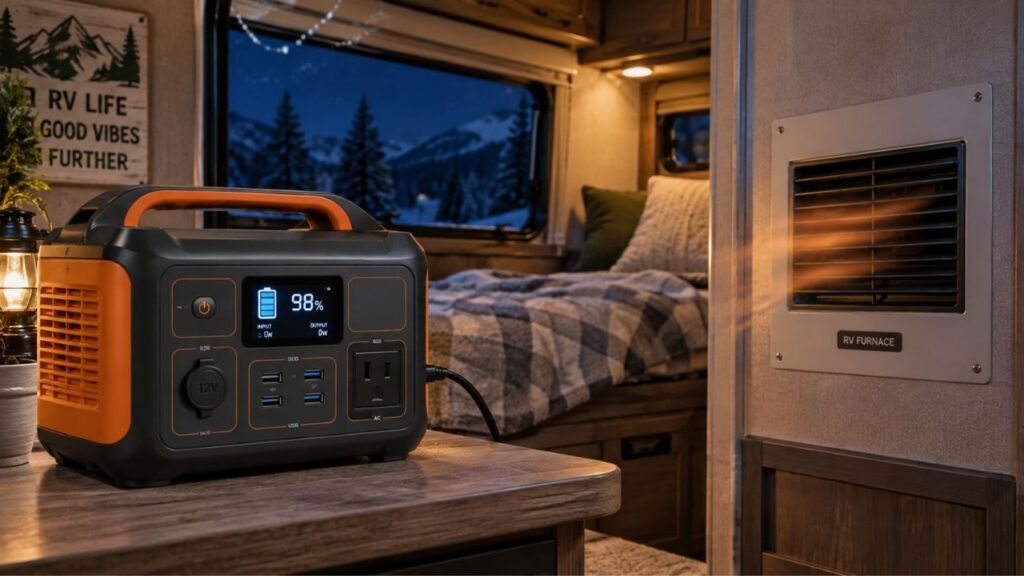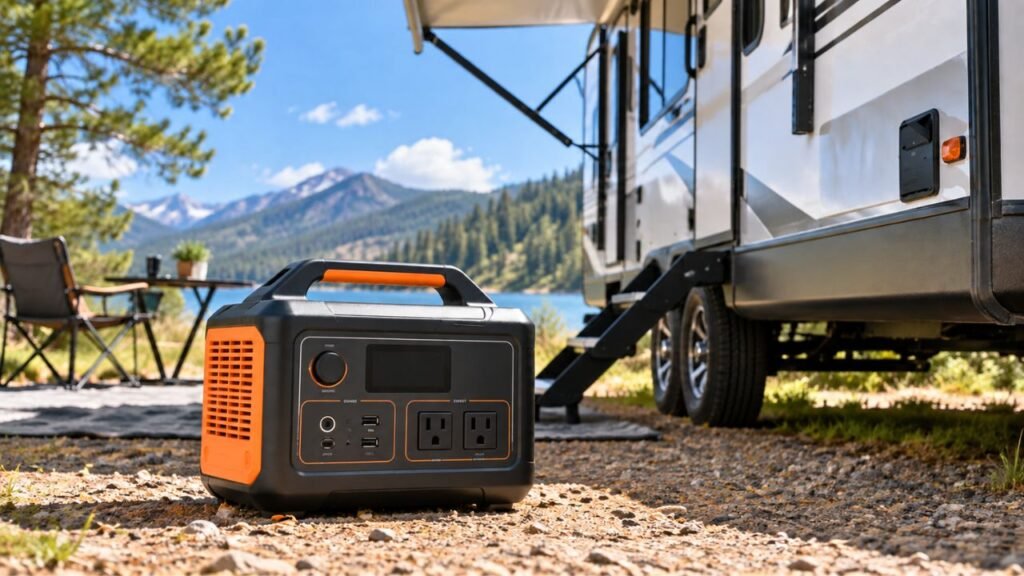
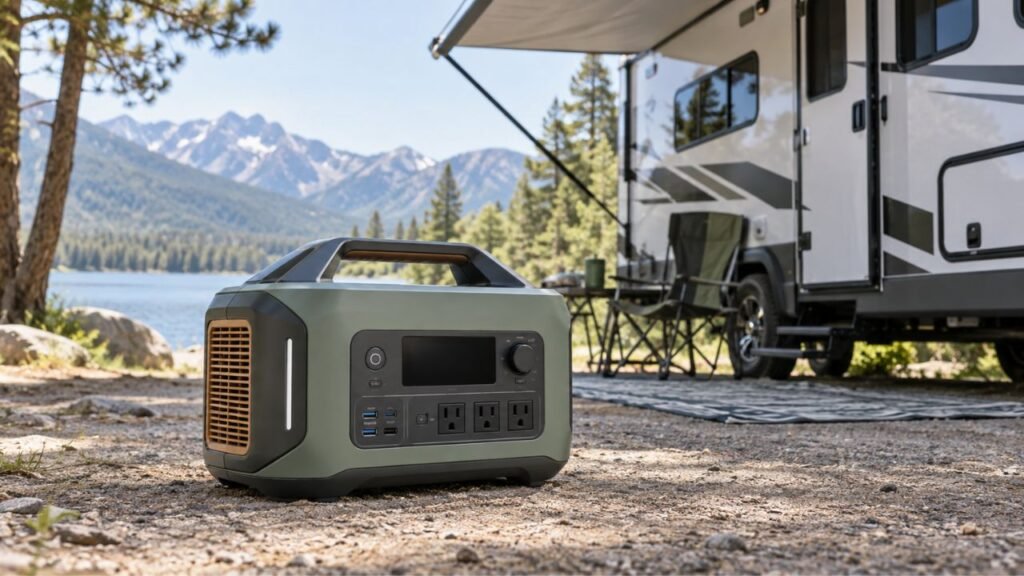
Yes, a portable power station can plug into an RV shore inlet. You need the correct RV adapter and compatible 120V AC output. The power station must also handle your RV’s actual running load safely.
This setup can power several RV circuits without campground hookups. I’ll explain adapters, watt limits, converter behavior, grounding issues, and safe connection steps.
Key Takeaways
- Portable power stations can safely supply many RV shore power inlets.
- A 30-amp RV does not require 30 amps continuously.
- Your power station’s inverter determines the available power limit.
- Some larger stations include a dedicated TT-30 RV receptacle.
- Standard outlets usually require a properly rated dogbone RV adapter.
- Your RV converter may consume extra power while connected.
- Heavy appliances can overload smaller portable power stations quickly.
- Some RV protection systems may reject floating-neutral power sources.
Can You Plug a Portable Power Station Into an RV Shore Power Inlet?
You can normally power an RV through its regular shore inlet. The portable power station simply becomes your temporary external AC source.
At a campground, electricity normally comes from the electrical pedestal. During boondocking, the portable station can perform a similar role.
The basic connection looks like this:
Portable power station → adapter if needed → RV shore cord → RV shore inlet
Electricity then reaches your RV’s normal AC breaker panel. From there, it supplies whichever circuits you leave switched on.
However, connecting the RV does not increase your available electricity. Your portable power station still determines how much power exists.
For example, your RV may have a 30-amp shore connection. That connection can normally accept around 3,600 watts at 120 volts.
Suppose your portable station only provides 1,800 watts continuously. Your RV then effectively has about 1,800 watts available.
The larger RV plug does not create additional capacity.
Using the designated RV shore inlet is also different from unsafe backfeeding. You are supplying power through an inlet designed for incoming electricity.
Never use improvised male-to-male cords or output-to-output connections. Those methods can expose energized conductors and create serious electrical hazards.
What Connection Does Your RV and Power Station Have?
Before buying an adapter, identify both sides of the connection. Your RV plug and power station outlet determine what you need.
| RV Setup | Power Station Output | Connection Needed | Practical Power Limit |
| 30-amp RV | TT-30R outlet | RV shore cord directly | Power station output rating |
| 30-amp RV | Standard 15A outlet | 15A-to-TT-30 dogbone | Usually about 1,800W maximum |
| 30-amp RV | Standard 20A outlet | Proper 20A-to-TT-30 adapter | Source and outlet rating |
| 50-amp RV | Standard 15A/20A outlet | Proper 50A RV dogbone adapter | Power station output rating |
| 50-amp RV | TT-30R outlet | TT-30-to-50A RV adapter | TT-30 or station output limit |
| 50-amp RV | Compatible RV outlet | Matching RV cord | Station’s specified output |
The important point is separating plug size from available power.
A TT-30 connector is designed for 30-amp RV service. However, the power station behind that connector may provide less power.
Always check the station’s continuous inverter rating before connecting loads.
The same principle applies when adapting a 50-amp RV. The adapter allows the connection but does not provide full 50-amp service.
What Adapter Do You Need?
The right adapter depends on your RV shore cord. It also depends on the outlets available on your power station.
30-Amp RV With a Standard 15A or 20A Power Station Outlet
Many smaller power stations use standard household-style 120V AC outlets. A 30-amp RV normally uses a TT-30 shore power plug.
You therefore need a dogbone designed for that direction.
The power station side usually has the smaller male plug. The RV cord connects to the larger TT-30 female end.
Do not assume the adapter provides 30 amps.
If the station outlet supports only 15 amps, the entire RV remains limited to that source.
At roughly 120 volts, 15 amps equals about 1,800 watts.
That may still run plenty of useful RV equipment. You simply need to manage simultaneous loads carefully.
30-Amp RV With a TT-30 Power Station
This is usually the simplest connection available.
Some larger portable power stations include a TT-30R receptacle specifically for RV use. Your RV shore cord can often connect directly to that outlet.
You may not need any adapter at all.
Still, check the station’s actual inverter specification before assuming 3,600 watts. A TT-30-shaped outlet does not automatically guarantee full 30-amp campground capacity.
The manufacturer’s continuous AC rating remains your real limit.
50-Amp RV With a Standard Power Station Outlet
You can often power basic loads inside a 50-amp RV. You simply need a properly designed RV adapter.
The adapter lets the smaller source connect to the larger RV cord.
However, your RV does not suddenly receive 50 amps.
A 1,800-watt portable station still provides approximately 1,800 watts. You must operate the RV within that smaller electrical budget.
Lights, electronics, refrigerators, televisions, and chargers may work normally. Multiple air conditioners and large appliances probably will not.
50-Amp RV With a TT-30 Power Station
A 50-amp RV can also connect to many TT-30 sources. You will need the correct TT-30-to-50A RV dogbone adapter.
This arrangement works well for operating selected 120V loads.
Again, treat the station as the limiting part.
A 50-amp RV normally has far more campground capacity available. The portable station cannot reproduce that capacity through an adapter alone.
How to Connect a Portable Power Station to an RV Shore Inlet
Connecting the systems is simple when everything matches correctly. I recommend adding loads gradually rather than energizing everything immediately.
- Identify your RV service type.
Determine whether your RV uses 30-amp or 50-amp shore service. - Check the portable power station specifications.
Confirm voltage, continuous wattage, surge output, and outlet limitations. - Turn off large RV loads first.
Switch off air conditioning, electric water heating, and space heaters. - Turn off the power station’s AC output.
Making the physical connection without live output reduces unnecessary arcing. - Connect your normal RV shore cord.
Attach it securely to the RV shore inlet when applicable. - Install the correct adapter if required.
Use a properly rated RV dogbone rather than improvised connectors. - Connect the cord to your portable station.
Make sure each connection fits completely and remains secure. - Enable the power station’s AC output.
Confirm that the station shows normal operation. - Turn on the RV main breaker if needed.
Then restore smaller circuits before starting larger appliances. - Watch the station’s wattage display.
Gradually adding loads makes overload problems easier to identify. - Check the connections for abnormal heating.
Warm or hot plugs can indicate resistance or overloading.
When disconnecting, reverse the general procedure.
Turn off large loads first, disable AC output, then unplug everything. This reduces stress on connectors and electrical equipment.
How Much Power Can the RV Actually Draw?
Your RV shore cord may have a large electrical rating. However, the weakest component determines your usable power.
The basic electrical relationship is:
Watts = Volts × Amps
At approximately 120 volts:
- 15 amps provides about 1,800 watts.
- 20 amps provides about 2,400 watts.
- 30 amps provides about 3,600 watts.
- 50-amp RV service provides substantially more total capacity.
A traditional 50-amp RV connection works differently from 30-amp service. It normally uses two 120V hot legs.
That is why full 50-amp campground service provides significantly more capacity.
Your portable station may supply only one smaller 120V source. An adapter cannot create the missing electrical capacity.
You should also distinguish continuous power from surge power.
Continuous output tells you what the inverter can sustain normally. Surge output covers temporary startup loads from certain appliances.
An RV air conditioner illustrates this difference well.
The compressor may need moderate wattage while operating steadily. However, starting the compressor can require considerably more power momentarily.
A station may therefore run an air conditioner after startup. Yet the inverter might shut down during the starting surge.
Always check both ratings before assuming compatibility.
What RV Appliances Can You Run From the Power Station?
Most RVs contain both small and high-demand electrical loads. Start with essentials before attempting larger appliances.
Usually easier loads include:
- LED interior lighting
- Television
- Wi-Fi equipment
- Laptop chargers
- Phone chargers
- Small ventilation fans
- RV electronics
- Propane appliance control circuits
Loads needing closer wattage monitoring include:
- Microwave
- Coffee maker
- Toaster
- Hair dryer
- Electric refrigerator mode
- Furnace electrical components
- Small countertop cooking appliances
Loads most likely to overload smaller stations include:
- Rooftop air conditioner
- Electric water heater
- Space heater
- Washer or dryer
- Large induction cooktop
- Multiple kitchen appliances simultaneously
Actual wattage varies significantly between RV models and appliances.
Read the appliance label whenever possible rather than relying completely on estimates.
Your power station display can also help.
Turn on one device at a time and watch consumption. You will quickly learn which appliances dominate your electrical budget.
Should You Turn Off the RV Converter When Using a Power Station?
Your RV converter can quietly consume significant portable battery capacity. Whether you should disable it depends on your goal.
When connected to shore power, many RV converters automatically become active. They convert 120V AC electricity into 12V DC power.
They also commonly recharge the RV house battery.
That means electricity may travel through this path:
Power station battery → AC inverter → RV converter → DC charging → RV battery
Each conversion introduces some energy loss.
Suppose your RV house battery is already fully charged. Keeping the converter running may unnecessarily reduce portable-station runtime.
Turning off the converter breaker can sometimes prevent that waste.
However, do not automatically switch it off in every RV.
Some RV systems rely on converter operation differently. Your 12V equipment may also need battery or converter support.
If your goal is intentionally charging the RV battery, leave it operating.
If maximum portable-station runtime matters more, disabling unnecessary charging may help.
Check the RV manufacturer’s instructions before changing normal converter operation.
Why Your RV EMS May Say “Open Ground” With a Power Station
Sometimes everything appears connected correctly, yet your RV receives no power. The RV’s electrical management system may be rejecting the source.
Some Portable Power Sources Use a Floating Neutral
Certain inverter-based power stations use what is commonly called a floating neutral.
Their neutral and grounding conductors are not bonded together internally like certain utility-powered systems.
That design can be normal for the portable station itself.
However, some RV protection devices expect a different electrical relationship.
The result can be confusing.
Your portable station appears healthy and produces 120V power. Yet your RV EMS refuses to energize the coach.
Why an EMS or Ground Monitor Rejects the Connection
An electrical management system checks incoming power before allowing electricity through.
Depending on the equipment, it may monitor:
- High voltage
- Low voltage
- Reverse polarity
- Open neutral
- Open ground
- Other wiring faults
A portable inverter source may trigger one of these checks. This does not automatically mean either product is defective.
The two systems may simply use different grounding arrangements.
Do Not Automatically Add a Neutral-Ground Bonding Plug
You may see online advice recommending a neutral-ground bonding plug. Do not make that modification without checking compatibility first.
Some power sources are specifically designed for certain bonding arrangements. Others should not be externally bonded that way.
Using the wrong configuration can defeat safety protections.
The safest approach is checking the portable station manufacturer’s guidance. Also check requirements for your specific RV electrical protection equipment.
Never bypass an EMS merely because it refuses the source.
Find the reason first.
Newer RV Ground Monitoring Makes This More Important
Grounding compatibility is becoming increasingly important for RV electrical systems.
Newer safety requirements are placing greater emphasis on detecting improper grounding before shore electricity reaches the RV.
That means future RV owners may encounter compatibility checks more frequently.
Portable power station manufacturers are also developing more RV-specific outputs. Those improvements should make proper integration easier over time.
For now, verify compatibility rather than assuming every inverter behaves identically.
How to Stop the RV From Draining the Power Station Too Quickly
Connecting through the shore inlet can energize many things simultaneously. Some loads remain easy to overlook during normal camping.
To extend runtime:
- Switch the water heater to propane when appropriate.
- Avoid electric space heating whenever battery runtime matters.
- Use propane refrigerator mode where your equipment permits it.
- Turn off the RV converter when charging is unnecessary.
- Switch off unused AC breakers when practical.
- Run major appliances individually instead of simultaneously.
- Avoid leaving countertop appliances connected unnecessarily.
- Watch real-time wattage on the power station display.
- Use 12V equipment directly when that reduces conversion losses.
- Save enough battery capacity for important overnight loads.
The electric water heater is particularly easy to overlook.
Its heating element may draw roughly 1,200 watts or more. That single appliance can consume a smaller station surprisingly quickly.
Your refrigerator can also change energy use dramatically.
A refrigerator running on electric mode adds another continuous AC demand. Propane mode may reduce that burden when properly supported.
The goal is not avoiding every appliance.
Instead, decide which comforts deserve your limited battery capacity.
Can a Portable Power Station Run a 30-Amp RV?
Yes, a portable power station can run many 30-amp RVs. You simply may not have the RV’s full 30-amp capacity available.
This distinction matters.
A 30-amp RV rating describes the maximum electrical service available. It does not mean the RV constantly consumes 30 amps.
Your RV might only use 300 watts at one moment.
Turn on a microwave and usage might jump substantially. Start an air conditioner and the demand can climb again.
A 1,800-watt station can therefore run a 30-amp RV. You just need to keep total consumption below its limit.
Think of the station as giving your RV a smaller electrical budget.
You can still use the entire RV electrical system conveniently. You simply cannot run every appliance simultaneously.
Can a Portable Power Station Run a 50-Amp RV?
Yes, many portable power stations can power selected loads inside 50-amp RVs.
Again, the RV service rating does not represent minimum consumption.
A large fifth wheel may normally connect to full 50-amp campground service. Yet lights and electronics might consume only a few hundred watts.
A smaller portable power station can handle those loads.
Problems begin when you expect normal 50-amp campground performance.
Large RVs often have:
- Two rooftop air conditioners
- Residential refrigerators
- Electric fireplaces
- Washer and dryer systems
- Large microwaves
- Electric water heaters
- Multiple entertainment systems
Running several together can quickly exceed portable inverter capacity.
Also pay attention to genuine 240V equipment.
Many small portable stations provide only 120V AC. An adapter cannot create proper 240V power from a 120V-only source.
Verify your RV loads before assuming every circuit will operate.
Is It Better to Power the RV Through the Shore Inlet or Plug Appliances Into the Station Directly?
Both approaches work, but they serve different situations. Your preferred method depends on convenience and efficiency priorities.
Use the Shore Inlet for Convenience
Connecting through the shore inlet makes the RV operate more normally.
You can use existing wall outlets instead of running extension cords. The RV breaker panel also continues controlling connected circuits.
This approach works especially well when several low-power devices need electricity.
It also allows your RV converter to operate when desired.
For many campers, shore-inlet connection simply feels cleaner and easier.
Plug Appliances Directly Into the Station for Maximum Efficiency
Direct connection sometimes makes more sense for only one appliance.
Suppose you only need a laptop and television.
Plugging them directly into the portable station avoids energizing unnecessary RV circuits. It may also prevent the converter from charging automatically.
Direct connection can therefore improve runtime.
It can also simplify troubleshooting when RV protection equipment rejects the source.
Neither approach is universally better.
Whole-RV shore connection provides convenience, while direct connection often saves energy.
Choose according to the number of loads you actually need.
When Should You Not Connect a Portable Power Station to the RV Shore Inlet?
A shore-inlet setup should remain simple and predictable. Stop when the required connection starts becoming improvised or unclear.
Do not connect the systems when:
- The power station output voltage does not match requirements.
- The adapter is damaged, loose, burnt, or incorrectly wired.
- The power station manufacturer prohibits this type of connection.
- Your expected load exceeds the station’s continuous rating.
- Appliance startup demand exceeds the station’s surge rating.
- Your RV EMS reports a fault you cannot explain.
- A cord or adapter becomes unusually hot during operation.
- The connection requires a male-to-male electrical cable.
- Multiple power sources could energize circuits simultaneously.
- You would need to defeat grounding protection.
- You are unsure how a modified RV transfer system operates.
Permanent electrical modifications deserve additional caution.
Transfer switches, distribution panels, neutral conductors, and grounding systems directly affect electrical safety.
If modifications go beyond normal plug-and-play RV connections, use a qualified RV electrician or technician.
Common Problems After Connecting a Portable Power Station to an RV
Most connection problems come from loads or electrical compatibility. The symptoms usually provide useful clues about what is happening.
Power Station Immediately Shows Overload
Start by switching off your largest RV appliances.
Common hidden loads include the converter, electric refrigerator mode, and water heater. Your air conditioner may also attempt starting immediately.
Turn off those breakers and reconnect.
Then add circuits individually while watching the station display.
If everything works until one appliance starts, you found the likely overload source.
RV EMS Shows Open Ground
Your portable station may use a floating-neutral electrical design.
The EMS can interpret that arrangement as an unacceptable incoming source.
Do not immediately bypass the EMS.
First check the portable station manual for RV compatibility. Then check your EMS documentation for inverter-source requirements.
Only use grounding accessories specifically approved for the equipment involved.
RV Has Power but the Air Conditioner Will Not Start
This commonly points toward compressor startup demand.
Your portable station may have enough continuous output after startup. However, the compressor surge may exceed the inverter’s temporary limit.
Check the air conditioner startup requirement.
Also compare that number with the station’s surge specification.
Some RV air conditioners can use compatible soft-start equipment. A soft starter may reduce startup demand substantially.
However, confirm compatibility with your specific air conditioner before installation.
Power Station Battery Drops Faster Than Expected
Look for loads you may not realize are active.
The converter could be charging your RV battery continuously. Your refrigerator might be running on electric mode.
The water heater element might also be operating.
Additional losses come from converting battery DC into AC electricity. The RV converter may then convert some electricity back into DC.
Turn off unnecessary breakers and compare consumption again.
You can often find the hidden load within several minutes.
Some Circuits in a 50-Amp RV Do Not Work
A 50-amp RV normally uses two separate 120V legs.
Your portable power station may provide only one 120V source. Adapter designs can also determine which circuits become energized.
Do not assume every 50-amp adapter behaves identically.
Check your RV wiring layout and adapter specifications.
This becomes especially important when specialized equipment uses 240V.
The Adapter or Plug Gets Hot
A slightly warm connection deserves attention.
A clearly hot connector is not something you should ignore.
Possible causes include:
- Loose electrical contact
- Corroded terminals
- Damaged plug blades
- Undersized adapters
- Excessive electrical load
- Poor-quality extension cords
- Worn RV inlet contacts
Switch off the load and disconnect the equipment.
Inspect everything before using the setup again.
Continuing through an overheating connection can damage the plug or inlet. It can also increase fire risk.
Portable Power Station RV Shore-Inlet Safety Checklist
Before using this setup, take one minute for basic checks. That short routine can prevent most common connection problems.
- Confirm your RV’s shore service type.
- Check the power station output voltage.
- Check its continuous AC wattage rating.
- Check the individual outlet rating.
- Check the surge power specification.
- Use only properly rated RV adapters.
- Inspect cables for cuts or heat damage.
- Switch off heavy loads before connecting.
- Decide whether RV battery charging is necessary.
- Watch power consumption after connection.
- Investigate every EMS warning before continuing.
- Never defeat grounding protection.
- Never use male-to-male power cords.
- Keep connectors dry and fully inserted.
- Stop using connections that become unusually hot.
- Follow instructions from both equipment manufacturers.
Conclusion
A portable power station can plug into an RV shore inlet. For many campers, it is an easy way to power existing RV circuits.
The connection itself is only part of the setup, though.
You need the correct voltage, adapter, inverter capacity, and grounding compatibility. You also need to control high-draw appliances carefully.
Remember that a 30-amp or 50-amp RV does not require full service constantly. Your portable station simply gives the RV a smaller available electrical budget.
Start with essential loads and add larger appliances gradually. That approach makes the system safer, easier, and more predictable.
Related FAQs
Can I Plug My 30-Amp RV Into a Regular Power Station Outlet?
Yes, you usually can with a properly rated RV dogbone adapter. Your usable power remains limited by the station’s outlet and inverter rating.
Do I Need a Special Adapter to Connect a Power Station to an RV?
You need an adapter when the power station outlet differs from your RV plug. A TT-30-equipped station may connect directly to many 30-amp RV cords.
Does a TT-30 Outlet Mean the Power Station Provides 30 Amps?
Not necessarily. TT-30 describes the connector type and normal RV service format. Always check the station’s actual continuous inverter and outlet ratings.
Can I Plug a 50-Amp RV Into a Portable Power Station?
Yes, many 50-amp RVs can use smaller portable sources with proper adapters. However, you will not receive full 50-amp campground capacity.
Should I Turn Off My RV Converter When Using a Power Station?
Turning it off may extend runtime when house-battery charging is unnecessary. Leave it operating when you intentionally want the station charging your RV battery.
Why Does My RV Surge Protector Show Open Ground on a Power Station?
Some portable stations use floating-neutral inverter designs that certain RV protection systems reject. Check both manufacturers’ instructions before changing any grounding configuration.
Can I Run My RV Air Conditioner From the Shore Inlet Using a Power Station?
Possibly, if the station handles both running and compressor-starting wattage. Larger stations and compatible soft-start systems can improve your chances significantly.
Can I Leave the Portable Power Station Connected to the RV Overnight?
Yes, when the equipment supports continuous operation and loads remain within limits. Make sure connections stay dry, cool, secure, and properly ventilated.
Will Connecting Through the Shore Inlet Charge My RV Battery?
Usually, yes, when your RV converter or charger becomes active. That charging load also consumes energy from the portable power station.
Do I Still Need an RV Surge Protector When Using a Portable Power Station?
Your existing protection equipment can still provide useful fault monitoring. However, some devices may report grounding errors with certain inverter-based portable power sources.

Warren Turner writes practical guides and reviews on generators, portable power stations, and battery backup systems. He focuses on real-world performance, everyday power needs, and helping readers choose dependable equipment without unnecessary complexity.