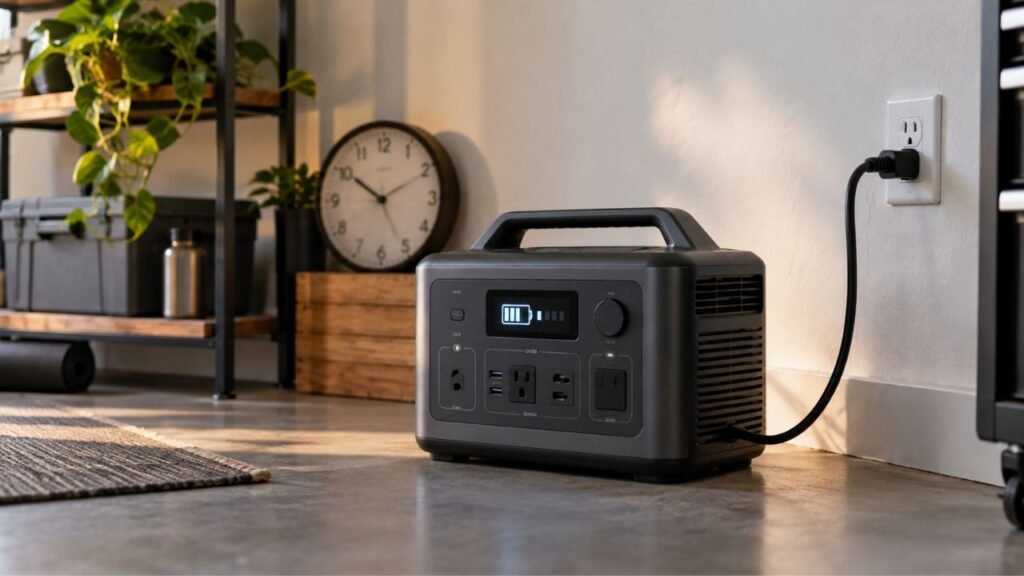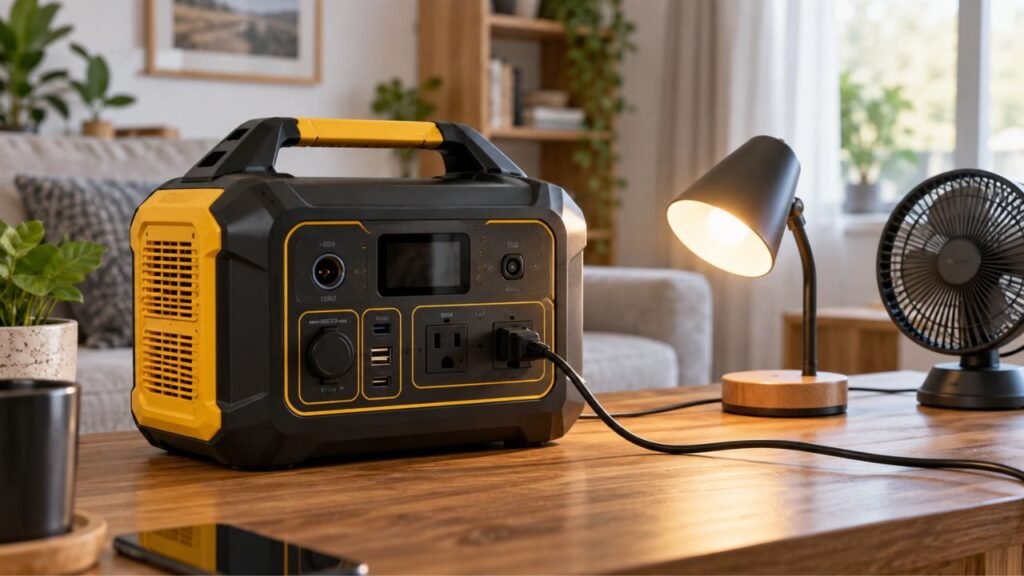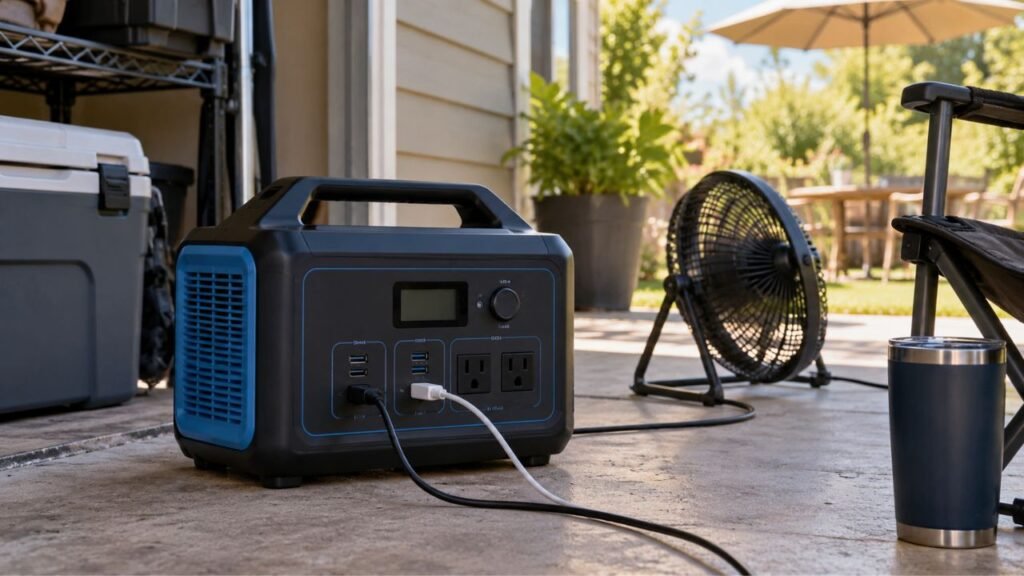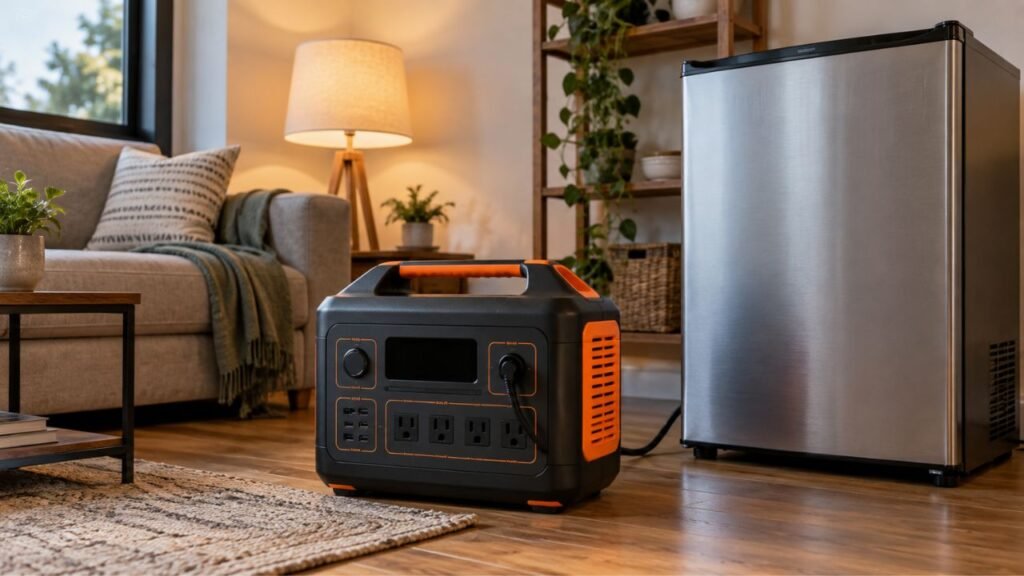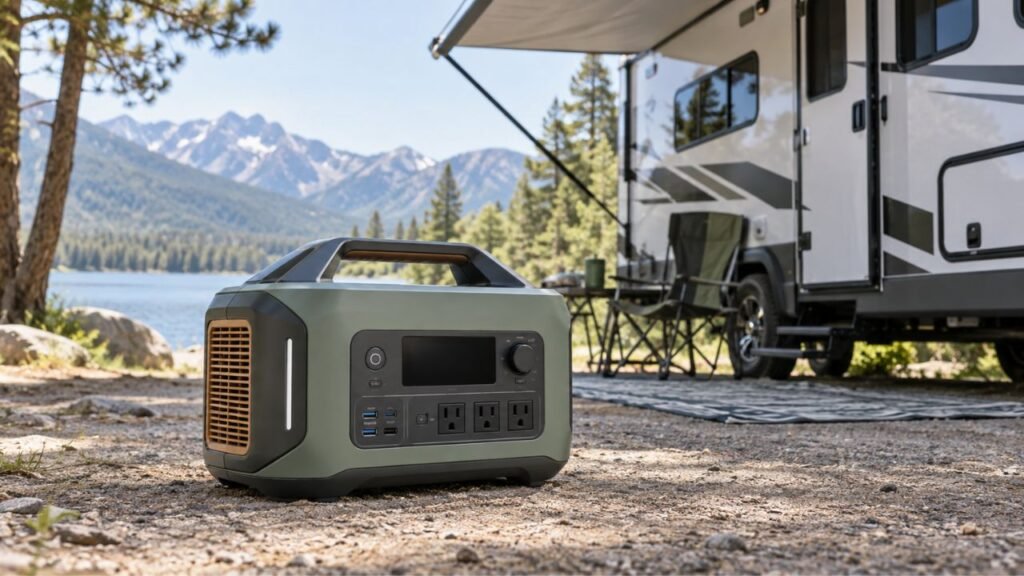
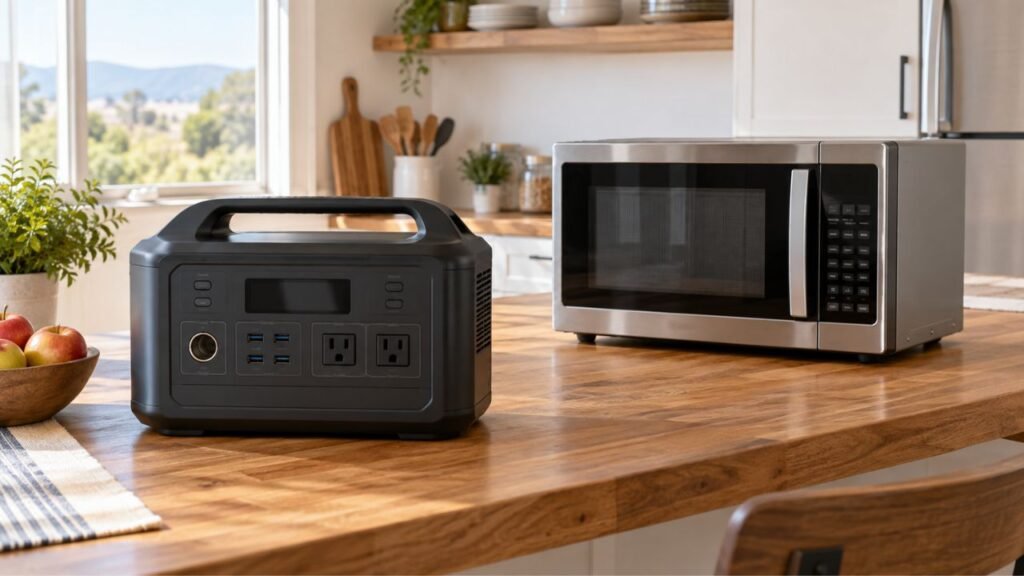
Yes, a portable power station can run most RV microwaves. The station must provide enough continuous AC output for the microwave’s actual input wattage, while also handling its starting demand without triggering overload protection.
The tricky part is choosing the correct power station size. I’ll show you what wattage matters, how much battery you need, expected runtime, and how other RV appliances affect your setup.
Key Takeaways
- Most RV microwaves can run from a properly sized power station.
- Check the microwave’s input watts, not only its cooking watts.
- A 900W microwave may actually consume around 1,300W or more.
- Many RV setups work best with 1,500W–2,000W continuous output.
- Battery capacity controls runtime, while inverter wattage controls compatibility.
- Pure sine wave AC output is the preferred choice for microwaves.
- Avoid running the microwave with other large RV appliances simultaneously.
- A 1,000Wh battery can usually provide several short heating sessions.
Can a Portable Power Station Run an RV Microwave?
A portable power station can run an RV microwave when its inverter matches the microwave’s electrical demand.
The first number you need is the microwave’s AC input wattage.
That matters more than battery capacity when determining whether it starts.
For example, imagine your RV microwave requires 1,350 watts while operating.
A portable station with a 1,000W inverter cannot run it reliably. This remains true even if that station has a huge battery.
On the other hand, a 2,000W power station with only 500Wh capacity may successfully run the microwave. It simply cannot provide as many cooking sessions before needing a recharge.
Think about the specifications this way:
Watts determine whether the microwave can run.
Watt-hours determine how long you can run it.
Keeping those two measurements separate makes sizing much easier.
How Many Watts Does an RV Microwave Actually Use?
RV microwave wattage can be surprisingly confusing. The large wattage number printed on the appliance often does not show how much electricity it actually pulls from your power source.
Cooking Watts vs Input Watts
Microwave manufacturers often advertise the appliance using its cooking output.
You might see ratings such as:
- 700W
- 800W
- 900W
- 1,000W
Those numbers describe microwave cooking power.
They do not necessarily describe electricity consumed from the AC outlet.
A typical 900W RV microwave might require around 1,300–1,400 watts of electrical input. Some larger models can draw roughly 1,500 watts or more.
That difference happens because the microwave cannot convert every watt from the outlet directly into cooking energy.
Internal electronics, the magnetron, cooling fan, transformer, and conversion losses all consume power.
That means choosing a 1,000W power station for a microwave labeled “900W” can easily cause an overload.
Always size your power station from input wattage whenever possible.
Where to Find Your Microwave’s Real Wattage
You should check the microwave itself before buying a power station.
Look for the electrical rating in these places:
- Rating label behind the microwave
- Sticker around the door opening
- Manufacturer specification sheet
- Owner’s manual
- Product specification page
- Electrical information near the power cord
Look specifically for terms such as input power, rated input, or power consumption.
Some microwaves list amps instead of watts.
You can estimate wattage using:
Watts = Volts × Amps
For example, a microwave drawing 11.5 amps from 120V uses approximately:
120 × 11.5 = 1,380 watts
The actual manufacturer input rating is preferable when available.
Do RV Microwaves Have Startup Surge?
Microwaves can place a demanding load on an inverter when heating begins.
However, I would not use a universal “two times” or “three times” startup rule. Microwave starting behavior varies considerably between designs.
Some power stations easily start a microwave near their continuous rating.
Others may trigger overload protection despite appearing powerful enough on paper.
Your safest approach is choosing enough continuous output first.
Then leave reasonable inverter headroom above the microwave’s input rating.
Do not depend on a huge advertised peak rating to compensate for inadequate continuous output.
For example, a station offering 1,200W continuous and 2,400W peak power still isn’t ideal for a microwave requiring 1,350W continuously.
The microwave needs that power longer than a brief surge rating permits.
What Size Portable Power Station Do You Need for an RV Microwave?
Most common RV microwaves pair well with portable power stations providing approximately 1,500W–2,000W of continuous AC output. However, your microwave’s actual input label should always determine the final size.
Continuous AC Output
Continuous output tells you how much power the inverter can provide steadily.
Suppose your RV microwave requires 1,350 watts.
Here is how different stations might perform:
- 1,000W station: Too small
- 1,200W station: Too small
- 1,500W station: Possibly suitable with limited headroom
- 1,800W station: Better operating margin
- 2,000W station: Comfortable for microwave-only operation
Leaving some headroom is useful.
Running an inverter continuously near its maximum rating increases heat and leaves little capacity for other RV loads.
I would rather have a 1,800W or 2,000W inverter powering a 1,350W microwave than constantly push a 1,500W unit near its limit.
Peak or Surge Output
Peak power handles short increases in electrical demand.
It can help when the microwave first begins heating.
However, peak power should never replace adequate continuous power.
Suppose a power station advertises:
1,200W continuous / 2,400W surge
That does not make it suitable for a microwave needing 1,400W continuously.
The 2,400W rating only applies briefly.
Focus primarily on continuous AC output.
Consider surge capacity additional headroom rather than your main sizing number.
Battery Capacity
Battery capacity is measured in watt-hours, or Wh.
Once the inverter can handle your microwave, watt-hours determine how many heating sessions you get.
For occasional RV microwave use, these ranges are practical starting points:
- Under 500Wh: Usually limited for microwave-focused use
- 500–750Wh: Can work for short, occasional heating
- Around 1,000Wh: Practical for several short cooking sessions
- 1,500–2,000Wh: Better for regular microwave use
- 2,000Wh+: Useful when powering additional RV essentials
A 1,000Wh recommendation is not a hard electrical requirement.
Some 500Wh stations have powerful enough inverters to run microwaves.
They simply have less stored energy available.
Pure Sine Wave Output
A pure sine wave inverter is the better choice for an RV microwave.
Pure sine wave AC closely resembles electricity supplied by a household outlet.
Microwaves contain electronics, motors, and high-power internal components that generally perform better with clean AC power.
Most modern higher-capacity portable power stations already use pure sine wave inverters.
Still, check the specification before buying.
I would avoid relying on modified sine wave equipment for regular microwave use.
RV Microwave Wattage and Recommended Power Station Size
The table below provides practical planning ranges. Exact electrical demand varies between microwave models, so always verify your appliance’s input rating.
| RV Microwave Cooking Rating | Possible Input Draw | Suggested Continuous PPS Output | Practical Battery Capacity |
| 600–700W | Around 900–1,100W | 1,200–1,500W+ | 500–1,000Wh+ |
| 800W | Around 1,100–1,300W | 1,500W+ | 750–1,000Wh+ |
| 900W | Around 1,300–1,400W | 1,500–1,800W+ | 1,000Wh+ |
| 950–1,000W | Around 1,400–1,600W | 1,800–2,000W+ | 1,000–2,000Wh+ |
| Larger microwave/convection unit | Around 1,500W+ | 2,000W+ | 1,500–2,000Wh+ |
These numbers are planning estimates rather than universal specifications.
Your microwave’s actual AC input rating always takes priority.
How Long Will a Portable Power Station Run an RV Microwave?
Microwaves use plenty of power while operating, but RV owners usually run them for only a few minutes. That makes battery runtime more manageable than the high wattage initially suggests.
RV Microwave Runtime Formula
You can estimate runtime using this simple formula:
Runtime = Battery capacity × usable efficiency ÷ microwave input watts
For quick planning, I normally use around 85% usable capacity for AC loads.
That gives you:
Battery Wh × 0.85 ÷ Microwave input watts
The 85% figure is only an estimate.
Real inverter efficiency changes with power level, temperature, battery condition, and power station design.
Example: 1,000Wh Station With a 1,350W Microwave
Imagine you have:
- 1,000Wh portable power station
- 1,350W microwave input
- Estimated 85% usable AC energy
The calculation becomes:
1,000 × 0.85 ÷ 1,350 = 0.63 hours
That equals approximately 38 minutes of cumulative microwave runtime.
You probably will not operate your microwave continuously for 38 minutes.
Instead, you might heat food for three to five minutes.
A five-minute session with this microwave would use approximately 130Wh from the battery after allowing for conversion losses.
That could provide several short heating sessions from a 1,000Wh station.
Approximate Microwave Runtime by Battery Size
Here’s another quick comparison using a 1,350W microwave.
| Power Station Capacity | Approximate Cumulative Microwave Time |
| 500Wh | About 19 minutes |
| 750Wh | About 28 minutes |
| 1,000Wh | About 38 minutes |
| 1,500Wh | About 57 minutes |
| 2,000Wh | About 76 minutes |
These estimates assume approximately 85% usable AC energy.
They also assume the microwave is the main appliance drawing power.
Why Real Runtime Can Be Shorter
Several things can reduce the runtime you see in the RV.
Common reasons include:
- Refrigerator or other appliances running simultaneously
- RV converter charging the house battery
- Power station inverter losses
- Very hot or cold battery temperatures
- Battery age and condition
- Low starting state of charge
- Power station cooling fans
- Microwave electrical demand changing during operation
This is why real-world testing is valuable before a long boondocking trip.
Should You Plug the Microwave Directly Into the Power Station or Power the Whole RV?
You can power an RV microwave in two common ways. One method powers the microwave directly, while the other feeds AC power through your RV’s normal electrical system.
Option 1: Plug the Microwave Directly Into the Power Station
Direct connection is the easiest setup electrically.
The microwave plugs into an AC outlet on the portable power station.
This makes load calculations straightforward because the station mainly sees the microwave.
You also avoid unintentionally powering additional RV equipment.
Direct connection works best when the microwave plug is accessible.
Built-in RV microwaves can make this approach inconvenient because their outlets are sometimes hidden inside cabinetry.
Do not use undersized extension cords for a high-wattage microwave.
High-current appliances need properly rated cords and connections.
Option 2: Connect the Power Station to the RV Shore Power Inlet
Some RV owners connect their portable power station to the RV’s shore power inlet using a properly rated adapter.
This allows the built-in microwave to operate through the RV’s regular 120V electrical system.
It can be convenient, but there is an important catch.
The microwave may not be your only AC load.
When the RV detects shore-style power, the converter may begin charging your house battery.
Other appliances can also remain connected.
Your portable power station might therefore supply:
Microwave + converter + refrigerator + entertainment equipment + other AC loads
That combined demand can overload an otherwise suitable station.
If you power the entire RV, manage your electrical loads carefully.
Turn off unnecessary appliances before starting the microwave.
Always use properly rated RV connections and manufacturer-approved equipment.
Never create homemade wiring arrangements that could backfeed another electrical source.
What Should You Turn Off Before Running the RV Microwave?
Your microwave may work perfectly alone but overload the station when another heavy appliance starts. Temporarily reducing other loads gives the inverter more room to handle the microwave.
Consider switching off or avoiding:
- RV rooftop air conditioner
- Electric water heater
- Electric space heater
- Coffee maker
- Toaster
- Hair dryer
- Electric kettle
- Induction cooktop
- Other high-wattage kitchen appliances
- Battery converter/charger when appropriate for your setup
Remember that power station loads add together.
Suppose your microwave uses 1,350W.
Another appliance drawing 1,200W brings the combined load to:
1,350W + 1,200W = 2,550W
A 2,000W power station cannot support that combined demand.
The station may immediately trigger overload protection.
Can You Run the RV Air Conditioner and Microwave Together?
Running the RV air conditioner and microwave together is possible only when the portable power station can handle their combined demand.
For most modest portable power setups, I would avoid doing it.
An RV microwave may draw around 1,200–1,500W.
Meanwhile, the air conditioner already consumes significant running power.
Its compressor can also create a demanding startup load.
Even if the numbers appear acceptable while both appliances are running, compressor startup can push the system beyond its limit.
A simple RV habit works well here.
Turn off the air conditioner briefly while using the microwave.
Once your food finishes heating, turn the AC back on.
That small load-management habit can let you use a smaller power station more reliably.
Why Does the Portable Power Station Shut Off When the Microwave Starts?
If your station immediately shuts down, there is usually a power-related reason. Check the microwave input rating, power station output, and other active RV loads before assuming something is defective.
Microwave Input Exceeds Continuous Output
This is the most common problem.
A microwave requiring 1,350W cannot operate normally from a 1,000W inverter.
The station detects excessive demand and shuts down to protect itself.
Starting Demand Trips Overload Protection
Sometimes the continuous numbers look acceptable, but the station still shuts down when heating starts.
The microwave may create a brief starting demand that triggers the inverter’s protection system.
More inverter headroom can help.
A higher-rated power station may also handle short load changes better.
Other RV Loads Are Already Running
This commonly happens when the station powers the entire RV.
Your microwave might use 1,350W while the converter consumes several hundred additional watts.
A refrigerator, TV, battery charger, or other appliance could add even more.
Check the station’s display before starting the microwave.
The existing load shows how much inverter capacity remains available.
Battery Charge Is Very Low
High-power AC appliances place substantial demand on the battery.
Some stations may become less tolerant of heavy loads near their low-voltage shutdown point.
Recharge the unit and try again before concluding the inverter is undersized.
Power Station Is Too Hot
Microwaves place a heavy load on the station’s inverter.
That generates heat.
If airflow is blocked or the unit becomes too hot, thermal protection may shut it down.
Keep ventilation openings uncovered.
Do not place the station inside a sealed cabinet while running heavy appliances.
Will Using 50% Microwave Power Reduce the Load on the Power Station?
Not necessarily.
This is one microwave tip that can easily cause confusion.
Many traditional microwaves do not produce a steady 50% electrical load when you select 50% cooking power.
Instead, they often cycle full microwave power on and off.
For example, the microwave might operate at full output for several seconds, stop heating briefly, and then restart.
During the active portion of that cycle, the portable power station may still see nearly the microwave’s full electrical demand.
That means lowering the microwave to 50% does not automatically turn a 1,400W electrical load into a steady 700W load.
Your station still needs enough inverter output for the microwave’s active heating periods.
This matters if you are trying to make an undersized station work.
Reducing the microwave’s cooking setting is not a reliable substitute for having enough inverter capacity.
Is an Inverter Microwave Better for Portable Power?
An inverter microwave can be friendlier for battery-powered setups, especially when using reduced cooking levels. However, you still need to check its maximum electrical input rating.
There are actually two different “inverters” involved here.
The portable power station inverter converts battery DC electricity into 120V AC.
An inverter microwave uses electronic control to regulate microwave cooking power.
Traditional microwaves often achieve lower cooking settings by cycling full power.
Many inverter microwaves can provide more continuous power modulation.
That can create smoother operation at reduced cooking settings.
However, do not assume every inverter microwave automatically uses dramatically less electricity.
Its maximum input wattage may still be high.
Always size your power station using the microwave’s actual electrical specifications.
How to Use an RV Microwave Without Draining Your Power Station Quickly
Microwave cooking works best from batteries when you treat it as a short-duration appliance. Small changes in how you cook can preserve considerable battery capacity.
Try these habits:
- Heat only the amount of food you currently need.
- Use shorter cooking sessions whenever practical.
- Avoid operating other heavy appliances simultaneously.
- Start cooking with the battery reasonably well charged.
- Check real-time wattage on the power station display.
- Recharge with solar between cooking sessions when available.
- Use propane for longer cooking jobs when practical.
- Keep the power station properly ventilated.
- Avoid blocking the station’s cooling vents.
- Turn unnecessary RV AC circuits off when using shore-style connection.
The microwave’s high wattage looks intimidating.
However, three minutes at 1,350W consumes far less energy than running a 1,500W space heater for two hours.
Duration matters just as much as wattage.
When Does Using a Microwave From a Power Station Make Sense?
A microwave is actually a practical appliance for many battery-powered RV setups because most heating sessions are short.
Good situations include:
reheating leftovers, heating soup, warming coffee, cooking frozen meals, and preparing quick breakfasts.
You might only run the microwave for two to five minutes.
That keeps total energy consumption relatively manageable.
Microwave use becomes less attractive when you repeatedly cook large meals or run lengthy defrost programs.
During extended boondocking, battery energy may be better reserved for:
- Refrigerator
- Lights
- Water pump
- Electronics
- Ventilation
- Medical equipment
- Communication devices
For longer cooking jobs, propane can often preserve more battery capacity.
The best approach depends on your camping style and recharge options.
A Simple 60-Second Compatibility Check
You do not need complicated electrical calculations before every meal. Run through these steps once, and you will quickly know whether your setup is suitable.
- Find the microwave’s actual input wattage.
- Check your station’s continuous AC output.
- Make sure continuous output exceeds microwave input.
- Leave reasonable inverter headroom when possible.
- Confirm the station provides pure sine wave AC.
- Check battery watt-hours for your desired cooking time.
- Add any appliances operating at the same time.
- Turn off unnecessary high-wattage RV loads.
- Watch the station display during your first test.
- Confirm the setup works before depending on it remotely.
Once these numbers match, microwave use becomes fairly straightforward.
Conclusion
Yes, a portable power station can run an RV microwave, and many modern stations handle the job well.
The most important step is checking the microwave’s input wattage, not only its advertised cooking power.
Many common RV microwaves pull roughly 1,200–1,500 watts from the AC supply. For those appliances, a pure sine wave station providing around 1,500–2,000W continuous output is a practical range, with additional headroom preferred.
After inverter output, consider battery capacity.
A 1,000Wh station can often support several short microwave sessions, while larger batteries provide more flexibility during longer trips.
Finally, remember your microwave rarely operates alone inside an RV.
Managing the air conditioner, converter, water heater, coffee maker, and other large loads can make the difference between reliable operation and constant overload shutdowns.
Related FAQs
Can a 1,000W Portable Power Station Run an RV Microwave?
Usually not if your RV microwave requires more than 1,000 watts of actual AC input. Many 700W–900W cooking-rated microwaves consume around 1,000–1,400W or more electrically, so always check the appliance’s input rating before connecting it.
Can a 1,500W Power Station Run an RV Microwave?
A 1,500W power station can run many smaller RV microwaves if their actual input stays below the station’s continuous output limit. However, the operating margin may be small if the microwave pulls around 1,300–1,400W.
Can a 2,000W Power Station Run an RV Microwave?
Yes, a 2,000W pure sine wave power station can usually handle many common RV microwaves comfortably. You still need to confirm the microwave’s actual input wattage and account for other appliances using power simultaneously.
How Many Watts Does a 900W RV Microwave Actually Use?
A 900W microwave can consume considerably more than 900 watts from the outlet. Depending on the model, actual electrical input may be around 1,300–1,400W because the advertised 900W figure normally refers to cooking output.
How Much Battery Does Five Minutes of Microwave Use?
A 1,350W microwave running for five minutes uses about 113Wh at the appliance itself. After allowing for inverter losses, the power station may lose roughly 130Wh of stored battery capacity during that session.
Can You Run an RV Microwave While Boondocking?
Yes, you can run an RV microwave while boondocking when your portable power station provides enough continuous inverter output and battery capacity. Short microwave sessions are particularly practical when solar or another charging method can replenish the battery later.
Can You Run an RV Microwave Through the Shore Power Plug?
Yes, a suitable portable power station can supply an RV through its shore power inlet when used with properly rated equipment. Remember that the RV converter and other AC appliances may also consume power when the connection becomes active.
Does an RV Microwave Need a Pure Sine Wave Power Station?
Pure sine wave output is strongly recommended for RV microwaves. It closely matches normal household AC electricity and provides better compatibility with the microwave’s electronics, fan, transformer, and other internal electrical components.
Can Solar Panels Run an RV Microwave?
Solar panels usually recharge or supplement the portable power station rather than powering the microwave directly. The station’s battery and AC inverter still need enough output for the microwave’s instantaneous electrical demand.
Does a Microwave Drain a Portable Power Station Fast?
A microwave draws substantial power while operating, but most heating sessions last only a few minutes. Because of that short operating time, total battery consumption can remain reasonable compared with appliances running continuously for hours.

Warren Turner writes practical guides and reviews on generators, portable power stations, and battery backup systems. He focuses on real-world performance, everyday power needs, and helping readers choose dependable equipment without unnecessary complexity.