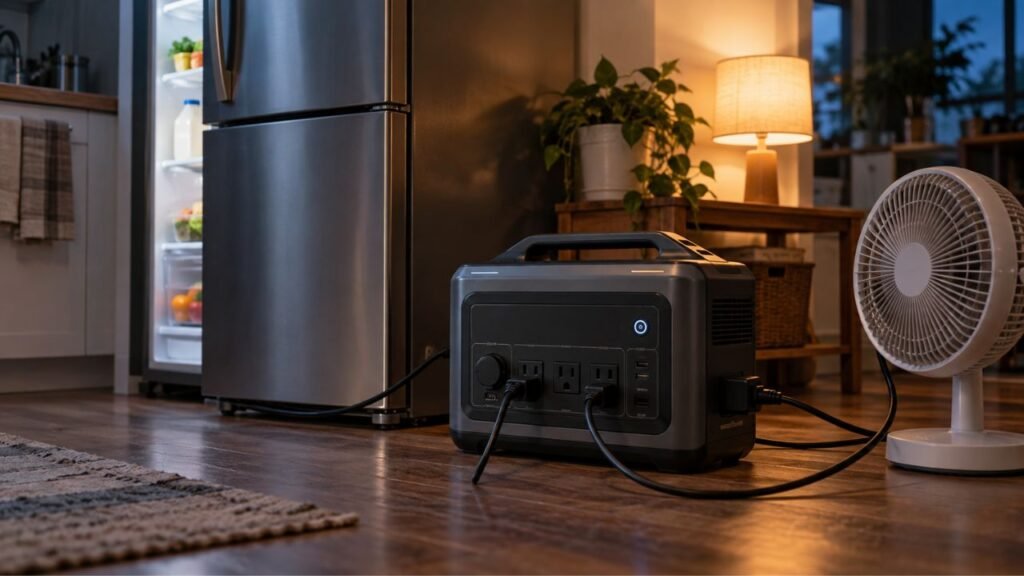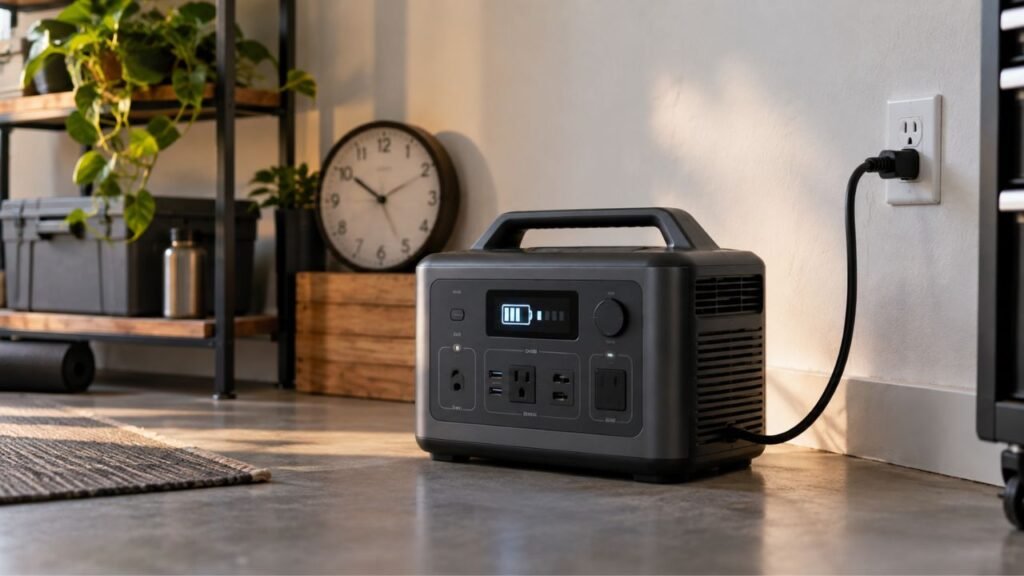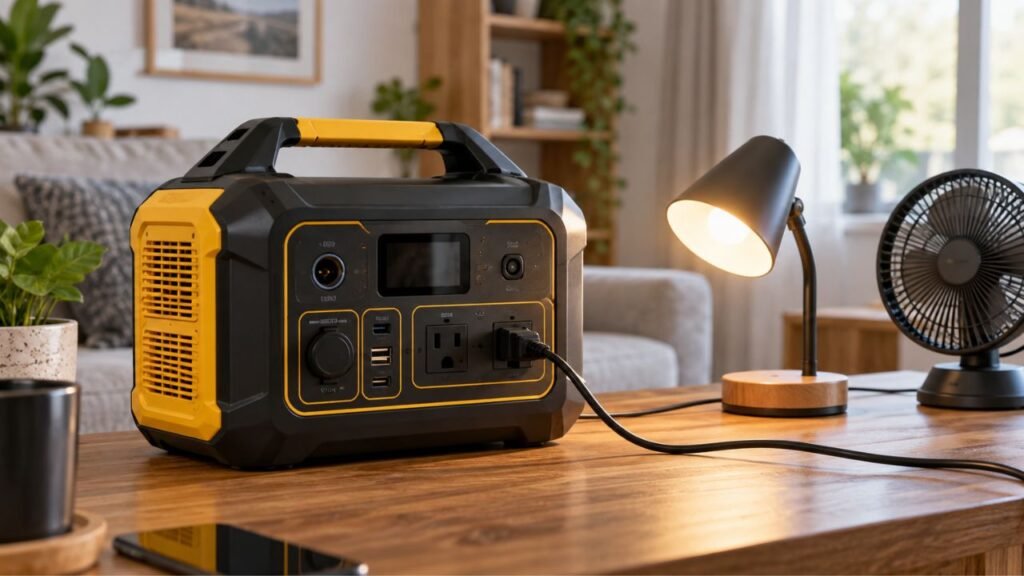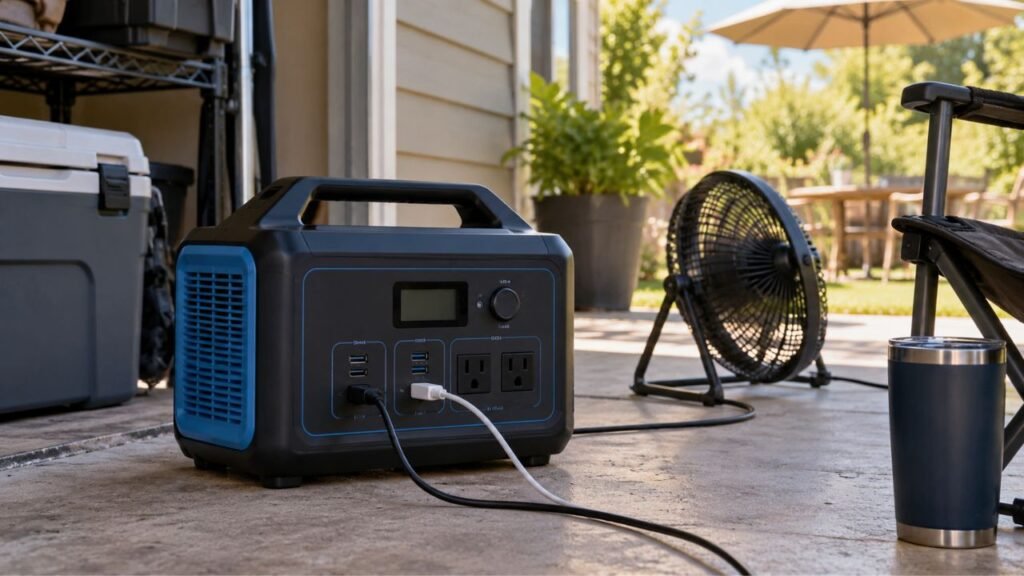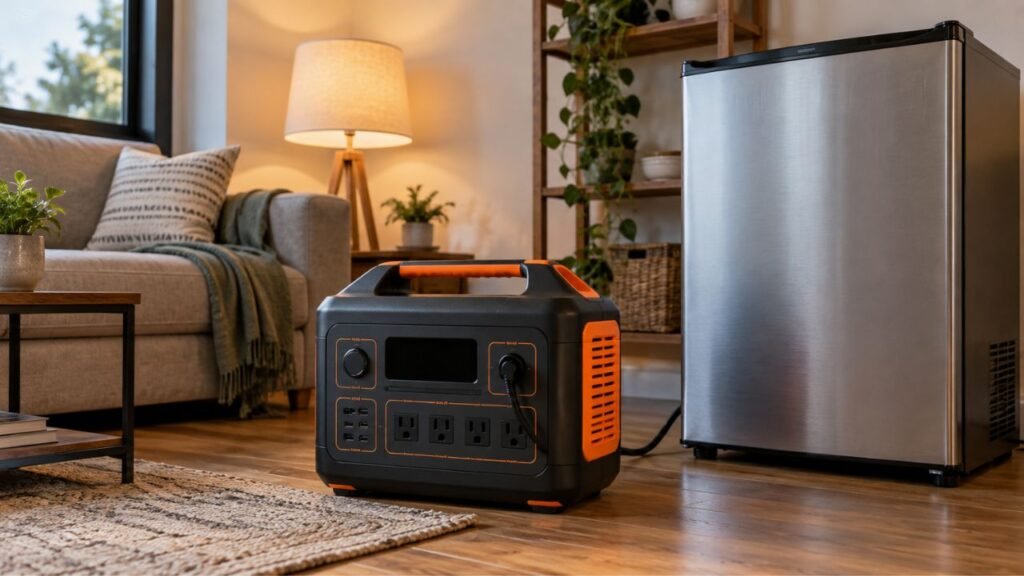
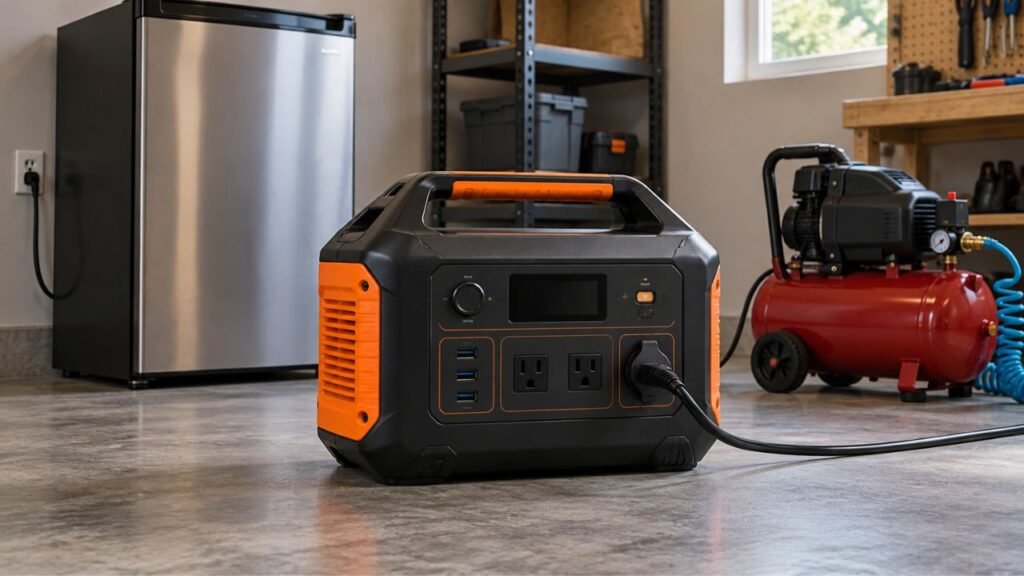
A portable power station handles motor startup surges through its inverter’s temporary surge capacity. The battery supplies the required current, while protection systems monitor voltage, current, temperature, and overload conditions during startup.
That short burst matters for refrigerators, pumps, air conditioners, and power tools. Below, I’ll show you exactly how startup surges work, how to size your power station, and what to check when a motor refuses to start.
Key Takeaways
- Motors can require several times their normal power during startup.
- Continuous watts determine whether the motor keeps running afterward.
- Surge capacity determines whether the motor can successfully start.
- Battery watt-hours mainly determine runtime, not motor startup capability.
- Existing loads also count when a motor suddenly starts.
- Surge duration can matter as much as the advertised surge wattage.
- Compatible soft starters can reduce startup demand on certain motors.
- Real-world testing is important before relying on emergency backup power.
How Does a Portable Power Station Handle a Motor Startup Surge?
Several parts of the power station work together during motor startup. The inverter supplies temporary extra output while the battery provides current behind it.
The Inverter Temporarily Supplies Higher Output
The inverter converts stored DC battery power into household-style AC electricity.
During normal operation, it stays within its continuous output rating. For example, a station may provide 1,800 watts continuously.
Motor startup creates a different situation.
When a refrigerator compressor or pump starts, demand rises suddenly. The inverter may briefly deliver considerably more than its continuous rating.
That temporary capability is usually called surge, peak, or starting output.
Suppose your station offers:
- 1,800 watts continuous output
- 3,600 watts surge output
A 900-watt motor could potentially need 2,500 watts during startup. The 1,800-watt continuous rating looks too low for that moment.
However, its 3,600-watt surge capability may successfully cover startup.
Once the motor reaches operating speed, demand drops significantly. The inverter then returns to normal continuous operation.
The Battery Supplies the Required DC Current
The inverter cannot create extra electrical energy by itself.
The battery pack must supply enough current for the inverter. Internal wiring and power electronics must also tolerate that temporary demand.
This is why two similarly sized power stations can perform differently.
Both might contain around 2,000Wh of stored energy. However, one could have much stronger high-current discharge capability.
Battery chemistry can affect high-load performance, but chemistry alone tells little. You still need the manufacturer’s actual inverter and surge specifications.
A LiFePO4 battery does not automatically guarantee strong motor-starting performance.
The BMS and Protection Circuits Monitor the Surge
The battery management system, commonly called the BMS, provides protection.
It does not simply create additional surge power for the motor.
Instead, the BMS monitors conditions throughout the battery system. Depending on the design, it may watch:
- Battery current
- Cell voltage
- Battery temperature
- Charging conditions
- Discharging conditions
- Short circuits
- Excessive loads
If motor demand rises beyond safe limits, protection can activate quickly.
The power station may display an overload warning or disable AC output.
That shutdown can be frustrating, but it protects expensive internal components.
Why Do Electric Motors Need Extra Power When Starting?
An electric motor behaves differently while stationary than while already spinning.
When first energized, it can draw a large amount of current. This brief demand is commonly called inrush current or startup current.
The motor needs this energy to begin turning its mechanical load.
Once it reaches operating speed, electrical demand normally drops considerably.
That difference creates two separate wattage numbers you should consider.
You have the normal running demand and the temporary starting demand.
Some motors may require only moderately higher startup power. Others can need several times their normal running wattage.
Compressors and pumps can be particularly demanding.
The exact multiplier depends on the motor design, attached load, voltage, temperature, and starting method.
That is why I would not blindly use one multiplier for everything.
A 700-watt refrigerator compressor also behaves differently from a 700-watt heater.
The heater is mostly a steady resistive load.
The compressor includes an electric motor that must start mechanically.
Starting Watts vs. Running Watts vs. Battery Capacity
These specifications sound similar but answer completely different questions. Knowing the difference makes portable power station sizing much easier.
| Specification | What It Means | What It Determines |
| Running watts | Normal power used after startup | Whether the station can keep the motor running |
| Starting watts | Brief power demand while starting | Whether the motor can successfully start |
| Continuous output | Sustained inverter output | How much combined load the station supports continuously |
| Surge output | Temporary inverter output | How much short-term startup demand it can tolerate |
| Surge duration | How long extra output remains available | Whether the motor has enough time to accelerate |
| Watt-hours | Stored battery energy | Approximately how long your loads can operate |
| LRA or inrush current | Motor current during startup | Helps estimate demanding startup conditions |
The biggest mistake is choosing a station from battery capacity alone.
A 2,000Wh battery tells you how much energy is stored.
It does not guarantee the inverter can start a large compressor.
A smaller battery paired with a stronger inverter could start the motor. A larger battery with a weaker inverter might shut down immediately.
Think about the specifications this way.
Watts answer, “Can it run this?”
Surge watts answer, “Can it start this?”
Watt-hours answer, “How long can it run?”
Keeping those three questions separate prevents many sizing mistakes.
Which Appliances Have Motor Startup Surges?
Many everyday appliances use motors or compressors that create startup demand. Some produce mild surges, while others can challenge portable inverters.
Common examples include:
- Refrigerators
- Chest freezers
- Upright freezers
- Sump pumps
- Well pumps
- Window air conditioners
- Portable air conditioners
- RV air conditioners
- Air compressors
- Furnace blowers
- Dehumidifiers
- Shop vacuums
- Circular saws
- Miter saws
- Other corded power tools
Not every appliance produces the same startup behavior.
Modern variable-speed and inverter-driven appliances may start more gradually. Their electronics can control motor acceleration instead of instantly applying full power.
Older single-speed motors may have much larger startup demands.
You therefore need specifications for your actual appliance whenever possible.
How Do You Know Whether Your Power Station Can Handle the Startup Surge?
You can determine compatibility with a simple step-by-step check. Focus on running power, starting demand, inverter ratings, voltage, and existing loads.
Find the Motor’s Running Wattage
Start with the appliance’s normal electrical demand.
Check the:
- Appliance nameplate
- Owner’s manual
- Manufacturer specification sheet
- Technical data label
Manufacturers may list watts directly.
Sometimes they provide volts and amps instead.
For simple planning, the listed rated wattage is usually preferable. Actual consumption can still change while the equipment operates.
Do not assume the biggest number printed on packaging means running watts.
Find the Actual Starting Wattage or Inrush Current
Next, determine what happens during startup.
The best information usually comes directly from the appliance manufacturer.
Look for terms such as:
- Starting watts
- Peak watts
- Starting amps
- Inrush current
- Locked rotor amps
- LRA
A meter capable of capturing inrush current can provide useful measurements.
However, working around household electrical systems can create shock hazards. Use appropriate equipment and professional help where necessary.
If you cannot find actual startup information, an estimated multiplier helps screening.
Just treat it as an estimate rather than an exact specification.
Also remember that volts multiplied by AC amps technically gives volt-amperes.
It does not always equal true watts for a motor load.
Check Continuous and Surge Output Ratings
Now compare your appliance with the power station.
You need to pass two separate checks.
First, calculate your normal operating load.
Motor running watts + other running devices = total continuous load
That total should remain below the station’s continuous output rating.
Next, examine startup.
Motor starting demand + other running loads = startup-period demand
That figure needs to fit the station’s usable surge capability.
Suppose the motor’s manufacturer already lists complete starting watts.
Do not automatically add the motor’s normal watts again.
Starting wattage usually represents the motor’s total demand during startup.
Check How Long the Surge Rating Is Available
This specification is often overlooked.
Two power stations may both advertise a 3,600-watt surge rating.
That does not guarantee they handle identical motor loads.
One inverter might support that level extremely briefly.
Another might tolerate elevated output for a longer startup period.
Motors also differ in how quickly they reach operating speed.
A motor that needs a longer starting period can trip protection. This can happen even when its initial peak seems acceptable.
Check the manual for details about peak or surge duration.
Unfortunately, not every manufacturer publishes this information clearly.
When details are unavailable, real-world testing becomes particularly valuable.
Account for Other Devices Already Running
This is where many otherwise correct calculations fail.
Your refrigerator might not be the power station’s only load.
Perhaps you already have these devices connected:
- Router
- Television
- Lights
- Laptop
- Phone chargers
Those loads continue drawing power when another motor starts.
Imagine they use 350 watts together.
Your sump pump then needs 2,400 watts during startup.
The inverter briefly sees roughly 2,750 watts of total demand.
You need to compare that combined number with available surge capability.
Starting several motors simultaneously can create even larger peaks.
When possible, stagger larger motor loads during an outage.
Make Sure the Voltage Is Compatible
Wattage is only one part of compatibility.
The power station must also provide the correct output voltage.
Many portable power stations sold in the United States provide 120V AC.
That works for many household plug-in appliances.
However, certain well pumps, HVAC equipment, shop machines, and appliances require 240V.
A massive 120V power station cannot directly operate a 240V-only motor.
Always confirm voltage before considering wattage or battery capacity.
Example: Calculating a Motor Startup Load
A simple example shows how these specifications work together. These numbers are hypothetical and meant only to demonstrate the process.
Assume your portable power station provides:
- 1,800W continuous output
- 3,600W surge output
Other equipment already uses 250 watts.
Now assume your motor uses:
- 700W while running
- 2,800W during startup
First, check continuous operation.
700W + 250W = 950W
Your station can continuously provide 1,800 watts.
A 950-watt combined running load sits comfortably below that rating.
Now check startup.
2,800W + 250W = 3,050W
The advertised surge capability is 3,600 watts.
On wattage alone, the combination appears capable of starting.
However, I still would not call compatibility guaranteed.
You also need correct voltage and adequate surge duration. Battery condition and temperature can also affect actual performance.
Test the complete setup before depending on it during an outage.
Why Can a Motor Still Trip the Power Station Even When the Surge Rating Looks High Enough?
Paper specifications do not always predict every startup successfully. Several real-world conditions can push the system past its operating limits.
Possible reasons include:
- The startup surge lasts longer than the inverter allows.
- Another motor starts during the same moment.
- Several devices already consume significant inverter capacity.
- Battery charge is very low.
- Extreme temperatures reduce available performance.
- Battery voltage drops too far under high current.
- The compressor attempts a difficult restart.
- The motor has mechanical problems.
- The power station activates overload protection too quickly.
- A long or undersized extension cord causes voltage drop.
- The appliance requires a different output voltage.
- A boost feature is being mistaken for true surge capacity.
A refrigerator gives a good example.
Its compressor may run normally most of the time. Yet restarting under certain pressure conditions can demand more startup effort.
The same power station might therefore handle several starts successfully.
A later restart could still activate overload protection.
That is another reason I recommend testing several complete cycles.
Is a Power-Lifting or Boost Mode the Same as Surge Power?
Some portable power stations offer special power-lifting or boost modes. These features are useful, but they should not automatically be treated as surge ratings.
Certain boost modes allow a station to operate higher-wattage appliances by reducing output voltage.
That approach can work acceptably with some simple resistive appliances.
However, a motor is not necessarily compatible with reduced voltage.
Lower voltage can increase current demand or prevent proper acceleration.
Sensitive electronics may also behave unpredictably.
So, if a station says it can “power appliances up to 2,400 watts” through a boost feature, read the fine print.
That does not necessarily mean its inverter supplies normal 120V power at 2,400 watts.
It also does not automatically mean it can start a 2,400-watt motor.
For motor loads, rely primarily on true continuous and surge specifications.
Then check whether the manufacturer approves boost mode for that appliance type.
Can a Soft Starter Help a Portable Power Station Start a Motor?
A soft starter can reduce startup demand for certain compatible motors. However, it is not a universal solution for every motor-driven appliance.
How a Soft Starter Reduces Inrush Current
A motor normally receives a strong electrical demand when startup begins.
A compatible soft starter changes how that startup occurs.
Rather than allowing maximum starting demand immediately, it controls acceleration.
This can reduce the peak current seen by the power station.
The motor reaches operating speed more gradually.
That lower inrush can sometimes make a previously incompatible setup workable.
Where Soft Starters Are Most Useful
Soft starters are especially common with compressor-based equipment.
Applications can include:
- Certain central air conditioners
- Some RV air conditioners
- Compatible heat pumps
- Certain compressor systems
They can be useful when startup demand exceeds inverter capability.
However, the motor’s continuous running load must still fit afterward.
Reducing startup current does not reduce an oversized continuous load enough.
When a Soft Starter Is Not the Answer
Do not assume every motor should receive a third-party soft starter.
Some appliances already contain electronic startup controls.
Others use variable-speed or inverter-driven motor systems.
Adding incompatible hardware could interfere with their normal operation.
Plug-in refrigerators, freezers, and household appliances also usually are not designed for random external soft-starter modifications.
Permanent HVAC modifications should be handled appropriately.
For hardwired equipment, use a qualified electrician or HVAC technician.
What Should You Do If a Motor Will Not Start?
Start with the simplest checks before assuming something has failed. The goal is identifying whether the problem involves load, voltage, or startup capability.
Try these steps:
- Disconnect unnecessary appliances from the power station.
- Fully charge the portable power station.
- Test the motor by itself first.
- Confirm the appliance’s normal running wattage.
- Find manufacturer starting watts or startup current.
- Compare starting demand with the station’s surge rating.
- Check whether surge duration information is available.
- Confirm the appliance requires the station’s output voltage.
- Inspect extension cords for proper gauge and length.
- Allow compressors enough time before another restart.
- Check whether environmental temperature affects the station.
- Consider an approved soft starter where appropriate.
- Move to a stronger inverter if startup demand remains excessive.
Do not repeatedly force a motor that only hums or stalls.
A stalled motor can remain under very high current demand.
If the inverter repeatedly trips, stop testing and investigate the cause.
You want the motor to start promptly and reach normal speed.
How Should You Test Motor Loads Before an Outage?
Specifications provide your starting point, but actual testing builds confidence. Test important motor loads before you genuinely need emergency backup power.
I recommend this process:
- Fully charge the power station.
- Start with every unnecessary load disconnected.
- Connect the motor-driven appliance alone.
- Start the appliance normally.
- Watch the power station’s output display.
- Check for overload warnings.
- Let the motor complete several normal operating cycles.
- Allow compressors to stop and restart normally.
- Add essential secondary loads afterward.
- Test realistic simultaneous-load conditions.
- Avoid intentionally exceeding published station limits.
- Repeat your backup test before severe-weather seasons.
Testing only one successful startup can create false confidence.
Refrigerators and pumps cycle automatically.
Your backup setup should handle repeated starts while normal loads continue running.
If the equipment is critical, give yourself reasonable power headroom.
Common Motor Surge Sizing Mistakes
Most startup problems come from a handful of sizing mistakes. Avoiding these errors makes power station planning far more reliable.
Common mistakes include:
- Choosing a station based only on watt-hours.
- Checking continuous output but ignoring surge output.
- Assuming every motor uses the same startup multiplier.
- Ignoring the duration of the startup surge.
- Ignoring other appliances already running.
- Adding motor running watts twice during calculations.
- Assuming the BMS creates additional power.
- Treating boost mode like normal surge capability.
- Ignoring voltage requirements.
- Assuming one successful startup guarantees every restart.
- Testing only when battery charge is near 100%.
- Using long, undersized extension cords.
- Assuming newer battery chemistry guarantees higher surge output.
- Trying to start several compressors simultaneously.
The safest approach is simple.
Use manufacturer data whenever possible, allow reasonable headroom, then test.
Conclusion
A portable power station handles motor startup surges through temporary inverter capability supported by the battery system. The surge must remain within the station’s electrical and protection limits long enough for the motor to reach operating speed.
Remember the three questions that matter most. Can it start? Check surge capability. Can it keep running? Check continuous output. How long can it run? Check battery watt-hours.
Use actual appliance startup specifications whenever you can. Include other loads, confirm voltage, and test the complete setup before depending on it during an outage.
Related FAQs
How Much Surge Power Does a Motor Need?
There is no universal startup multiplier for every electric motor. Some motors need moderately higher starting power, while compressors and pumps may require several times their running demand. Manufacturer starting specifications or actual inrush measurements provide better guidance than a generic multiplier.
Why Does My Power Station Shut Off When a Refrigerator Starts?
The refrigerator compressor probably creates a startup surge exceeding the inverter’s temporary capability. Other connected devices can make this worse because their running loads remain active during compressor startup. Check the refrigerator’s startup demand and your station’s surge rating.
Is Surge Wattage the Same as Peak Wattage?
Manufacturers often use surge watts and peak watts to describe temporary output above continuous capacity. However, the allowed duration can differ between products. Always check the manufacturer’s definition instead of comparing only the advertised peak number.
Does a Larger Battery Help With Motor Startup Surge?
A larger battery mainly gives you more stored energy and longer runtime. It does not automatically mean stronger startup performance. The inverter, battery discharge capability, internal electronics, and protection limits determine whether a motor can successfully start.
Can a 2,000W Portable Power Station Start a 1,500W Motor?
Possibly, but the 1,500-watt running figure is not enough information. The motor could briefly require much more power during startup. Its startup demand must remain within the station’s surge capability while normal running demand stays below continuous output.
Can a Soft Starter Reduce Motor Startup Surge?
Yes, a compatible soft starter can reduce inrush current by controlling how quickly certain motors accelerate. They are commonly considered for compatible air conditioners, heat pumps, and compressors. They are not universal accessories for every appliance or motor.
Do Inverter-Driven Appliances Have Lower Startup Surges?
Many inverter-driven appliances can start their motors more gradually than traditional single-speed designs. This can reduce abrupt startup demand. However, designs vary, so you should still check the actual appliance specifications rather than assuming startup surge is negligible.
Can Two Motors Start at the Same Time on a Portable Power Station?
They can only start together if their overlapping startup demands and existing loads remain within the station’s limits. Staggering refrigerators, pumps, air conditioners, and other large motors can reduce the chance of triggering inverter overload protection.

Warren Turner writes practical guides and reviews on generators, portable power stations, and battery backup systems. He focuses on real-world performance, everyday power needs, and helping readers choose dependable equipment without unnecessary complexity.