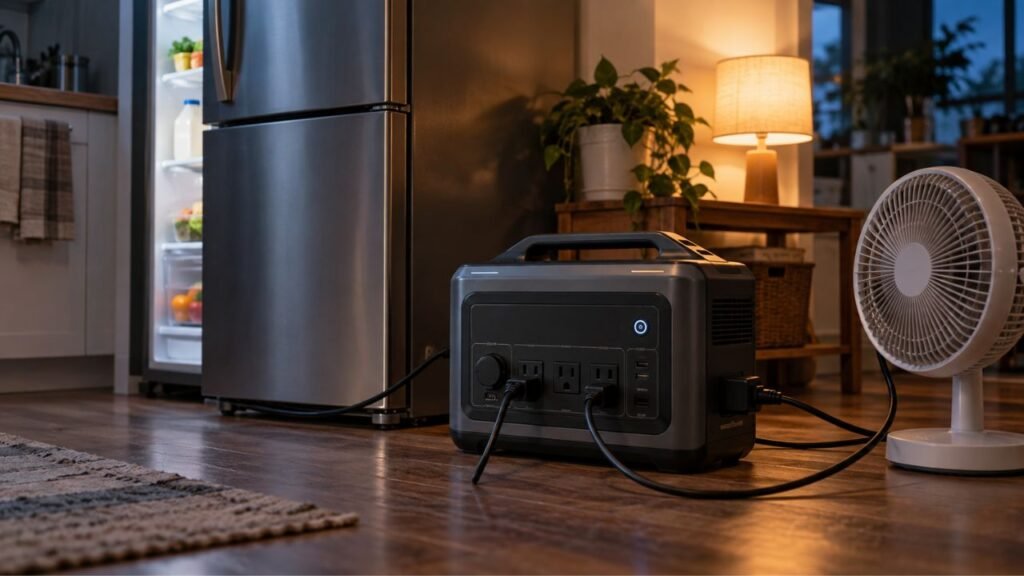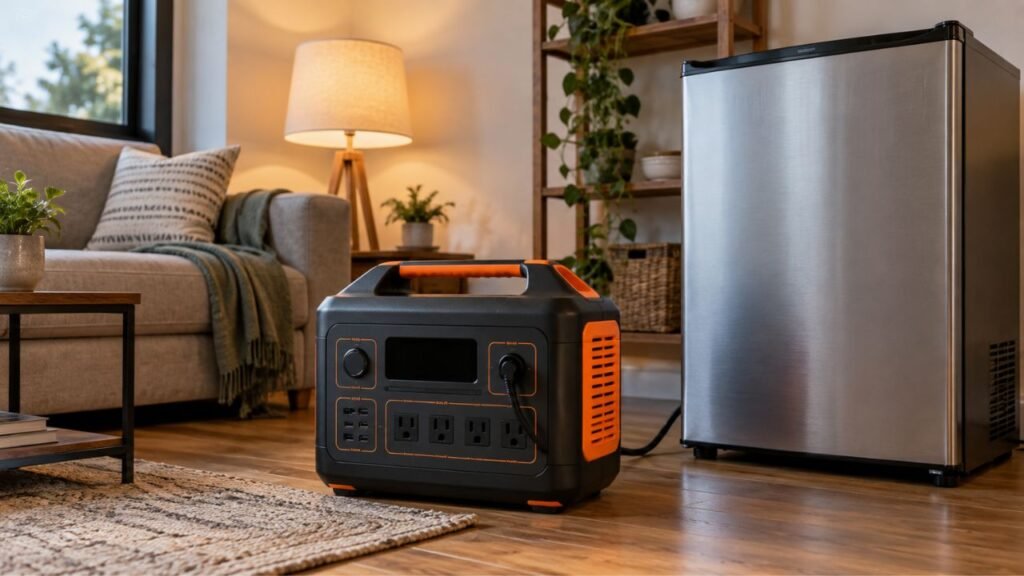
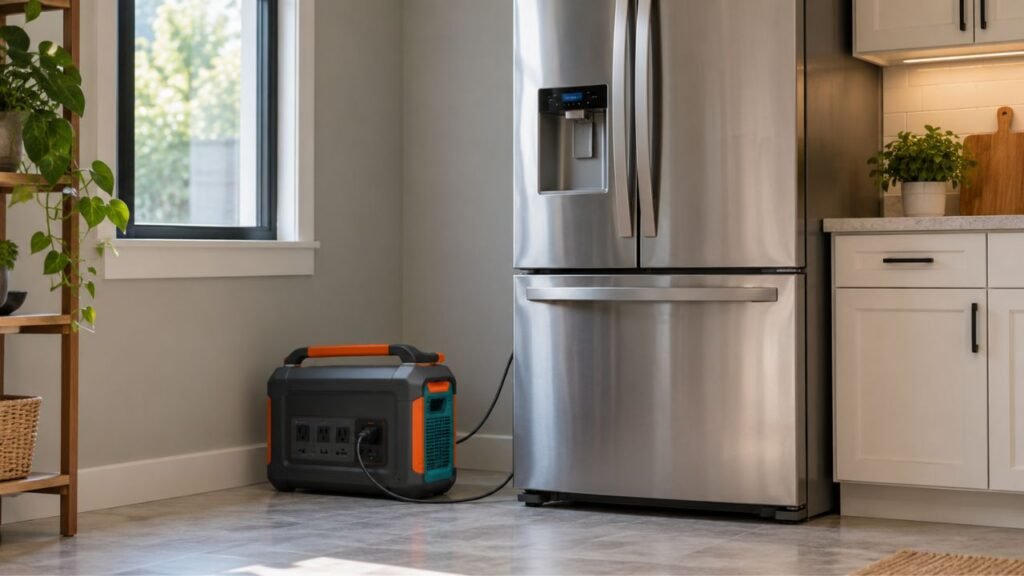
A refrigerator usually trips a portable power station because its compressor needs a brief burst of startup power. If that surge exceeds the station’s inverter limit, its protection system shuts down the AC output.
However, compressor surge is not the only possible cause. Low battery power, other connected appliances, overheating, Eco settings, poor connections, or refrigerator problems can cause similar shutdowns. I’ll help you narrow down which problem you’re actually dealing with.
Key Takeaways
- Refrigerator compressors can need much more power during startup.
- Running watts alone do not show the complete power requirement.
- Watt-hours affect runtime but do not determine startup capability.
- Other connected appliances can leave insufficient inverter headroom.
- Eco or AC timeout settings can mimic an overload shutdown.
- Low battery levels and high temperatures may trigger protection.
- Repeated clicking or humming can indicate a refrigerator problem.
- Shutdown timing can help identify the most likely cause.
Why Does a Refrigerator Trip a Portable Power Station?
Your refrigerator contains a compressor powered by an electric motor. That motor normally needs considerably more electricity when starting than while running.
For example, your refrigerator might settle around 150 watts during normal operation. Its compressor could briefly demand several times that amount during startup.
Your portable power station’s inverter must supply that brief demand.
If the demand exceeds its allowed surge output, protection circuitry shuts the AC outlet down. This prevents excessive current from damaging the inverter, battery, wiring, or connected equipment.
That’s why a refrigerator can trip a station rated well above its normal running wattage.
However, don’t immediately assume the power station is too small. The exact shutdown timing can reveal several other problems.
Diagnose the Problem by When the Power Station Trips
Pay attention to exactly when the refrigerator causes the shutdown. That detail can quickly point you toward the most likely problem.
| When the shutdown happens | Likely cause | Check first |
| Immediately when compressor starts | Startup surge overload | Surge output rating |
| Refrigerator hums before shutdown | Difficult compressor startup | Fridge condition and surge demand |
| Works alone but fails with other appliances | Combined overload | Total connected wattage |
| Works initially but trips later | Marginal startup headroom | Later compressor cycles |
| Trips as battery gets low | Battery protection or reduced headroom | Battery percentage |
| Trips after extended operation | Thermal protection | Station temperature and ventilation |
| AC outlet shuts down while fridge rests | Eco mode or AC timeout | Power-saving settings |
| Fails only through extension cord | Voltage drop or bad connection | Cord size and condition |
| Also struggles on household electricity | Refrigerator problem | Compressor or start components |
This approach saves you from replacing equipment unnecessarily.
Let’s go through each possible cause more carefully.
What Causes a Refrigerator to Overload a Portable Power Station?
Several conditions can trigger an actual overload or produce similar symptoms. Start with compressor surge, then work through the less obvious possibilities.
The Compressor Startup Surge Exceeds the Inverter Limit
This is the most common reason refrigerators trip portable power stations.
Your refrigerator compressor is basically a motor. Motors require additional current to begin turning from a complete stop.
Once the compressor reaches normal speed, its electrical demand falls significantly.
Suppose your refrigerator uses around 140 watts while running. Seeing that number might make a 500-watt power station seem sufficient.
But the compressor could momentarily demand much more during startup.
If your station cannot supply that brief surge, its inverter shuts down.
You may see an overload warning, hear an alarm, or notice the AC outlets suddenly turn off.
Do not rely on one universal startup multiplier either.
Different refrigerators use different compressor technologies. Refrigerator size, age, temperature, operating conditions, and compressor design all affect starting demand.
Other Appliances Leave Too Little Surge Headroom
Sometimes your portable power station can start the refrigerator perfectly by itself.
The problem appears when other appliances remain connected.
Imagine your station supports 1,000 watts continuously. Your refrigerator might normally consume only 150 watts.
But perhaps you are simultaneously powering:
- A television
- Wi-Fi equipment
- Phone chargers
- A fan
- A coffee maker
- Another refrigerator or freezer
The refrigerator compressor suddenly starts while those loads remain active.
Now the inverter must support everything at the same moment.
Even several relatively small loads can remove the surge margin your refrigerator needs.
High-wattage heating appliances create an even bigger problem.
Microwaves, coffee makers, electric kettles, heaters, and toaster ovens can consume most of a smaller inverter’s available output.
Testing the refrigerator alone is therefore one of your best first steps.
The Battery Is Very Low
A low battery does not automatically mean your refrigerator cannot start.
However, a nearly depleted station can create problems in marginal setups.
Portable power stations have battery management systems protecting their internal cells. When battery voltage falls too far, the station may reduce output or shut down completely.
A compressor starting at that moment adds a sudden heavy demand.
Your display could still show some remaining battery capacity. Yet the station may reach its low-voltage protection threshold under that brief load.
This is especially important when your refrigerator normally starts successfully with a fully charged station.
If problems appear only below a certain battery percentage, test again after fully charging the unit.
The Power Station Is Too Hot or Too Cold
Portable power stations operate within specified temperature ranges.
When internal temperatures become excessive, protection systems may reduce output or completely shut the inverter down.
Common causes include:
- Blocked cooling vents
- Direct sunlight
- Poor airflow
- Hot garages
- Enclosed cabinets
- Heavy continuous loads
Cold temperatures can also reduce available battery performance.
This becomes particularly important during winter outages when the station sits inside an unheated garage, shed, or vehicle.
If temperature protection appears on the display, disconnect unnecessary loads.
Allow the station to return to its recommended operating temperature.
Never cover the power station to keep it warm while operating. Doing so can interfere with cooling and create another problem.
A Defrost Heater or Other Refrigerator Load Turns On
Your refrigerator does not always consume exactly the same power.
Modern refrigerators may contain several electrical components besides the compressor.
Depending on the model, these can include:
- Evaporator fans
- Condenser fans
- Defrost heaters
- Ice makers
- Door heaters
- Electronic controls
- Water dispensers
An automatic defrost cycle can temporarily change overall power consumption.
Your station might handle normal cooling cycles comfortably but have less available margin when another refrigerator component operates.
That does not mean every refrigerator runs all these loads simultaneously.
Control strategies differ substantially between models.
The important point is that refrigerator power demand changes throughout normal operation.
The Compressor Is Restarting Too Soon
Here’s one cause people often overlook.
A refrigerator compressor can have more difficulty restarting immediately after stopping.
Refrigerant pressures inside the cooling system may need time to equalize.
If power suddenly disappears and immediately returns, the compressor may attempt to restart against higher pressure.
That can temporarily increase starting difficulty.
You might notice:
- Humming
- Clicking
- Brief startup attempts
- Station overload warnings
- Repeated shutdowns
Avoid rapidly switching the refrigerator off and back on repeatedly.
If the power station trips, give the refrigerator time before attempting another restart. Follow the restart guidance provided by your refrigerator manufacturer.
An Extension Cord Causes Excessive Voltage Drop
Your refrigerator should ideally connect directly to the power station during troubleshooting.
Long or undersized extension cords add electrical resistance.
That resistance can cause voltage drop, particularly when the compressor suddenly demands additional current during startup.
A poor connection creates similar problems.
Check for:
- Loose plugs
- Damaged receptacles
- Burned contacts
- Frayed cables
- Undersized extension cords
- Very long extension cords
If the refrigerator works when connected directly but fails through the extension cord, investigate the cord before blaming the power station.
Never continue using plugs or cords that become unusually hot.
The Refrigerator Has a Starting Problem
Sometimes the power station is doing exactly what it should.
The refrigerator itself may be developing a problem.
A failing compressor, start relay, capacitor, or related component can make compressor startup harder than normal.
Watch for warning signs such as:
- Repeated clicking
- Compressor humming without starting
- Unusually hot compressor housing
- Frequent failed restart attempts
- Poor cooling performance
- Problems even on household power
One especially useful test is connecting the refrigerator back to normal utility power.
If the same starting difficulty continues, the portable station might not be your primary problem.
A qualified appliance technician should inspect refrigerator-side electrical or compressor problems.
Running Watts, Surge Watts, and Watt-Hours Are Different
Three specifications cause considerable confusion when people size portable power stations.
Running watts describe how much power an appliance uses during normal operation.
Surge watts describe the brief additional power required by certain loads during startup.
Watt-hours describe how much energy the battery stores.
These numbers answer different questions.
Suppose your refrigerator runs at 150 watts.
A 2,000Wh power station could theoretically provide much more runtime than a 1,000Wh model.
However, imagine both stations have relatively weak inverters.
If neither inverter can supply the refrigerator’s startup demand, both units could trip immediately despite having different battery capacities.
So remember this simple distinction:
Watt-hours determine approximately how long you can run something. Inverter output determines whether you can successfully start and operate it.
Both specifications matter, but they solve different problems.
How Can You Find Your Refrigerator’s Startup Power?
Generic refrigerator wattage charts provide rough estimates, not guaranteed answers. Your own refrigerator’s specifications are more useful for accurate troubleshooting.
Check the Refrigerator Manual and Data Plate
Start with your refrigerator’s model number and electrical label.
Depending on the refrigerator, you may find information including:
- Rated voltage
- Current in amps
- Rated wattage
- Frequency
- Compressor specifications
- Locked-rotor amperage
Do not assume multiplying volts by amps always gives exact real-world running watts.
With AC motors, volts multiplied by amps describes apparent power in volt-amperes. Actual watts can differ because motor loads have a power factor.
You do not need to become an electrical engineer here.
The important point is avoiding false precision from one simple calculation.
Check the Manufacturer’s Specifications
If startup information is missing from the refrigerator label, check its manual or manufacturer documentation.
The manufacturer may provide electrical requirements for your exact model.
That’s more reliable than assuming every standard refrigerator has identical startup behavior.
You can also contact the refrigerator manufacturer if you’re planning outage-critical backup power.
Ask specifically about compressor starting current or maximum startup demand.
Measure the Refrigerator’s Startup Behavior
A plug-in electricity meter can help you understand refrigerator consumption.
It works well for checking:
- Normal running wattage
- Average consumption
- Daily energy use
- General runtime planning
However, inexpensive meters may not capture extremely short startup surges accurately.
The compressor surge can happen too quickly for some displays.
Equipment designed to capture inrush current provides better startup measurements.
For most homeowners, you don’t necessarily need specialized test equipment.
If the station consistently displays an overload warning exactly when the compressor starts, you already have useful evidence.
How Do You Troubleshoot a Refrigerator That Trips a Power Station?
Work through these checks in order. Changing one thing at a time makes identifying the actual cause much easier.
- Disconnect every other appliance from the station.
Leave only the refrigerator connected during your first test. - Fully recharge the portable power station.
This removes low battery protection from the troubleshooting equation. - Check the station’s temperature.
Make sure cooling vents are open and unobstructed. - Look for an error message.
Check whether the display reports overload, temperature, battery, or inverter protection. - Compare the refrigerator and inverter specifications.
Look at both continuous output and surge capability. - Disable Eco or AC auto-off temporarily.
Do this only if your station’s manual permits changing that setting. - Connect the refrigerator directly when practical.
Remove unnecessary power strips, adapters, and extension cords. - Avoid immediate compressor restarts.
Give the refrigerator some time after a shutdown. - Start the refrigerator and watch the station display.
Pay attention to wattage changes and warning indicators. - Let the refrigerator complete several cooling cycles.
One successful startup does not prove long-term compatibility. - Reconnect additional appliances individually.
Watch how each device affects available inverter headroom. - Test the refrigerator on household power if problems continue.
Repeated humming or clicking may indicate an appliance problem.
If the station works normally with other appliances but always trips during refrigerator startup, inverter compatibility becomes increasingly likely.
Why Does the Refrigerator Run at First and Trip Later?
A successful first startup does not guarantee every later startup will succeed.
Several conditions can change as your refrigerator continues running.
The battery level gradually falls. The power station becomes warmer. You may connect additional devices. The compressor may restart under different pressure conditions.
Your refrigerator may also enter another operating cycle.
Another possibility is the station’s power-saving system.
The refrigerator compressor turns off after reaching its temperature target. During that idle period, electrical demand can become extremely low.
Some power stations interpret prolonged low demand as inactivity.
Their AC output then shuts off automatically.
When the refrigerator later needs cooling again, no AC power remains available.
That looks like the refrigerator tripped the station, although no real overload occurred.
Check the station’s display and error history before assuming surge overload.
Could Eco Mode Make the Power Station Look Like It Tripped?
Yes. Some Eco settings can create exactly that symptom.
Power stations often include energy-saving features designed to prevent inverter standby losses.
The feature may be called:
- Eco mode
- AC timeout
- Auto-off
- Power-saving mode
- Sleep mode
Your refrigerator naturally cycles between higher and lower power consumption.
Once the compressor stops, the remaining load may become too small for the station’s Eco-mode threshold.
The station eventually switches its AC inverter off.
Hours later, you discover a warm refrigerator and assume the inverter overloaded.
Before changing equipment, temporarily disable automatic AC shutdown according to your station’s manual.
Then test the refrigerator through several compressor cycles.
If the problem disappears, your equipment may be compatible after all.
Remember that keeping the inverter permanently active can increase standby energy consumption.
Does a Refrigerator Need a Pure Sine Wave Power Station?
Pure sine wave AC is the preferred choice for refrigerator compressors.
Most good modern portable power stations already use pure sine wave inverters.
Their output more closely resembles normal household AC electricity.
Older or inexpensive modified sine wave inverters can cause certain motor appliances to operate poorly.
Possible symptoms include:
- Additional motor noise
- Higher operating temperature
- Difficult compressor starts
- Reduced efficiency
- Unstable operation
Still, waveform problems should not be your first assumption.
If your modern station clearly specifies pure sine wave output, investigate startup surge and protection settings first.
Will a Bigger Portable Power Station Stop the Refrigerator From Tripping?
Only if the larger station also provides enough inverter output.
This distinction matters because people often shop by battery capacity alone.
Imagine two portable power stations:
Station A stores 2,000Wh but has relatively modest inverter capability.
Station B stores 1,000Wh but includes a much stronger inverter.
Station B could start your refrigerator more reliably despite storing less energy.
The larger battery in Station A mainly provides longer potential runtime.
So when upgrading for refrigerator backup, compare:
- Continuous AC output
- Surge or peak output
- Surge duration
- Battery capacity
- Output waveform
- Operating temperature range
Do not simply buy the highest watt-hour number you can afford.
Your goal is sufficient startup capability plus enough battery capacity for your desired outage duration.
How Much Surge Capacity Should a Power Station Have for a Refrigerator?
There is no single surge rating that guarantees compatibility with every refrigerator.
Some compact refrigerators have relatively modest startup demands.
Large refrigerators, older compressors, or difficult starting conditions can require considerably more.
Your safest approach is checking the actual refrigerator specifications.
Then choose an inverter with reasonable headroom above that requirement.
Avoid sizing the station right at the estimated maximum startup demand.
Real-world conditions change.
Battery level, temperature, extension cords, simultaneous appliances, and compressor conditions can all influence available margin.
Extra inverter headroom gives the system room to handle those changes.
Also remember that surge specifications differ between manufacturers.
One company might advertise a very brief peak figure. Another may support additional output for a longer period.
Check how the manufacturer defines its surge rating whenever possible.
Should You Use X-Boost or Power-Lifting Mode for a Refrigerator?
Be careful with high-wattage enhancement modes.
Some portable power stations include features called X-Boost, Power Lifting, or similar names.
These features can help certain appliances operate beyond the station’s normal continuous rating.
However, they do not necessarily provide more genuine compressor-starting capability.
Some systems support high-wattage loads by reducing AC voltage.
That approach can work well with simple resistive appliances, including certain heaters.
A refrigerator compressor is different.
Its motor and electronic controls may expect normal voltage.
Do not enable one of these modes simply because your refrigerator trips the station.
Check whether your specific power station manufacturer recommends that feature for compressor appliances.
If refrigerator compatibility is unclear, leave normal pure sine wave output enabled.
When Should You Suspect the Refrigerator Instead of the Power Station?
Sometimes the portable power station correctly detects an abnormal refrigerator load. These warning signs make an appliance problem more likely:
- The refrigerator also struggles on household electricity.
- The compressor repeatedly clicks without starting.
- You hear prolonged humming before shutdown.
- The compressor becomes unusually hot.
- Cooling performance has recently become worse.
- The fridge repeatedly starts and stops unexpectedly.
- Similar motor appliances work normally from the station.
Do not compensate for a failing refrigerator by repeatedly increasing inverter size.
A deteriorating compressor or start component should be inspected directly.
Continuing repeated failed startups can place additional stress on the refrigerator.
When Should You Stop Troubleshooting?
Most basic checks are simple, but certain symptoms require stopping immediately. Do not continue testing when you notice:
- A burning electrical smell
- A hot plug or receptacle
- Melted or discolored connectors
- Damaged power cables
- A swollen power station enclosure
- Repeated battery fault warnings
- Smoke from either device
- Moisture around electrical connections
- Persistent compressor clicking
- Protection faults that immediately return
Never open a portable power station to repair its inverter or battery.
These systems can store hazardous electrical energy even when switched off.
Also never bypass an overload or temperature protection system.
Protection circuits are shutting the equipment down for a reason.
What Should You Do If the Refrigerator Cannot Stay Powered During an Outage?
If troubleshooting takes time, protect your food while you investigate.
Keep refrigerator doors closed as much as possible.
An unopened refrigerator can generally maintain safe temperatures for about four hours during a power outage.
Keep the refrigerator at or below 40°F whenever possible.
For longer outages, move highly perishable foods into a well-chilled cooler with sufficient ice or another reliable cold source.
Avoid repeatedly opening the refrigerator just to check the temperature.
Every door opening allows cold air to escape.
Once you have stable backup power, reconnect the refrigerator and confirm several successful compressor cycles.
Conclusion
A refrigerator usually trips a portable power station because compressor startup briefly exceeds available inverter output. But don’t assume surge is responsible every time.
First, notice exactly when the shutdown occurs.
Test the refrigerator alone with a fully charged, properly ventilated station. Check inverter ratings, warning codes, AC timeout settings, battery level, connections, and compressor behavior.
If the refrigerator works initially but fails later, investigate Eco settings, temperature, battery level, and changing refrigerator loads.
If it also struggles on household electricity, the refrigerator itself deserves attention.
The goal is not simply buying a larger battery. You need enough inverter headroom, dependable connections, and a refrigerator that starts normally.
Related FAQs
Why Does My Power Station Shut Off When the Refrigerator Compressor Starts?
The compressor probably creates a startup surge exceeding the inverter’s short-term output capability. The station detects excessive demand and switches off its AC output to protect itself, even though normal refrigerator running wattage may be much lower.
Can a 1,000-Watt Portable Power Station Run a Refrigerator?
Possibly. A 1,000-watt continuous rating alone does not guarantee refrigerator compatibility because compressor startup demand matters. Check the station’s surge capability and compare it with the actual starting requirements of your refrigerator.
Why Does My Refrigerator Run for an Hour and Then Trip the Power Station?
Later shutdowns can result from another compressor startup, lower battery charge, increasing inverter temperature, additional connected appliances, automatic refrigerator functions, or an AC timeout setting that switches the inverter off during low-load periods.
Will a Larger Battery Stop My Refrigerator From Tripping?
Not necessarily. A larger watt-hour battery mainly extends runtime. Your refrigerator still needs an inverter capable of handling both normal running power and compressor startup demand, so compare inverter ratings before upgrading.
Can Eco Mode Shut Off Power to a Refrigerator?
Yes. Some power stations automatically disable AC output when connected loads remain very low. Since refrigerators spend considerable time with their compressors off, certain Eco settings can mistake that idle period for inactivity.
Can a Refrigerator Defrost Cycle Trip a Portable Power Station?
It can in some setups. Automatic defrost systems may temporarily add electrical demand. If your portable station already operates near its inverter limit, additional refrigerator loads could push total consumption beyond available output.
Does a Refrigerator Need a Pure Sine Wave Inverter?
Pure sine wave power is preferred for refrigerator compressors and electronics. Most modern quality portable power stations provide it. Modified sine wave output may cause additional noise, heat, inefficient operation, or difficult compressor starting.
Why Does My Refrigerator Trip the Station Only When the Battery Is Low?
A nearly depleted battery can reach its protection threshold when the compressor suddenly starts. The refrigerator may operate normally at higher charge levels but trigger low-voltage or battery protection once available energy falls substantially.
Can an Extension Cord Make a Refrigerator Trip a Power Station?
Yes. A long, damaged, or undersized extension cord can create additional voltage drop during compressor startup. Test the refrigerator directly from the station when practical to determine whether the cord contributes to the shutdown.
How Do I Measure Refrigerator Startup Watts?
Start with manufacturer specifications when available. A plug-in watt meter can measure normal consumption, but basic models may miss very brief compressor surges. Equipment designed to capture inrush current provides more accurate startup measurements.

Warren Turner writes practical guides and reviews on generators, portable power stations, and battery backup systems. He focuses on real-world performance, everyday power needs, and helping readers choose dependable equipment without unnecessary complexity.