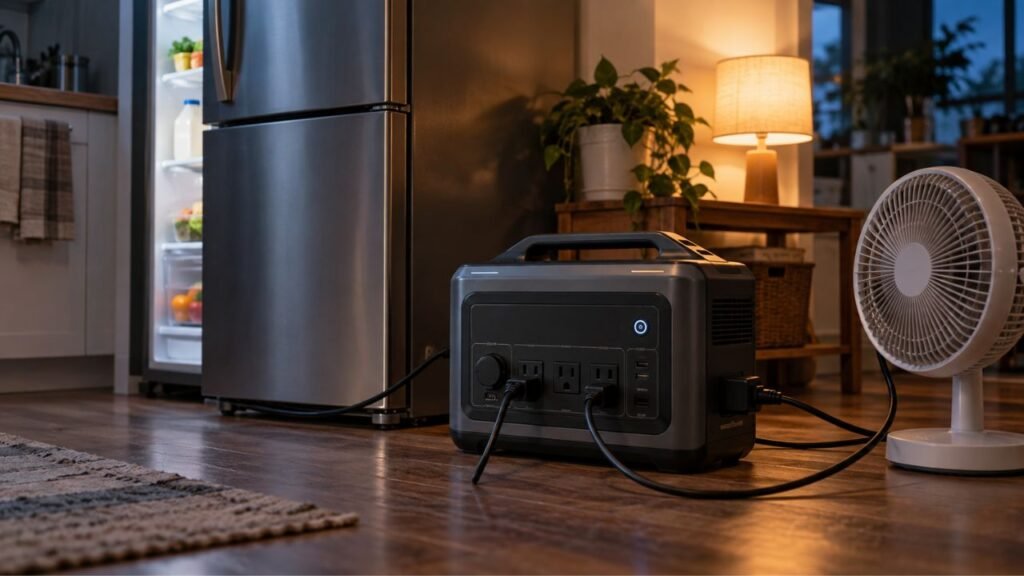
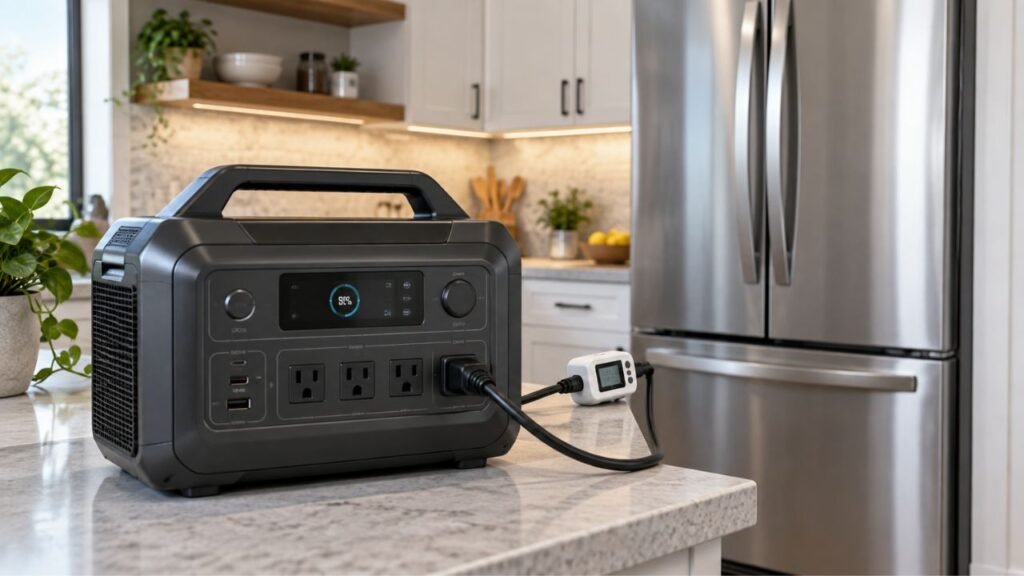
The best way to measure refrigerator startup watts is using a power meter designed to capture peak or inrush demand. Measure several normal compressor startups, then use the highest reliable reading when checking your portable power station’s surge capability.
This article shows you several practical measurement methods. You’ll also learn which readings matter, which shortcuts mislead, and how to size your power station correctly.
Key Takeaways
- Refrigerator startup demand is much higher than normal running demand.
- A basic live watt meter may miss a brief compressor surge.
- Use a meter with documented peak or inrush measurement capability.
- Measure several compressor starts instead of relying on one test.
- Volts multiplied by amps gives VA, not always actual watts.
- Compressor LRA can help when direct measurement is unavailable.
- Compare startup demand with your power station’s surge output.
- Running watts must also stay below continuous AC output.
- Battery capacity does not determine whether the compressor will start.
- Leave some output headroom for other connected household devices.
What Are Refrigerator Startup Watts?
Your refrigerator does not pull one fixed amount of power continuously. Its electrical demand changes depending on what components are operating.
Understanding those different loads makes your measurements much more useful.
Running Watts
Running watts describe the power your refrigerator uses during normal operation.
When the compressor is running, your refrigerator might draw considerably more power than when the compressor is resting. Fans, lights, control boards, heaters, and ice-making components can also affect the reading.
This means you should not confuse average energy consumption with compressor running watts.
Your refrigerator may average relatively little power across an entire day. However, its compressor can still create a much larger temporary load.
Startup Watts and Inrush Current
The compressor contains an electric motor that needs extra current during startup.
For a brief moment, the motor can demand significantly more current than normal. This temporary electrical demand is usually called startup surge or inrush current.
That short surge matters greatly when using portable power stations.
Your power station might comfortably supply the refrigerator after startup. However, its inverter could shut down during the initial compressor surge.
That explains why a refrigerator sometimes runs perfectly from wall power yet trips a smaller power station.
Startup Watts vs. VA
This distinction is easy to overlook when measuring refrigerator loads.
For a simple DC circuit, multiplying volts by amps gives watts. AC appliances with motors are slightly different because power factor also matters.
For AC loads:
Apparent Power in VA = Volts × Amps
Active power can be estimated using:
Watts = Volts × Amps × Power Factor
Suppose a compressor startup reaches 8 amps on a 120-volt circuit.
The apparent starting demand would be:
120V × 8A = 960VA
That does not automatically mean the compressor consumes exactly 960 real watts.
However, VA can still be useful when evaluating inverter startup stress.
For everyday power station sizing, I recommend remaining conservative rather than chasing an overly precise number.
What Is the Best Way to Measure Refrigerator Startup Watts?
You have several practical measurement options available. Some are easier, while others capture compressor startup more accurately.
The best method depends on your equipment and desired accuracy.
| Measurement Method | Equipment Needed | Captures Startup Well? | Difficulty | Best Use |
| Peak-capable plug-in meter | Power meter with peak recording | Yes, when properly designed | Easy | Most homeowners |
| Inrush clamp meter | Clamp meter and line splitter | Yes | Moderate | Detailed testing |
| Compressor LRA | Appliance or compressor specifications | Estimates startup demand | Easy | When meters are unavailable |
| Basic plug-in watt meter | Standard watt meter | Sometimes misses peak | Easy | Running watts |
| Running watts multiplier | Calculator only | No | Very easy | Rough estimate only |
A plug-in meter with genuine peak recording is usually easiest.
However, check the meter specifications carefully. A display showing live watts does not necessarily capture very short startup events.
For more technical testing, an inrush-capable clamp meter works well.
If neither option is available, compressor specifications provide another useful path.
How to Measure Refrigerator Startup Watts With a Plug-In Meter
A plug-in meter makes refrigerator testing straightforward. However, the meter must actually capture short peak loads.
Follow these steps carefully for a useful measurement:
- Check whether your meter supports peak or maximum power recording.
- Plug the meter directly into a suitable grounded wall outlet.
- Plug your refrigerator power cord into the meter.
- Select the meter’s peak, maximum, or startup recording function.
- Allow your refrigerator to operate under normal conditions.
- Wait until the compressor shuts off naturally.
- Continue monitoring until the compressor starts again.
- Record the highest startup value captured by your meter.
- Allow another normal operating cycle to complete.
- Repeat the test several times for better confidence.
- Keep the highest believable startup reading you recorded.
Do not rely only on the number shown during normal compressor operation.
For example, your refrigerator might settle around 140 watts while running. During startup, the meter could briefly record several times that amount.
That larger number is the important measurement for surge sizing.
The 140-watt figure still matters, but for continuous output instead.
Should You Unplug the Refrigerator to Force the Compressor to Start?
Waiting for a natural compressor cycle is usually the better testing method.
It gives you a startup event under ordinary refrigerator operating conditions. You also avoid unnecessary repeated power cycling.
If you disconnect your refrigerator, do not reconnect it immediately.
Refrigeration systems can retain pressure after the compressor stops. Restarting too quickly may create a harder-than-normal startup condition.
Some refrigerators also include internal restart delays.
If you need to disconnect the refrigerator, follow its manufacturer instructions before reconnecting power.
Waiting several minutes is common, but the correct delay depends on your refrigerator.
For this reason, I prefer measuring several natural startup cycles whenever possible.
It provides a more representative picture of normal backup-power requirements.
How to Measure Refrigerator Inrush With a Clamp Meter
A clamp meter can provide more detailed startup-current information. However, you need the correct meter and measurement setup.
You should use this method only with equipment intended for AC appliance testing.
What Equipment Do You Need?
Use a clamp meter that specifically includes an inrush-current function.
You will also need an AC line splitter designed for standard household loads.
The line splitter separates conductors safely for clamp-meter measurement. You should never cut or open your refrigerator power cord.
A suitable setup normally includes:
- A clamp meter with inrush measurement capability
- A properly rated AC line splitter
- A grounded 120-volt household outlet
- Your refrigerator’s original power cord
Make sure every component handles the refrigerator’s expected current safely.
How to Take the Reading
Plug the line splitter into your wall outlet first.
Next, plug the refrigerator into the line splitter.
Place your clamp meter around the designated measurement section. Follow the line splitter and meter instructions carefully.
Select the inrush measurement mode before compressor startup.
Then allow the refrigerator compressor to start naturally.
The meter should capture the short current spike during startup.
Record the inrush-current result.
Repeat the process across several normal compressor cycles.
Suppose the highest reading is 7.5 amps at approximately 120 volts.
Your starting apparent power would be roughly:
7.5A × 120V = 900VA
I would use that information conservatively when evaluating inverter surge capability.
Why Can’t You Clamp Around the Whole Refrigerator Cord?
A clamp meter normally needs to measure one conductor.
Your refrigerator cord contains both outgoing and returning current conductors. Their magnetic fields largely cancel when measured together.
Clamping around the complete cord can therefore produce an incorrect reading.
That is why an AC line splitter is useful.
It provides a safe measurement point without modifying your refrigerator wiring.
Can You Calculate Startup Watts From the Refrigerator Label?
Sometimes the refrigerator label gives useful electrical information. However, you need to understand what each number actually represents.
Do not assume every number printed there describes compressor startup.
If the Label Gives Watts
A wattage number may describe normal appliance demand or rated input.
That number can help estimate continuous power requirements.
However, it may not represent the brief compressor startup surge.
Check your refrigerator documentation if the meaning is unclear.
If the Label Gives Volts and Amps
Many appliance labels provide voltage and amperage instead of watts.
You might see something similar to:
120V, 3.2A
Multiplying those values gives:
120 × 3.2 = 384VA
That figure represents apparent power based on the listed current.
It does not necessarily mean the refrigerator consumes exactly 384 watts continuously.
The listed amperage can also represent a rated operating condition rather than compressor startup.
Use label values as supporting information, not perfect startup measurements.
If You Find LRA on the Compressor
Compressor specifications sometimes include a value called LRA, meaning Locked Rotor Amps.
LRA represents a very high motor-current condition associated with the compressor starting against little or no rotation.
It can provide useful information when direct measurement is impossible.
For example, suppose the compressor lists:
LRA: 10 amps
On a nominal 120-volt supply:
10A × 120V = approximately 1,200VA
That gives you a conservative picture of potential starting stress.
However, actual normal startup behavior may differ from the listed LRA.
RLA vs. LRA
You may also find RLA, meaning Rated Load Amps.
RLA is associated with normal loaded compressor operation.
LRA is much higher because it relates to the motor’s starting condition.
Do not use RLA alone when estimating refrigerator startup demand.
For portable power station sizing, the higher startup condition matters greatly.
Why a Basic Kill A Watt-Style Meter May Miss the True Startup Surge
A standard plug-in watt meter can still be extremely useful.
It can show running watts, voltage, amps, power factor, and energy consumption. However, not every model captures very short compressor peaks.
The issue is measurement speed.
A refrigerator startup surge can happen faster than the meter display updates.
You might watch the screen and see:
80W → 220W → 150W
Meanwhile, the actual startup event could have briefly climbed much higher.
The meter simply may not display that short peak.
That does not mean your meter is defective.
It means live wattage and peak capture are different measurement functions.
Before relying on any meter, check whether its specifications mention:
- Peak watts
- Maximum watts
- Startup current
- Inrush current
- Peak hold
- Fast transient capture
If none appear, use the meter mainly for running-load measurements.
You can then use another method for compressor startup demand.
Why Should You Measure More Than One Compressor Startup?
One startup measurement gives useful information. Several measurements provide much more confidence.
Refrigerator startup demand can vary slightly between compressor cycles.
Several conditions can influence the reading:
- Refrigerator internal temperature
- Room temperature around the appliance
- Household supply voltage
- Compressor temperature
- Time since the compressor last stopped
- Refrigerant pressure inside the system
- Defrost-cycle activity
- Fans or heaters operating simultaneously
- Condition of compressor starting components
- Refrigerator age and mechanical condition
I recommend measuring at least several normal startup cycles.
You might record 620W, 705W, 680W, and 735W.
In that situation, I would plan around approximately 735W or higher.
Do not average those measurements when checking surge capability.
The power station must handle the more demanding compressor startups.
Do Inverter Refrigerators Have the Same Startup Surge?
Not every refrigerator starts its compressor the same way.
Many newer refrigerators use inverter-driven or variable-speed compressors instead of traditional fixed-speed compressor motors.
These designs can control compressor speed more gradually.
As a result, startup behavior may differ considerably from older refrigerators.
That is another reason generic multiplication rules can become misleading.
A traditional compressor might produce a sharp initial current surge.
An inverter compressor may ramp differently depending on its control system.
However, you should not automatically assume every inverter refrigerator has negligible startup demand.
Measure your specific refrigerator whenever possible.
Manufacturer specifications can also provide useful supporting information.
How Do You Match the Measured Startup Watts to a Portable Power Station?
Getting the refrigerator measurement is only half the job.
Now you need to compare those numbers with your portable power station specifications.
Compare Startup Demand With Surge Output
First, find your highest reliable refrigerator startup measurement.
Then check your portable power station’s AC surge rating.
Suppose your refrigerator records a 760-watt startup event.
A power station capable of only 600 watts surge is clearly undersized.
A station rated exactly around 760 watts would also leave little margin.
I prefer leaving reasonable headroom whenever compressor loads are involved.
Startup conditions can vary between refrigerator cycles.
Other appliances may also be consuming power during compressor startup.
Compare Running Watts With Continuous AC Output
Next, check the refrigerator’s steady running demand.
Suppose your refrigerator uses approximately 145 watts once running.
Your portable power station must supply that continuously without overload.
Most medium-sized units can handle 145 watts easily.
However, things change when several appliances share the inverter.
A refrigerator using 145 watts plus other household loads could approach the station’s continuous limit.
Allow Headroom for Other Loads
Imagine your backup system powers these devices:
- Refrigerator: 145W running
- Wi-Fi router: 15W
- Television: 90W
- Several lights: 40W
- Laptop charger: 65W
Your steady total would already approach 355 watts.
Now imagine the refrigerator compressor suddenly needs 760 watts to start.
The power station must temporarily support that startup demand alongside other active loads.
That is why sizing from refrigerator wattage alone can cause problems.
Calculate simultaneous loads before relying on the system during an outage.
Battery Capacity Does Not Fix an Undersized Inverter
This is one of the most common backup-power misunderstandings.
Battery capacity tells you approximately how much stored energy is available.
Inverter output determines how much power the station can deliver.
Those are completely different limitations.
A power station with a huge 2,000Wh battery could still fail.
Its inverter might simply lack enough surge output for compressor startup.
Likewise, a smaller-capacity station might start the refrigerator easily.
It may simply run out of stored energy sooner.
Always check watts and watt-hours separately.
Example: Measuring a Refrigerator Before Choosing a Power Station
A simple example makes the entire process easier to understand.
Suppose you test a standard household refrigerator across three normal compressor starts.
| Measurement | Example Result |
| Compressor off | 8W |
| Compressor running | 145W |
| Startup test 1 | 690W |
| Startup test 2 | 760W |
| Startup test 3 | 725W |
| Highest measured startup | 760W |
These numbers are only examples, not universal refrigerator ratings.
The refrigerator normally needs around 145 watts while its compressor runs.
However, the highest measured startup event reached 760 watts.
For power station selection, those numbers serve different purposes.
Use 145 watts when checking continuous inverter output.
Use 760 watts when evaluating compressor startup capability.
I would not choose a station rated exactly at 760 watts surge.
Providing additional headroom helps accommodate changing startup conditions.
You must also account for any other loads running simultaneously.
Finally, choose battery capacity based on desired refrigerator runtime.
That requires energy consumption in watt-hours rather than startup watts.
Common Mistakes When Measuring Refrigerator Startup Watts
Several simple mistakes can produce misleading results.
Avoid these problems before choosing your portable power station:
- Using normal running watts as the startup requirement
- Relying only on the refrigerator’s annual EnergyGuide consumption
- Assuming every plug-in watt meter records short peaks
- Watching only the power station’s built-in display
- Multiplying volts and amps and automatically calling it watts
- Taking only one compressor startup measurement
- Repeatedly unplugging and reconnecting the refrigerator
- Restarting the compressor immediately after shutting it down
- Testing while unknown household loads remain connected
- Ignoring the power station’s continuous output rating
- Looking only at battery watt-hour capacity
- Comparing surge ratings without considering simultaneous loads
- Assuming every refrigerator needs the same startup multiplier
- Assuming a newer refrigerator cannot produce startup demand
The most important improvement is simple.
Measure your actual refrigerator whenever reliable equipment is available.
What If Your Refrigerator Still Trips the Portable Power Station?
Sometimes your numbers appear compatible, yet the refrigerator still causes shutdowns.
Work through the problem systematically before blaming either device.
Disconnect Other Loads
Start by powering only the refrigerator.
Remove chargers, televisions, lights, heaters, and other AC devices.
Then test another normal compressor startup.
If the refrigerator now starts successfully, simultaneous load was probably the issue.
Check the Station’s Actual Surge Specification
Portable power station marketing can make surge ratings confusing.
Check how much temporary power your specific model can actually provide.
Also check how long that surge output remains available.
A large advertised surge number is less useful if its operating limits do not match your refrigerator startup behavior.
Retest the Refrigerator Startup
Take another series of startup readings.
A previous test may not have captured the highest compressor demand.
Record several normal cycles before making another decision.
Check for Low Voltage or Abnormal Compressor Starting
An aging refrigerator may behave differently than it once did.
Worn start components or compressor problems can increase startup difficulty.
Low supply voltage can also affect motor startup behavior.
If startup current suddenly becomes unusually high, consider having the refrigerator inspected.
When Should You Have the Refrigerator Checked?
Consider professional inspection when the compressor repeatedly struggles to start.
Warning signs can include clicking, repeated cycling, humming, or unexpected shutdowns.
The problem may not be your portable power station.
A refrigerator that starts abnormally can overload otherwise suitable backup equipment.
Can You Estimate Refrigerator Startup Watts Without a Meter?
Yes, but direct measurement is generally more useful.
If you cannot measure startup demand, use the best available information.
I would rank estimation methods in this order:
- Manufacturer-provided startup or compressor specifications
- Compressor LRA information
- Reliable model-specific technical documentation
- Measured running load with conservative headroom
- Generic running-watt multiplier
You may often hear that refrigerator startup watts equal two or three times running watts.
That can work as a rough planning shortcut.
However, it should never be treated as a universal rule.
Different compressor designs can behave very differently.
An older refrigerator may also start differently from a modern inverter model.
When possible, use an actual measurement instead of a generic multiplier.
Conclusion
The most useful refrigerator startup measurement comes from equipment capable of capturing brief compressor demand. Measure several normal startups and keep the highest reliable result rather than relying only on running watts.
Then compare that startup demand with your portable power station’s surge output. Check continuous running watts separately, allow headroom for other loads, and size battery capacity according to the runtime you actually need.
Related FAQs
How Many Startup Watts Does a Typical Refrigerator Need?
There is no single startup-watt number for every refrigerator. Compressor type, refrigerator size, age, and design can all change startup demand, so measuring your specific appliance provides a more dependable answer.
Can I Measure Refrigerator Startup Watts With a Kill A Watt?
You can measure running watts with many Kill A Watt-style meters, but some models may not capture very short startup peaks. Check whether your exact meter supports peak, maximum, or inrush recording before relying on its startup reading.
How Many Times Should I Measure Refrigerator Startup Wattage?
Measure several normal compressor starts whenever possible. Three to five successful readings can reveal variation between cycles, and you should generally use the highest credible result for power station surge planning.
Is Refrigerator LRA the Same as Startup Watts?
No. LRA means Locked Rotor Amps and describes a high-current compressor condition. Multiplying LRA by voltage gives apparent power in VA, which can help estimate inverter startup stress but is not automatically exact real watts.
Does Volts Times Amps Equal Refrigerator Startup Watts?
Not necessarily for an AC compressor. Volts multiplied by amps gives apparent power in volt-amps, while actual watts also depend on power factor and the compressor’s electrical behavior.
Why Doesn’t My Portable Power Station Show the Full Refrigerator Surge?
Its display may refresh too slowly to show a very brief startup event. The inverter still experiences that surge even when the screen only shows a smaller number afterward.
Why Does My Refrigerator Run on Grid Power but Trip My Power Station?
Utility power can provide substantial short-duration motor-starting current. A portable power station has limited inverter output, so its overload protection may activate when the refrigerator compressor starts.
Does a Newer Inverter Refrigerator Have Lower Startup Watts?
Some inverter refrigerators ramp compressor speed more gradually and may have different startup behavior. However, designs vary, so you should not assume every inverter refrigerator has a small startup surge without checking or measuring it.
Is 1,000W Enough to Start a Refrigerator?
It can be enough for many refrigerators, but the answer depends on your specific compressor startup demand. Compare the refrigerator’s measured peak with the power station’s actual surge capability before relying on it.
Does Battery Capacity Affect Refrigerator Startup Power?
Battery capacity mainly affects runtime. The portable power station’s inverter output and surge capability determine whether it can successfully start the refrigerator compressor without triggering overload protection.

Warren Turner writes practical guides and reviews on generators, portable power stations, and battery backup systems. He focuses on real-world performance, everyday power needs, and helping readers choose dependable equipment without unnecessary complexity.