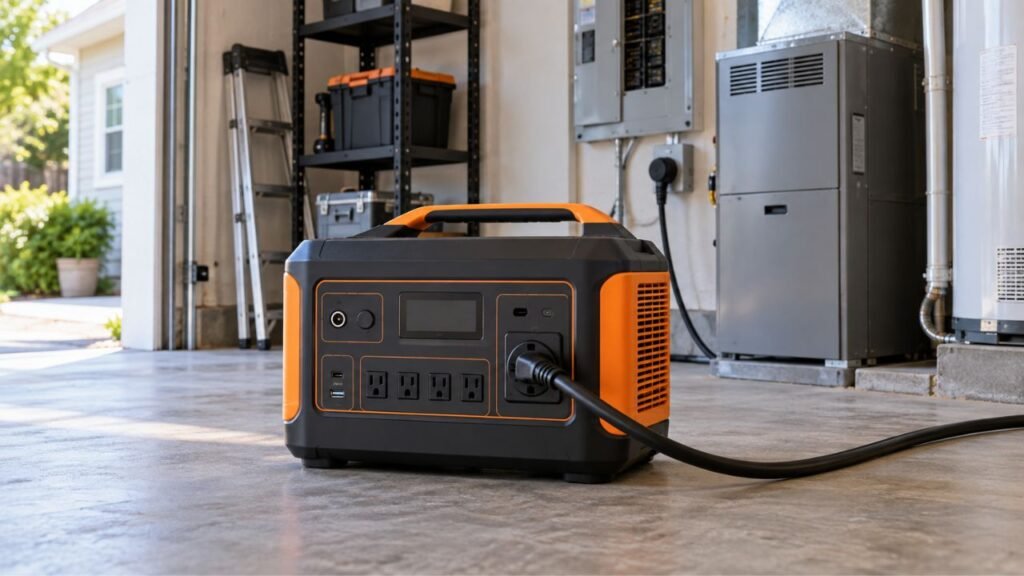
Yes, some portable power stations can provide true 240-volt power. However, most smaller models sold in the USA provide only 120V. For 240V appliances, you need native 120/240V split-phase output or an approved split-phase system.
This guide explains how portable power stations produce 240V power. I’ll also cover compatible appliances, wattage limits, outlets, runtime, and safe home connections.
Key Takeaways
- Most basic portable power stations provide only 120V AC power.
- Larger models may provide true 120/240V split-phase output.
- High wattage does not automatically mean a station supports 240V.
- Some systems combine two compatible units to produce split-phase power.
- U.S. 120/240V split-phase differs from overseas 220V or 230V systems.
- Continuous wattage must match your appliance’s normal operating demand.
- Surge capacity matters for air conditioners, pumps, and other motors.
- Battery capacity determines runtime, not the 240V rating alone.
- A 240V outlet does not guarantee its full standard circuit amperage.
- Home-panel backup requires properly designed transfer or isolation equipment.
Can a Portable Power Station Really Produce 240 Volts?
A portable power station can produce 240V when its inverter supports it. However, you cannot assume every large power station has this capability.
Most portable stations designed for camping or basic emergency backup provide 120V. That works well for refrigerators, televisions, computers, lights, and similar appliances.
Larger home-backup models may provide true 120/240V split-phase electricity. These systems can support equipment requiring voltage unavailable from ordinary 120V outlets.
You will generally find three types of systems:
- Standard portable power stations providing only 120V
- Single power stations providing native 120/240V split-phase output
- Compatible dual-unit systems combined to create 240V output
Do not judge voltage capability using inverter wattage alone. A 3,000W inverter might still provide only 120V.
The voltage rating tells you what electrical supply it produces. The wattage rating tells you how much power it can deliver.
What Does 240V Mean in a U.S. Home?
U.S. homes normally receive 120/240V split-phase electrical service. Understanding this setup makes choosing a power station much easier.
How 120/240V Split-Phase Power Works
A typical U.S. home receives two approximately 120V hot legs. Each leg provides about 120V when measured against neutral.
Measure between both hot legs, and you get about 240V.
That arrangement allows one electrical system to support different appliances. Standard household receptacles normally provide 120V.
Larger appliances can connect across both hot legs for 240V.
Common 240V household loads may include:
- Central air-conditioning systems
- Heat pumps
- Electric water heaters
- Electric clothes dryers
- Electric ranges
- Deep-well pumps
- Large workshop equipment
- Level 2 EV chargers
Your specific appliance can differ, so always check its nameplate.
Is 220V, 230V, and 240V the Same Thing?
People often use 220V, 230V, and 240V almost interchangeably. However, the electrical configuration matters more than the number alone.
Many countries commonly use approximately 220V to 240V single-phase electricity. Portable stations designed for those markets may output 230V directly.
The United States commonly uses 120/240V split-phase residential power instead.
A foreign 230V single-phase station therefore is not automatically equivalent. It may not provide the neutral arrangement needed for U.S. split-phase applications.
Always check the electrical specification instead of comparing voltage numbers alone.
| Power Type | Typical Configuration | Common Use | U.S. Home Backup Suitability |
| 120V single-phase | Hot and neutral | Standard household appliances | Limited to compatible 120V loads |
| 120/240V split-phase | Two hot legs and neutral | U.S. residential electrical systems | Suitable when correctly designed |
| 220V-240V single-phase | Higher-voltage single-phase supply | Common outside North America | Not automatically compatible |
How Do Portable Power Stations Provide 240V?
Manufacturers use several designs to provide higher-voltage AC power. Knowing the difference helps you avoid choosing the wrong system.
Native 120/240V Output From One Power Station
Some larger power stations contain an inverter designed for split-phase output.
One unit can therefore provide the electrical configuration needed for 240V equipment. You do not need two separate power stations working together.
Current large home-backup systems from EcoFlow, Jackery, Anker, and BLUETTI offer examples.
Native split-phase output is usually the simplest option for homeowners. There are fewer components and fewer compatibility questions to manage.
However, you still need to check output wattage and amperage.
A power station might provide 240V but lack enough power. That becomes important with HVAC systems, pumps, and electric heating appliances.
Two Power Stations Combined for Split-Phase 240V
Some manufacturers let you combine two compatible 120V power stations.
Specialized equipment synchronizes both inverter outputs to create split-phase power. Each unit effectively contributes to one side of the system.
This can provide useful flexibility if you already own one unit.
However, never assume two ordinary 120V stations can be connected together.
Their inverter outputs must remain correctly synchronized and electrically compatible. Use only equipment specifically approved by the manufacturer.
Improvised connections can damage equipment or create dangerous electrical conditions.
240V Pass-Through Is Not Always 240V Battery Output
This specification can confuse buyers when comparing portable power stations.
Some equipment may accept 240V AC for faster battery charging. That does not automatically mean its inverter produces 240V from battery power.
A system might also pass incoming AC electricity through its outlets. Its behavior can change after utility power disappears.
Look specifically for terms describing:
- AC discharge output
- Inverter output
- Battery-powered AC output
- Split-phase output
- Bypass or pass-through operation
- AC charging input
You want confirmation that 240V remains available while running from batteries.
How Can You Tell Whether a Power Station Has True 240V Output?
Product pages can contain several voltage and wattage numbers. Focus on the output specifications that describe actual inverter performance.
Look for these details:
- A specification stating 120/240V AC output
- A description stating split-phase output
- A dedicated 240V discharge specification
- 60Hz frequency for normal U.S. applications
- Continuous inverter wattage at 240V
- Maximum available amperage
- 240V receptacle type
- Surge or peak output capability
- Simultaneous 120V and 240V operating information
- Required hubs, connectors, or expansion equipment
The table below shows why each specification matters.
| Specification | What It Tells You |
| 120/240V split-phase | Confirms U.S.-style dual-voltage capability |
| Continuous watts | Power the station can sustain normally |
| Surge watts | Short-term power available during appliance startup |
| Maximum amps | Current available to the connected load |
| Outlet type | Which plugs can physically connect |
| Battery output mode | Confirms 240V operates without utility power |
| Simultaneous output | Shows whether 120V and 240V work together |
| 60Hz output | Confirms proper U.S. frequency for most appliances |
Do not rely only on marketing terms like “whole-home capable.” The specification sheet usually tells you much more.
Does a 240V Outlet Mean You Get Its Full Rated Amperage?
No. The outlet shape does not determine the inverter’s actual capacity.
This becomes particularly important with larger receptacles such as NEMA 14-50 connections. Many people associate that outlet with 50-amp electrical service.
A portable power station may physically use that connection while supplying less current.
For example, a 7,200W power station operating at 240V provides:
7,200W ÷ 240V = 30 amps
It therefore cannot provide 50 amps continuously despite the larger receptacle.
Always check the station’s inverter rating instead of judging the plug.
The same rule applies to L14-30 outlets and similar connections.
Your appliance must remain within both the power station’s electrical limits and the connected cable’s limits.
What Appliances Can a 240V Portable Power Station Run?
A 240V station can potentially run many larger household appliances. However, voltage compatibility alone does not guarantee successful operation.
Well Pumps
Many deep-well pumps operate on 240V power.
These pumps can also require substantial startup current. The motor may briefly draw considerably more power than its normal running demand.
Check:
- Pump voltage
- Running amperage
- Starting current
- Motor horsepower
- Power station surge capability
A station might handle the pump after startup but trip beforehand. That usually means the startup requirement exceeds its available surge power.
Central Air Conditioners and Heat Pumps
Many central HVAC condensers require 240V electricity.
These systems are among the hardest loads for portable batteries. Compressor startup can demand significant short-term power.
You need to check both operating demand and startup requirements.
Some systems may work with an appropriately installed soft starter. However, compatibility depends on the specific HVAC equipment.
Do not assume a station can run your central AC simply because it provides 240V.
Electric Water Heaters, Dryers, and Ranges
Full-size electric water heaters commonly use 240V.
Electric dryers, ranges, and ovens frequently use 240V as well. These loads may consume several thousand watts continuously.
Starting surge may not be their biggest problem.
Instead, sustained energy consumption can drain your battery very quickly.
For outage backup, you may operate these appliances selectively. Running everything simultaneously can overwhelm even large systems.
Workshop Equipment and Power Tools
Some larger workshop tools use 240V for better motor performance.
Examples can include:
- Air compressors
- Welders
- Large saws
- Dust collectors
- Pumps
- Industrial-style shop equipment
Check the equipment’s nameplate before connecting it.
Motor-driven equipment may require considerably more power while starting.
Level 2 EV Charging
Level 2 EV charging normally uses 240V electricity.
Some large portable power stations can provide limited Level 2 charging. However, battery capacity becomes the major limitation.
An electric vehicle may have a battery exceeding 60kWh.
A portable power station may store only 3kWh to 10kWh. You also lose some energy through charging and inverter conversion.
That means portable battery backup usually provides emergency driving range. It rarely provides a practical full EV recharge.
How Much Power Does a 240V Appliance Need?
Voltage tells you only part of an appliance’s electrical requirement. You must also consider current, wattage, startup demand, and runtime.
Voltage Does Not Tell You Wattage
You can estimate electrical power using this basic formula:
Watts = Volts × Amps
For example:
240V × 15A = 3,600W
A 240V appliance drawing 15 amps needs approximately 3,600 watts.
Your station’s continuous output should comfortably support that operating load.
Continuous Power Matters
Continuous output describes how much power the inverter supplies during normal operation.
Suppose your station provides 4,000W continuously.
A 3,000W appliance should normally remain within that limit. However, other connected loads also count toward the total.
If you add another 1,500W load, demand reaches 4,500W.
The station may overload or shut down.
Always calculate appliances that could operate at the same time.
Surge Power Matters for Motors and Compressors
Electric motors can draw much more power during startup.
Common examples include:
- Central air conditioners
- Heat pumps
- Well pumps
- Refrigerators
- Freezers
- Air compressors
- Workshop tools
A 1,500W motor may briefly require several thousand watts while starting.
Your power station needs enough surge capacity to handle that event.
Also check how long the manufacturer allows peak output. A very short advertised peak may not start every motor successfully.
Battery Capacity Determines Runtime
Battery capacity is normally measured in watt-hours or kilowatt-hours.
Suppose your station stores 4,000Wh.
Running a steady 2,000W load gives a theoretical runtime of:
4,000Wh ÷ 2,000W = 2 hours
Real runtime will be shorter because conversion is not perfectly efficient.
Internal electronics also consume some energy while the station operates.
The important point is simple:
240V does not automatically increase your available energy.
A 4,000Wh battery still stores roughly 4,000Wh of energy. Voltage determines compatibility, while capacity influences operating time.
Can a 240V Power Station Run a Whole House?
A large 240V power station can support many household circuits. However, 240V capability alone does not guarantee full whole-home backup.
Add Up Simultaneous Loads
Start by identifying appliances that may operate together.
A home might contain:
- Central air conditioning
- Well pump
- Refrigerator
- Electric water heater
- Electric range
- Clothes dryer
- Lighting
- Computers
- Television
- EV charger
Running everything simultaneously could require enormous inverter output.
Even a powerful portable system may not support that demand.
Instead, prioritize the loads you actually need during an outage.
Consider Starting Surge
Large motors make whole-home backup more complicated.
Your refrigerator, well pump, heat pump, and central AC may start unexpectedly. Multiple motors starting close together can create a major surge.
The system needs enough headroom for those events.
A load may operate perfectly after starting yet still overload the station during startup.
Check Battery Capacity
High inverter output solves only half the problem.
A station might deliver 7,000W while storing only several kilowatt-hours. Heavy appliances could therefore drain the battery surprisingly fast.
Think separately about:
- What the station can start
- What it can run continuously
- How long it can keep running
These are three different questions.
Use Load Management
Load management makes battery backup much more practical.
During an outage, you might:
- Avoid using the electric dryer
- Delay EV charging
- Run the water heater occasionally
- Avoid cooking while central AC starts
- Prioritize refrigeration
- Keep the well pump available
- Power essential lighting and communications
This approach reduces both inverter demand and battery consumption.
Can a Portable Power Station Supply 120V and 240V at the Same Time?
Some 240V portable power stations can supply both voltages simultaneously. Others require you to select one output mode at a time.
This difference matters when backing up a U.S. home.
Your house likely contains both 120V and 240V loads.
A refrigerator may use 120V while the well pump uses 240V. You may want both running during the same outage.
Some power stations support that combination directly.
Other models may disable certain front outlets when 240V mode activates. Some require compatible home-integration accessories for mixed-voltage operation.
Always read the operating manual carefully before buying.
| Output Behavior | Why It Matters |
| 120V and 240V work simultaneously | Supports mixed household loads more easily |
| User selects 120V or 240V | Some outlets become unavailable |
| Mixed output requires extra equipment | Additional hardware may be necessary |
| 240V only works during bypass | 240V may disappear during an outage |
The words “240V capable” alone do not explain these differences.
Examples of Portable Power Stations That Provide 240V
Several large portable power stations now support 240V output. These examples show how common the feature has become in home-backup systems.
| Model | Approximate Battery Capacity | Rated AC Output | 240V Design |
| EcoFlow DELTA Pro 3 | 4,096Wh | 4,000W | Native 120/240V split-phase |
| Anker SOLIX F3800 Plus | 3,840Wh | 6,000W | Native 120/240V |
| Jackery Explorer 5000 Plus | 5,040Wh | 7,200W | Native 120/240V |
| BLUETTI Apex 300 | 2,764.8Wh | 3,840W | Native 120/240V |
These examples do not mean every model fits every homeowner.
Specifications can also change between product versions or regional models.
Before purchasing, check:
- Exact U.S. model number
- Continuous output
- Surge capability
- Maximum 240V amperage
- Outlet configuration
- Expansion options
- Home-panel compatibility
- Simultaneous 120V and 240V operation
Choose the electrical specifications first, then compare brands.
Can You Convert a 120V Portable Power Station to 240V?
A simple plug adapter cannot turn a 120V-only inverter into true U.S. 120/240V split-phase power. The power station must support the required electrical output.
Why a Plug Adapter Does Not Create 240V
An adapter changes how a plug connects physically.
It does not redesign the inverter inside your power station.
If the inverter produces only 120V, plugging in another connector cannot suddenly make genuine split-phase 240V available.
This is similar to changing the shape of a faucet connection. The adapter changes the connection, not what the source produces.
When a Manufacturer Split-Phase Kit Can Work
Some systems are specifically designed for combining compatible power stations.
The manufacturer’s equipment synchronizes both inverter outputs correctly. It then produces the required split-phase relationship.
This method can be perfectly valid when supported.
However, only use combinations explicitly approved by the manufacturer.
Do not attempt to synchronize unrelated portable power stations yourself.
What About External Transformers?
A transformer can change AC voltage in specialized situations.
However, using one with a portable power station adds several complications.
You need to consider:
- Transformer wattage
- Efficiency losses
- Starting surge
- Neutral configuration
- Grounding
- Cable sizing
- Appliance compatibility
A transformer also does not necessarily create U.S. split-phase service.
For home backup, a power station designed for 120/240V output is usually simpler and safer.
How Do You Safely Connect a 240V Power Station to a Home?
Connecting one appliance directly differs greatly from supplying household wiring. Panel connections should always use properly designed isolation equipment.
Direct Appliance Connection
Some 240V appliances can connect directly to a compatible station outlet.
The appliance voltage must match the power station.
You should also verify:
- Outlet compatibility
- Appliance plug type
- Continuous wattage
- Starting surge
- Maximum current
- Cable rating
Do not force incompatible connectors together using improvised adapters.
Generator Inlet and Transfer Equipment
Supplying household circuits requires a safe way to isolate utility electricity.
Common systems may use:
- Generator inlet
- Manual transfer switch
- Approved interlock arrangement
- Dedicated backup panel
- Manufacturer-designed smart home panel
The correct setup depends on your electrical system and local requirements.
A properly designed system prevents utility power and backup power from interacting dangerously.
Never Backfeed Through a Household Outlet
Never use a male-to-male cord to feed power through a wall receptacle.
That setup can leave energized metal prongs exposed.
It can also send electricity into wiring unexpectedly and create serious electrocution or fire risks.
Backfeeding may also energize utility-side equipment when workers expect it to be disconnected.
Use proper transfer equipment instead.
Use a Qualified Electrician for Panel Integration
Portable appliance use is relatively straightforward.
Connecting a backup source to household wiring is much more involved.
An electrician may need to evaluate:
- Service-panel configuration
- Transfer equipment
- Breaker sizing
- Neutral arrangement
- Grounding and bonding
- Power inlet rating
- Cable sizing
- Split-phase compatibility
- Local electrical requirements
- Permit requirements
Not every generator transfer setup automatically works with every battery power station.
Check the power station manufacturer’s installation requirements as well.
Do You Actually Need a 240V Portable Power Station?
Many homeowners do not need 240V for basic emergency power. Your appliance list should determine the voltage you choose.
| Backup Need | Is 120V Usually Enough? | Is 240V Usually Needed? |
| Phones and laptops | Yes | No |
| Wi-Fi equipment | Yes | No |
| LED lighting | Yes | No |
| Refrigerator | Usually | No |
| Freezer | Usually | No |
| Television | Yes | No |
| CPAP machine | Usually | No |
| Window air conditioner | Often | Usually no |
| Deep-well pump | Sometimes | Often |
| Central air conditioner | Usually no | Often |
| Electric water heater | No | Usually |
| Electric range | No | Usually |
| Clothes dryer | No | Usually |
| Level 2 EV charger | No | Yes |
| Split-phase home panel | No | Yes |
If you only want refrigeration, lights, internet, and electronics, 120V may be enough.
A smaller station may cost less and remain easier to move.
Consider 240V when your backup plan includes larger household equipment.
My recommendation is simple:
Choose the appliances first, then choose the voltage.
That approach helps you avoid overspending on unnecessary capability. It also prevents buying a station unable to run critical equipment.
Common Mistakes When Shopping for a 240V Power Station
240V systems have more specifications to compare than basic portable stations. Avoiding these common mistakes can save considerable frustration later.
- Assuming high inverter wattage automatically means 240V output
- Confusing international 230V with U.S. 120/240V split-phase
- Assuming a plug adapter can create 240V
- Looking only at battery capacity
- Ignoring motor startup surge
- Ignoring maximum available 240V amperage
- Assuming a NEMA 14-50 outlet always supplies 50 amps
- Ignoring simultaneous 120V and 240V restrictions
- Confusing 240V charging input with 240V inverter output
- Assuming every 240V appliance will work automatically
- Forgetting to calculate simultaneous household loads
- Assuming “whole-home backup” means unlimited household power
- Connecting the station to home wiring without transfer equipment
A few minutes spent checking specifications can prevent an expensive mistake.
Final Words
Yes, a portable power station can provide 240-volt power. However, you need a system specifically designed for that electrical output.
For U.S. home backup, look specifically for 120/240V split-phase output. Do not assume every 220V, 230V, or 240V product provides the same electrical configuration.
You should also look beyond voltage.
Check continuous wattage, surge capacity, amperage, battery capacity, outlets, and operating modes. Those specifications determine whether your appliance will actually work.
For basic refrigerators, lights, electronics, and internet equipment, 120V may be enough.
For central AC, well pumps, electric water heaters, and panel backup, 240V becomes much more important.
Choose your critical loads first. Then build the backup system around their actual requirements.
Related FAQs
Are All Portable Power Stations 120V?
No. Many smaller portable power stations provide only 120V, but larger home-backup models increasingly provide genuine 120/240V split-phase output.
Can a 120V Portable Power Station Run a 240V Appliance?
No, not directly. A 240V appliance needs a compatible electrical supply, and a normal plug adapter cannot create missing 240V inverter output.
Can Two Portable Power Stations Be Connected to Make 240V?
Yes, but only certain compatible systems support this arrangement. Use manufacturer-approved split-phase equipment rather than connecting unrelated power stations together.
Is 240V Better Than 120V for a Portable Power Station?
Not necessarily. 240V is useful for larger appliances, while 120V is sufficient for most everyday electronics, refrigerators, lighting, and small household equipment.
Does a 240V Appliance Use More Battery Power?
Not simply because it uses 240V. Battery consumption depends mainly on the appliance’s wattage and operating time rather than voltage alone.
Can a 240V Portable Power Station Run Central Air Conditioning?
Some large models can run certain central air conditioners. You must check operating wattage, compressor startup demand, surge capacity, and available battery energy.
Can a Portable Power Station Run a 240V Well Pump?
Yes, a properly sized 240V station can run many well pumps. Make sure its continuous and surge ratings support the pump motor.
Can a Portable Power Station Provide Level 2 EV Charging?
Some 240V power stations can provide limited Level 2 charging. However, their smaller batteries usually add only limited driving range.
Is 220V the Same as 240V in the United States?
The terms are sometimes used casually for similar voltage ranges. However, U.S. homes normally use 120/240V split-phase rather than typical overseas 230V single-phase power.
Can a European 230V Power Station Run U.S. 240V Appliances?
Not automatically. Voltage may appear similar, but frequency, neutral arrangement, receptacles, grounding, and split-phase requirements can differ.
Can You Plug a Portable Power Station Into a Dryer Outlet?
You should not use a dryer outlet as an improvised home-backup connection. Household wiring requires approved transfer or isolation equipment for safe operation.
Does a NEMA 14-50 Outlet Mean the Power Station Supplies 50 Amps?
No. The outlet type only describes the connection. Actual available current depends on the power station’s inverter and manufacturer-rated output.
Can a 240V Portable Power Station Connect to a Transfer Switch?
Yes, some systems can connect through compatible transfer equipment. Always verify electrical compatibility and use proper installation for household panel connections.

Warren Turner writes practical guides and reviews on generators, portable power stations, and battery backup systems. He focuses on real-world performance, everyday power needs, and helping readers choose dependable equipment without unnecessary complexity.