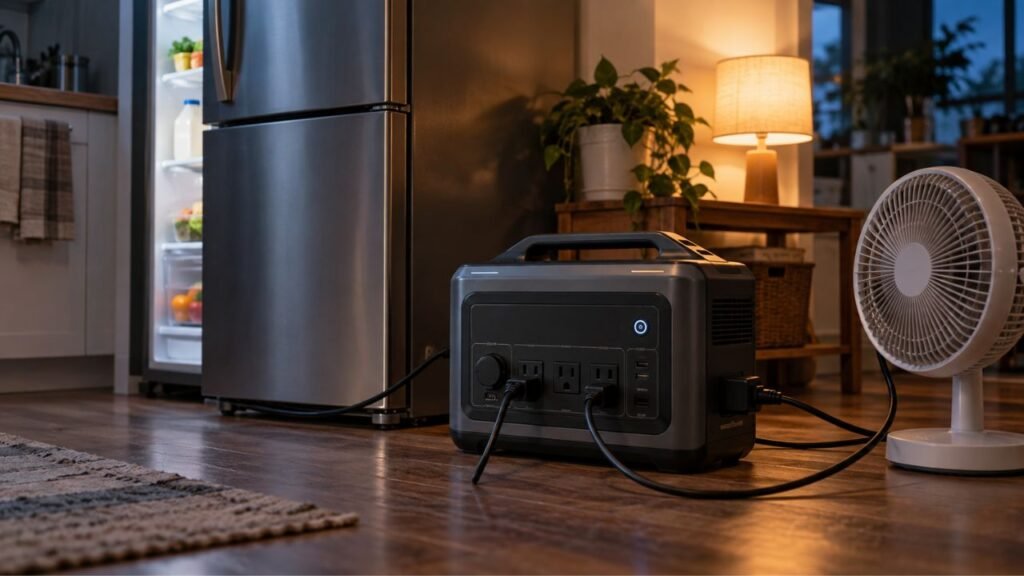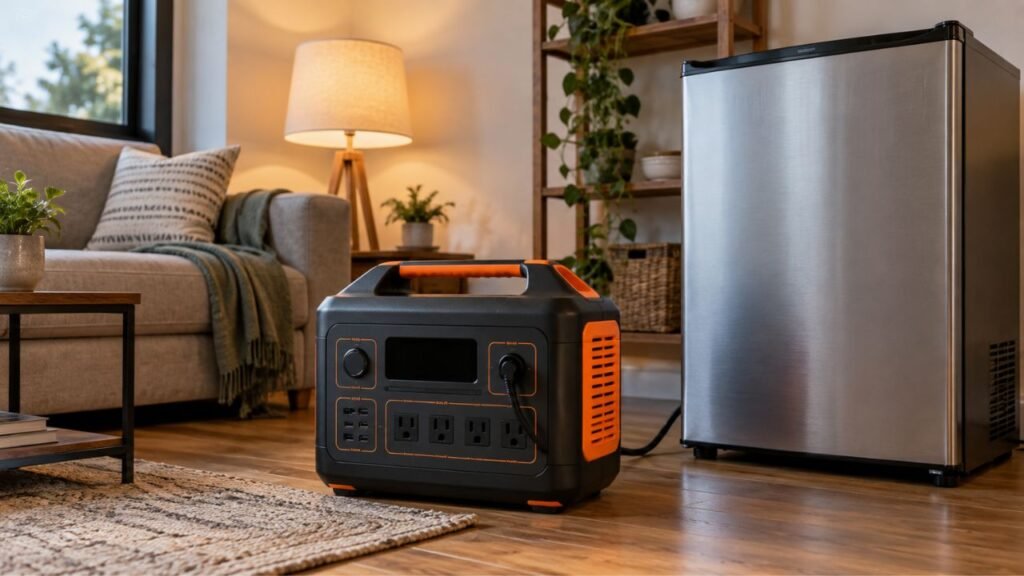
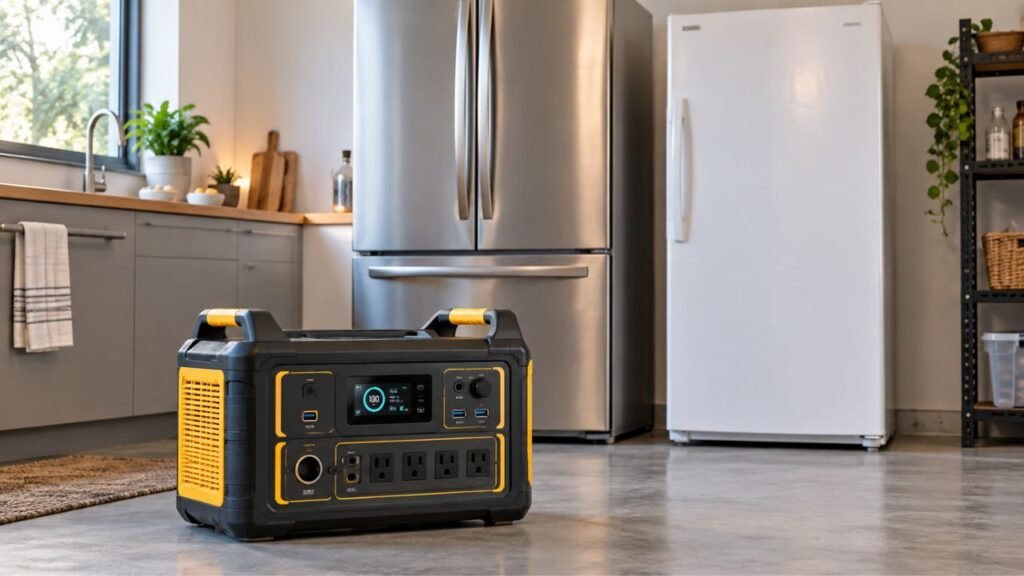
Yes, one portable power station can run a fridge and freezer together. However, its inverter must handle both appliances’ running watts and startup surges. The battery also needs enough capacity for your required backup time.
The important part is sizing the system for two cycling compressors. Below, I’ll show you how to calculate output, surge requirements, battery capacity, runtime, and backup priorities.
Key Takeaways
- One power station can operate a refrigerator and separate freezer together.
- Add both appliances’ running watts before checking inverter capacity.
- Compressor startup surges can occasionally happen at the same time.
- Battery watt-hours determine runtime, while inverter watts determine load capability.
- EnergyGuide data provides a better runtime estimate than running watts alone.
- Measuring actual 24-hour consumption gives the most useful backup estimate.
- Larger battery capacity becomes increasingly important during extended power outages.
Can One Portable Power Station Run a Fridge and Freezer at the Same Time?
A properly sized portable power station can operate both appliances simultaneously. You simply need enough inverter output and enough stored battery energy.
There are really two separate questions you need to answer.
First, can the power station run both appliances without overloading?
Second, can its battery keep them running for your required time?
Those two questions involve different specifications.
The inverter’s watt rating determines whether your appliances can operate. Battery capacity, measured in watt-hours, determines approximately how long they can operate.
For example, imagine your refrigerator and freezer use 300 watts together.
A 2,000W power station could easily handle that running load. However, a small 500Wh battery would provide relatively limited runtime.
Now consider the opposite situation.
A large 3,000Wh battery might store plenty of energy. However, an undersized inverter could still shut down during compressor startup.
That is why you should never choose refrigeration backup using battery capacity alone.
You need enough running output, surge output, and battery capacity.
How Much Power Do a Refrigerator and Freezer Need Together?
Refrigerators and freezers do not consume electricity at a constant rate. Their compressors cycle on and off as temperatures change throughout the day.
Understanding three different measurements makes sizing your power station much easier.
Running Watts
Running watts describe the power an appliance draws while operating.
A refrigerator might draw 100 to 250 watts while cooling. A standalone freezer might have a similar or sometimes lower operating draw.
However, these figures vary widely between models.
Age, size, compressor design, defrost systems, and efficiency all affect consumption.
Suppose your refrigerator draws 150 watts while its compressor runs. Your freezer draws another 120 watts while cooling.
Your combined running load becomes:
150W + 120W = 270W
That number gives you the basic continuous load requirement.
However, you should not stop your calculation there.
Startup Watts
Compressors briefly need considerably more power while starting.
This short increase is commonly called startup, surge, or inrush power.
Your refrigerator might normally draw 150 watts while running. Its compressor could temporarily need several times that amount during startup.
Your freezer behaves similarly.
More importantly, compressor startup does not happen only once.
Both appliances repeatedly cycle throughout the day.
Your refrigerator might stop cooling for twenty minutes, then restart. Your freezer might restart independently several minutes later.
Occasionally, their startup periods can overlap.
Your power station needs enough short-term output for these situations.
Daily Energy Consumption
Running wattage tells you load size, but not daily consumption.
A refrigerator drawing 150 watts does not normally consume:
150W × 24 hours = 3,600Wh
That calculation assumes the compressor runs continuously for 24 hours.
Most refrigerators cycle on and off instead.
For battery planning, daily energy consumption provides a better measurement.
Look for annual electricity consumption on your appliance’s EnergyGuide label.
You can convert annual consumption into daily consumption using:
Annual kWh ÷ 365 = Approximate daily kWh
For example:
400 kWh ÷ 365 = 1.10 kWh per day
That equals approximately:
1,100Wh per day
Perform the same calculation for your freezer and add both figures.
What Happens If Both Compressors Start at the Same Time?
Both compressors starting together can create the highest load your power station sees. This possibility is why surge capacity matters when powering two cooling appliances.
Imagine these example appliances:
- Refrigerator running power: 150W
- Refrigerator startup power: 700W
- Freezer running power: 120W
- Freezer startup power: 600W
Their normal combined running load would be:
150W + 120W = 270W
Now imagine the refrigerator compressor starts while the freezer already runs.
Your temporary load could become:
700W + 120W = 820W
If the freezer starts while the refrigerator runs:
600W + 150W = 750W
Now consider both compressors starting almost together:
700W + 600W = 1,300W
These numbers are only examples. Your actual appliances may behave very differently.
Still, the example shows why a 500W inverter could fail. It might seem adequate when you only consider 270 running watts.
You should check the power station’s continuous and surge ratings.
Also check how the manufacturer defines its surge rating. Some power stations can maintain peak output longer than others.
How Much Power Station Output Do You Need?
Output capacity decides whether your portable power station can operate both appliances. You need to compare continuous output and short-term surge capability separately.
Check Continuous AC Output
Start by adding both appliances’ running power requirements.
For example:
Refrigerator: 150W
Freezer: 120W
Combined: 270W
Your power station’s continuous AC output must exceed that load.
I would also avoid operating the inverter permanently near its maximum rating. Extra capacity gives you more room for compressor cycling and additional loads.
Remember to include anything else connected to the station.
A Wi-Fi router, lights, television, or phone charger also consumes power.
Check Surge or Peak Output
Next, check compressor startup requirements.
This step becomes especially important with two compressor appliances.
Your power station should handle one compressor starting while another runs. Ideally, it should also tolerate an occasional overlapping startup event.
Do not judge this using continuous wattage alone.
A station might advertise 1,000W continuous output and 2,000W surge output.
Those two ratings perform different jobs.
Continuous output supports normal operation.
Surge output handles brief high-power events.
Check the AC Waveform
Most modern portable power stations use pure sine wave inverters.
That is generally preferable when powering compressor-based household appliances and sensitive electronics.
Check both appliance manuals if you are uncertain about power requirements.
You should also confirm that your station provides standard U.S. AC voltage suitable for your appliances.
How Big a Portable Power Station Do You Need for a Fridge and Freezer?
There is no single battery size that fits every refrigerator and freezer. The right capacity depends on their actual daily energy consumption and your outage duration.
Here is one example showing how the calculation works.
| Item | Refrigerator | Freezer | Combined |
| Example running power | 150W | 120W | 270W |
| Example startup power | 700W | 600W | Up to 1,300W if overlapping |
| Example annual energy use | 400 kWh | 300 kWh | 700 kWh |
| Approximate daily energy | 1.10 kWh | 0.82 kWh | 1.92 kWh |
| Approximate 24-hour appliance energy | 1,100Wh | 820Wh | 1,920Wh |
Notice how different the watt and watt-hour numbers are.
The appliances might only draw 270 watts while both compressors operate. Yet their combined daily energy consumption could reach around 1,920Wh.
Using the example above:
400 kWh ÷ 365 = about 1.10 kWh daily
And:
300 kWh ÷ 365 = about 0.82 kWh daily
Together:
1.10 + 0.82 = about 1.92 kWh daily
That means the appliances themselves need approximately 1,920Wh during 24 hours.
However, I would not choose an exactly 1,920Wh power station.
The inverter and internal electronics also consume some stored energy.
You may also want reserve capacity for unusually high consumption.
Therefore, nominal battery capacity should normally exceed your calculated appliance requirement.
How Do You Calculate Fridge and Freezer Runtime?
Runtime calculations become much easier once you know actual energy consumption. Measured consumption is usually more useful than guessing from compressor wattage.
Use Measured Daily Energy When Available
The best approach is measuring each appliance over a typical day.
A plug-in electricity meter can show accumulated watt-hours or kilowatt-hours.
Measure the refrigerator for at least 24 hours.
Then repeat the process with your standalone freezer.
Suppose your measurements show:
Refrigerator: 1,050Wh daily
Freezer: 700Wh daily
Combined consumption becomes:
1,050Wh + 700Wh = 1,750Wh daily
Average hourly consumption would be:
1,750Wh ÷ 24 = about 73Wh per hour
You can then compare that figure with usable battery energy.
Use the EnergyGuide Label When You Cannot Measure Usage
You can still build a useful estimate without an electricity meter.
Find the annual kWh figure printed on each EnergyGuide label.
Suppose your refrigerator lists 400kWh annually.
400 ÷ 365 = about 1.10kWh daily
Now suppose your freezer lists 300kWh annually.
300 ÷ 365 = about 0.82kWh daily
Together, they use approximately:
1.92kWh, or 1,920Wh, each day
Real household consumption may be higher or lower.
Room temperature, usage habits, appliance age, and door openings affect consumption.
Account for Power Station Losses
A 2,000Wh power station does not necessarily deliver exactly 2,000Wh through its AC outlets.
Some energy is consumed during battery conversion and inverter operation.
The station itself also requires energy while its inverter remains active.
Because efficiency differs between models, use manufacturer data when available.
Otherwise, leave reasonable extra capacity instead of sizing exactly.
For example, suppose a 2,000Wh station delivered 85% through AC in your particular operating conditions.
Usable AC energy would be approximately:
2,000Wh × 0.85 = 1,700Wh
That is only an example, not a universal efficiency figure.
Example 12-Hour and 24-Hour Calculation
Return to our earlier 1.92kWh daily appliance example.
For approximately 12 hours:
1.92kWh ÷ 2 = 0.96kWh
So the appliances consume roughly 960Wh during twelve hours.
For approximately 24 hours:
1.92kWh = 1,920Wh
Then you must account for conversion losses and reserve capacity.
This explains why a nominal 2,000Wh station cannot automatically guarantee 24 hours.
Actual runtime depends on the complete system.
Why Actual Runtime Can Be Shorter Than Your Calculation
Runtime estimates are useful, but real conditions constantly affect refrigerator and freezer consumption.
Common reasons for shorter runtime include:
- High kitchen or garage temperatures
- Frequent refrigerator door openings
- Frequent freezer door openings
- Older or inefficient compressors
- Automatic freezer defrost cycles
- Refrigerator defrost heaters
- Ice makers and water dispensers
- Warm groceries placed inside
- Poor door seals
- Heavy frost buildup
- Starting with a partially charged power station
- AC inverter conversion losses
- Power station standby consumption
- Additional devices using the same battery
- Higher compressor cycling during hot weather
Treat your calculation as a planning estimate rather than a guaranteed runtime.
Leaving some battery reserve gives you more flexibility during unpredictable outages.
How to Measure Your Fridge and Freezer Before an Outage
A little preparation makes backup planning far more accurate. You can gather most information without opening or modifying either appliance.
Check Both Appliance Labels
Start with each appliance’s label and documentation.
Look for:
- Rated voltage
- Rated current
- Wattage information
- Model number
- EnergyGuide annual consumption
- Manufacturer power specifications
EnergyGuide consumption is especially useful for estimating daily battery requirements.
However, electrical nameplates often show maximum or rated electrical values.
Those figures do not always represent normal average consumption.
Measure Daily Energy With a Plug-In Watt Meter
A plug-in electricity meter gives you much better household data.
Connect the refrigerator and monitor accumulated consumption for 24 hours.
Record the result before testing the freezer separately.
Testing for several days provides an even better average.
Try measuring during normal household use.
Opening doors normally gives you a more realistic estimate.
Measure or Verify Compressor Startup Power
Startup power is harder to capture with a basic watt meter.
The compressor surge may happen too quickly for simple displays.
A meter with maximum or peak recording can provide better information.
Manufacturer documentation may also list startup or compressor specifications.
If you cannot determine exact surge requirements, avoid sizing the inverter extremely close to the running load.
Extra surge headroom can prevent frustrating shutdowns.
Should You Plug the Fridge and Freezer In at the Same Time?
You can connect both appliances together when your station supports their loads. However, staggered initial startup can reduce the first surge demand.
For example, connect your refrigerator first.
Allow its compressor to start and settle into normal operation.
Then connect the standalone freezer.
Doing this can prevent both compressors from demanding startup power simultaneously during initial connection.
However, there is an important limitation.
Staggering the first startup does not keep them permanently synchronized.
Each appliance has its own thermostat.
Later, the refrigerator compressor could restart while the freezer compressor starts.
Therefore, staggered connection helps during setup but does not replace proper surge capacity.
Your power station still needs enough output for normal cycling conditions.
Why Does the Power Station Shut Off When Both Appliances Are Connected?
Several problems can cause shutdowns when powering two refrigeration appliances. Watching when the shutdown happens can help identify the likely cause.
Compressor Surge Exceeds the Inverter Limit
This is one of the first things I would check.
The station may run both appliances normally for several minutes.
Then one compressor restarts and suddenly triggers an overload warning.
That usually suggests startup demand exceeded the inverter’s capability.
An overlapping compressor startup could make the problem even worse.
Combined Running Load Is Too High
Do not forget other appliances connected to the station.
Your refrigerator and freezer might only consume 300W together.
However, adding a microwave could suddenly add another 1,000 watts or more.
Coffee makers, kettles, heaters, and cooking appliances can also create large loads.
Disconnect unnecessary equipment when protecting refrigeration during an outage.
Battery Charge Is Too Low
Battery depletion can also cause shutdowns.
Check the remaining percentage before assuming you have an inverter problem.
Cold or unusually hot battery conditions can also affect some systems.
Follow your station manufacturer’s recommended temperature limits.
Another Appliance Started at the Same Time
Timing can make overloads seem random.
Imagine your refrigerator compressor starts while another device is already drawing significant power.
The combined demand may exceed your station’s limit.
This is why I recommend dedicating more capacity to essential refrigeration during outages.
The AC Output Automatically Turned Off
Some portable power stations offer energy-saving or automatic AC shutdown settings.
A refrigerator and freezer can both stop drawing significant power between compressor cycles.
Certain low-load settings may interpret that situation as inactivity.
The station might then disable its AC output.
Check your specific power station’s manual or app settings.
Disable unsuitable power-saving features when continuous refrigeration backup is required.
What Should You Do If Your Power Station Cannot Run Both?
You may still protect refrigerated and frozen food with limited battery capacity. The goal should become using available energy where it provides the most benefit.
Consider these steps:
- Keep refrigerator and freezer doors closed whenever possible.
- Remove unnecessary electrical loads from the power station.
- Monitor both appliances using reliable appliance thermometers.
- Recharge your power station whenever safe power becomes available.
- Add battery expansion if your system supports additional batteries.
- Use solar charging when conditions and system capacity make it practical.
- Avoid opening the freezer merely to check whether food remains frozen.
- Prioritize appliance power according to temperature and food-safety needs.
An unopened refrigerator generally keeps food cold for roughly four hours during an outage.
A full freezer can often maintain safe temperatures for approximately 48 hours unopened.
A half-full freezer may maintain temperature for approximately 24 hours.
Those differences matter when battery power is limited.
For example, you might need refrigerator power sooner while leaving a well-stocked freezer closed.
However, actual internal temperature should guide your decisions.
An appliance thermometer is much more useful than guessing from elapsed time.
Can You Alternate Power Between the Fridge and Freezer?
Alternating appliances can work when your inverter cannot operate both simultaneously. However, I would not rely on a rigid hourly switching schedule.
Food temperature matters more than a predetermined schedule.
Your refrigerator may warm faster than expected during hot summer weather.
A full chest freezer could remain safely cold much longer.
Use appliance thermometers to monitor both temperatures.
Then direct available battery power toward the appliance needing cooling.
Alternating can also reduce simultaneous compressor startup concerns.
However, repeated manual switching can become inconvenient during longer outages.
A larger station is usually easier if both appliances require continuous backup.
Can Solar Panels Keep a Fridge and Freezer Running Longer?
Solar panels can significantly extend runtime when daylight conditions are favorable. However, solar charging does not automatically provide unlimited refrigeration backup.
Your energy entering the system must keep pace with consumption.
Imagine your refrigerator and freezer consume 1.8kWh daily.
Your solar setup must replace approximately that energy plus system losses.
Several factors affect whether that happens:
- Total solar panel wattage
- Power station maximum solar input
- Available peak sun hours
- Cloud cover
- Seasonal sunlight
- Panel orientation
- Nearby shading
- Charging conversion losses
- Daily refrigerator consumption
- Daily freezer consumption
- Other connected loads
Suppose you have 400W of solar panels.
That does not mean they continuously produce 400W all day.
Output changes with sunlight conditions and panel positioning.
Your portable power station must also accept enough solar input.
For longer outages, think in terms of daily energy balance.
The closer solar production gets to daily consumption, the longer your battery can maintain refrigeration.
Fridge Plus Chest Freezer vs Fridge Plus Upright Freezer
Freezer design can noticeably change your backup requirements. That is why I would avoid choosing a station using freezer type alone.
Chest freezers often retain cold air effectively when opened.
Cold air tends to remain inside rather than spilling outward quickly.
Some chest freezers also have relatively low annual energy consumption.
However, that does not mean every chest freezer uses less electricity.
Large, older, or poorly maintained models may consume significantly more.
Upright freezers provide convenient shelf access but behave differently when opened.
Some models also use automatic defrost systems that temporarily increase power consumption.
Garage location adds another complication.
A freezer operating inside a hot garage may cycle considerably more frequently.
Instead of assuming one freezer style requires a certain battery size, check its EnergyGuide label.
Better yet, measure its actual consumption.
Your specific appliance matters more than a generic freezer category.
Is a 1,000Wh, 2,000Wh, or 3,000Wh Power Station Enough?
Battery capacity should match your appliances and desired backup duration. These capacity ranges can provide guidance, but they cannot guarantee exact runtime.
1,000Wh Power Station
A 1,000Wh power station may run both appliances if its inverter is strong enough.
The bigger problem will usually be runtime.
Suppose your refrigerator and freezer together consume 1,800Wh daily.
A 1,000Wh battery cannot provide a full day without recharging.
Actual delivered AC energy will also be below nominal battery capacity.
Still, it can provide valuable short-term backup during brief outages.
2,000Wh Power Station
A 2,000Wh station provides much more practical refrigeration backup.
Efficient appliances may run through a substantial portion of an outage.
Some combinations could approach overnight or near-day-long operation.
However, do not assume 2,000Wh automatically equals 24 hours.
If your appliances consume 2,000Wh daily, conversion losses already make the battery insufficient for an exact full-day match.
Measure or calculate your appliances before relying on that assumption.
3,000Wh and Larger Power Stations
A 3,000Wh or larger system gives you considerably more flexibility.
It can better support extended fridge and freezer operation.
You also gain reserve capacity for additional essential devices.
Expandable systems can make sense when multi-day outages are common concerns.
Solar charging can further extend usable backup time.
Just remember the basic distinction:
Watts tell you whether the station can run your appliances.
Watt-hours tell you approximately how long it can run them.
Both numbers matter.
A Simple Checklist Before Connecting Both Appliances
Before depending on one station for two refrigeration appliances, check everything systematically.
- Find your refrigerator’s normal operating wattage.
- Find or estimate its compressor startup requirement.
- Find your freezer’s normal operating wattage.
- Find or estimate its compressor startup requirement.
- Add both normal running loads together.
- Consider possible overlapping compressor startup demand.
- Check the station’s continuous AC output.
- Check its surge or peak AC output.
- Find each appliance’s annual EnergyGuide consumption.
- Convert annual kWh into approximate daily consumption.
- Measure actual 24-hour consumption when possible.
- Calculate energy required for your desired outage duration.
- Leave room for inverter and system losses.
- Include every additional device connected to the station.
- Check automatic AC shutdown or energy-saving settings.
- Confirm available AC, vehicle, or solar recharging options.
- Start the outage with your power station fully charged.
Doing these checks removes most of the guesswork.
You will know whether your setup can start both appliances and sustain them.
Conclusion
One portable power station can run a refrigerator and standalone freezer together. The station needs enough continuous output, surge capacity, and stored battery energy.
Start with your appliances’ actual ratings and daily energy consumption. Then account for overlapping compressor starts, conversion losses, and your required outage duration. That approach gives you a far more dependable backup plan than choosing a station from generic wattage estimates.
Related FAQs
Can a 1000W Power Station Run a Fridge and Freezer?
Possibly, but the 1,000W inverter rating alone cannot confirm compatibility. Add both running loads and verify their compressor startup demand against the station’s surge rating.
Can a 2000W Portable Power Station Run a Refrigerator and Freezer?
A 2,000W inverter can handle many household refrigerator and freezer combinations. However, the station’s watt-hour capacity determines how long those appliances continue operating.
How Many Watt-Hours Do a Fridge and Freezer Use Per Day?
Consumption varies widely between appliances, but EnergyGuide labels provide useful annual estimates. Add both annual kWh figures and divide by 365 for approximate daily consumption.
What Happens If the Fridge and Freezer Start at the Same Time?
Their compressor startup demands can overlap and create a significant temporary load. An undersized inverter may overload, shut down, or fail to start one compressor.
Can a Portable Power Station Run Two Refrigerators?
Yes, if its continuous output, surge capability, and battery capacity support both refrigerators. Use the same combined-load calculation used for a refrigerator and freezer.
Should I Power the Refrigerator or Freezer First During an Outage?
A refrigerator normally warms faster than a full unopened freezer, so it may need earlier attention. Monitor actual appliance temperatures and prioritize whichever approaches unsafe temperatures first.
Will a Chest Freezer Drain a Portable Power Station Quickly?
Not necessarily. Runtime depends on the freezer’s actual energy consumption, temperature, age, size, insulation, cycling frequency, and the power station’s usable battery capacity.
Can I Leave a Refrigerator Connected to a Portable Power Station Overnight?
Yes, provided the station supports the refrigerator’s load and has adequate capacity. Keep the power station properly ventilated and follow its manufacturer’s operating instructions.
Can Solar Recharge the Power Station While It Runs Both Appliances?
Many power stations support charging while supplying AC power, but capabilities vary. Check your model and ensure solar production can meaningfully replace the appliances’ daily energy consumption.

Warren Turner writes practical guides and reviews on generators, portable power stations, and battery backup systems. He focuses on real-world performance, everyday power needs, and helping readers choose dependable equipment without unnecessary complexity.