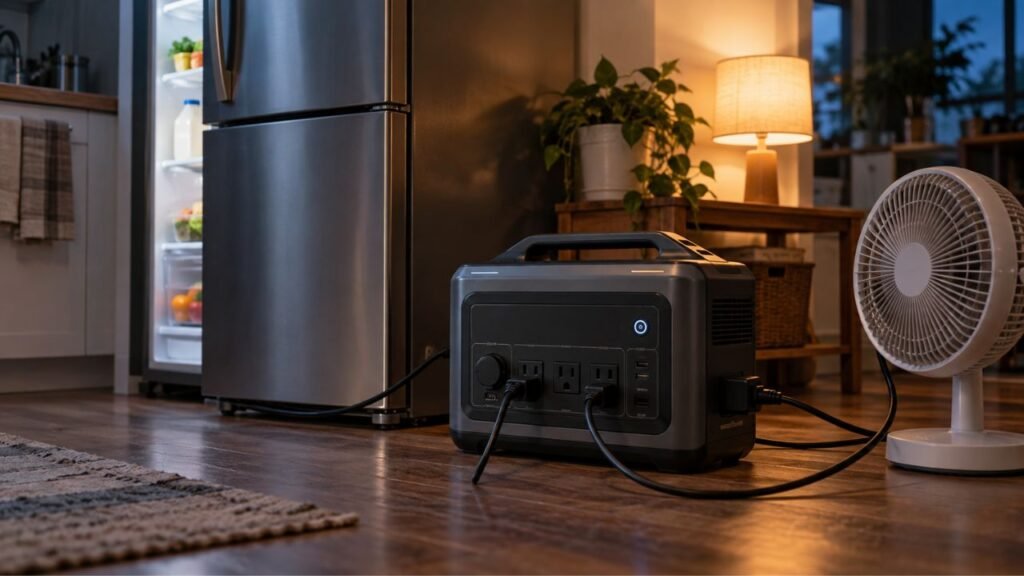
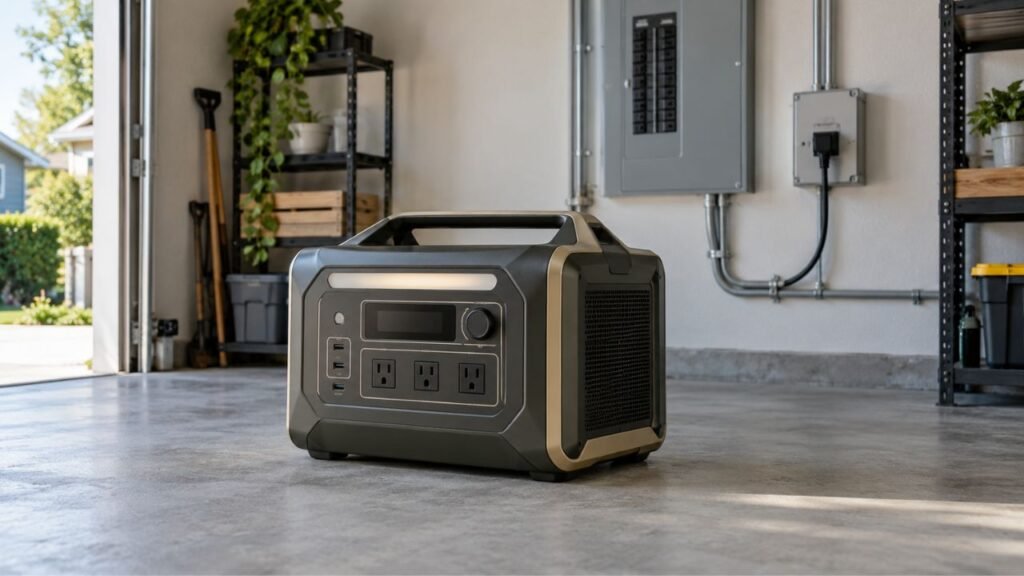
A transfer switch usually works best for controlled essential-circuit backup, while an interlock offers more flexibility across your existing electrical panel. However, the better choice depends on your power station’s output, voltage, surge capacity, neutral configuration, and the circuits you actually need during an outage.
I’ll walk you through both options without making this unnecessarily complicated. We’ll compare how they work, where each one fits, and what portable power station owners need to check before choosing either setup.
Key Takeaways
- Transfer switches usually provide simpler, more controlled essential-load backup.
- Interlocks give you access to more circuits inside your main panel.
- An interlock does not mean your power station can run everything.
- Your station must support the voltage required by your backup circuits.
- A 120V power station cannot directly operate normal 240V household loads.
- Floating-neutral and bonded-neutral configurations can affect system compatibility.
- An existing generator inlet is not automatically compatible with every station.
- Startup surge matters when powering refrigerators, pumps, and furnace blowers.
- A licensed electrician should verify panel and transfer-equipment compatibility.
Transfer Switch vs Interlock: Which Is Better for a Portable Power Station?
For most smaller portable power stations, I prefer a transfer switch serving selected essential circuits. It creates a more controlled system and reduces accidental overloads during an outage.
An interlock becomes more attractive with larger power stations. This is especially true when the station provides substantial inverter output and proper 120/240V split-phase power.
The biggest difference is circuit access.
A transfer switch usually gives you predetermined backup circuits. An interlock can give your backup source access to many circuits already inside your main panel.
However, remember one important rule:
Whole-panel access does not mean whole-house power.
A 3,000-watt power station remains limited to about 3,000 watts. Connecting it through an interlock cannot increase its inverter capacity.
That makes load management especially important with an interlock setup.
How Do a Transfer Switch and Interlock Work?
Both systems separate utility power from your backup power source. They simply control that separation differently.
How an Interlock Works With a Portable Power Station
An interlock is a mechanical device installed at the main electrical panel.
It prevents the utility main breaker and backup-source breaker from being switched on simultaneously. That physical restriction prevents the backup source from energizing utility lines.
Backup electricity usually enters through a dedicated power inlet. From there, it reaches a dedicated breaker inside the panel.
Once backup power becomes available, you decide which household breakers remain active.
That gives you considerable flexibility.
You might power your refrigerator and furnace during winter. During summer, you could prioritize refrigeration, lighting, internet, and selected outlets instead.
The interlock itself does not decide what your station can handle. You remain responsible for keeping the combined load within its limits.
Interlocks are also panel-specific.
An interlock that physically looks compatible should not automatically be considered suitable. The equipment must be approved for your exact electrical panel configuration.
How a Manual Transfer Switch Works
A manual transfer switch takes a more controlled approach.
Instead of making your entire panel available, it usually connects selected household circuits to your backup power source.
Those circuits might include:
- Refrigerator
- Freezer
- Furnace blower
- Sump pump
- Selected lighting
- Internet equipment
- Several important outlets
When utility power fails, you manually transfer those circuits to backup power.
This setup makes accidental overloads less likely because unnecessary circuits remain unavailable.
That can work particularly well with portable power stations.
Your station may only have enough inverter capacity for several essentials. A properly planned transfer-switch setup naturally keeps those priorities organized.
Where Automatic and Smart Transfer Equipment Fits
Automatic transfer equipment can switch sources without requiring manual operation.
However, compatibility becomes more complicated with portable power stations.
Traditional automatic transfer switches were commonly designed around standby generators. A portable battery system does not automatically work with every automatic transfer switch.
Some larger power stations now support manufacturer-designed home backup systems. These may provide automatic switching, load management, battery expansion, and solar integration.
If automatic backup matters to you, verify that the complete system supports it.
Do not assume sufficient wattage alone makes automatic transfer equipment compatible.
Transfer Switch vs Interlock for Portable Power Stations: Comparison
The basic difference comes down to control versus flexibility. This comparison shows where each option generally fits.
| Factor | Transfer Switch | Interlock |
| Utility isolation | Yes | Yes |
| Circuit availability | Selected circuits | Existing panel circuits |
| Load management | Easier | More manual control required |
| Accidental overload risk | Generally lower | Generally higher |
| Flexibility | Moderate | High |
| Separate circuit planning | Required | Less restrictive |
| Panel compatibility | System must still be compatible | Interlock must match panel |
| 120V-only station | Possible with properly designed setup | Requires careful evaluation |
| 240V loads | Requires compatible 120/240V source | Requires compatible 120/240V source |
| Neutral options | Some switches can switch neutral | Neutral usually remains continuous |
| Household ease of use | Usually easier | Requires more breaker awareness |
| Installation cost | Generally higher | Generally lower |
| Best use | Planned essential loads | Flexible circuit selection |
| Load mistakes | Less likely | Easier to make |
| Future circuit flexibility | Lower | Higher |
Neither choice is automatically safer simply because of its design.
A correctly selected and professionally installed system can safely isolate utility power. The practical difference is how much control you want during an outage.
Why Portable Power Stations Change the Transfer Switch vs Interlock Decision
Portable power stations behave differently from traditional fuel generators. Those differences should influence which home connection method you choose.
Portable Power Stations Have Hard Inverter Limits
Your home electrical panel can potentially serve very large loads.
Your portable power station cannot.
Suppose your station provides 3,600 watts continuously. Connecting it to a 200-amp panel does not change that limit.
You could have twenty breakers available through an interlock. Yet the combined appliances still need to remain under the station’s inverter rating.
This is why transfer switches often suit smaller systems.
They restrict backup access to circuits you intentionally selected beforehand.
Startup Surge Can Be More Important Than Running Watts
Motors and compressors often consume extra power when starting.
Common examples include:
- Refrigerators
- Freezers
- Sump pumps
- Well pumps
- Furnace blowers
- Small air conditioners
Imagine your refrigerator normally needs 200 watts.
Its compressor may briefly demand much more during startup. Another motor starting simultaneously could push the inverter beyond its surge limit.
The power station may then shut its AC output down.
Neither a transfer switch nor interlock increases surge capability.
You still need enough inverter headroom for those short startup events.
Battery Capacity Limits Runtime
Inverter output tells you how much equipment can run simultaneously.
Battery capacity tells you approximately how long those loads can operate.
These two specifications should not be confused.
For example, a powerful inverter might run several appliances successfully. However, a relatively small battery could discharge quickly under those loads.
That matters when selecting backup circuits.
A circuit may be electrically possible but impractical for long outages.
Output Port Limits Can Be Lower Than Headline Output
Do not choose your connection equipment using headline wattage alone.
Portable power stations often have several different output ports. Those ports may have separate voltage and current limits.
For example, the station’s combined inverter rating might look impressive. However, the particular home-backup receptacle may have a lower current limit.
Check the specifications for the actual output you will use.
Look at:
- Output voltage
- Continuous current
- Continuous wattage
- Surge capability
- Receptacle type
- Manufacturer-approved connection methods
That information matters more than marketing numbers on the product box.
120V vs 240V Power Stations: Why It Matters
Voltage compatibility becomes one of the biggest considerations with panel-connected backup. This is also where many homeowners get confused.
True 120/240V Split-Phase Power Stations
Many U.S. homes receive 120/240V split-phase electrical service.
Ordinary 120V circuits use one hot leg and neutral. Larger 240V appliances normally use both hot legs.
Some larger portable power stations can provide true 120/240V split-phase output.
Those systems may support both sides of a residential panel. They may also power compatible 240V appliances when adequately sized.
However, available voltage does not guarantee sufficient power.
A large central air conditioner might require 240V. It may also demand far more startup power than the station can provide.
Check both voltage and wattage.
What Happens With a 120V-Only Power Station?
A 120V portable power station cannot directly produce normal 240V household power.
Connecting it to equipment containing a 240V-style connector does not change that.
That distinction matters.
Some properly designed installations may allow a 120V station to supply selected 120V circuits. However, normal 240V loads remain unavailable.
Examples can include:
- Electric water heaters
- Electric dryers
- Electric ranges
- Large central air conditioners
- Some well pumps
- Certain heat pumps
- Level 2 EV charging equipment
Do not assume a larger connector means the station provides 240V.
Always check the actual electrical specifications.
Can You Connect a 120V Station to an Existing L14-30 Generator Inlet?
Sometimes, but compatibility must be evaluated carefully.
An L14-30 inlet is commonly associated with 120/240V generator connections. A 120V-only power station does not provide the same electrical output.
The inlet shape alone cannot tell you whether the connection is appropriate.
An electrician should evaluate:
- Power station voltage
- Output configuration
- Existing inlet wiring
- Transfer equipment
- Panel configuration
- Neutral arrangement
- Existing branch circuits
Avoid using improvised adapters merely because the plugs seem compatible.
The electrical behavior behind those connectors matters more than their shape.
Watch for Multi-Wire Branch Circuits
Some U.S. homes have multi-wire branch circuits.
These circuits can use two hot conductors while sharing one neutral conductor.
Under normal split-phase service, the electrical relationship between those hot conductors helps control neutral current.
A 120V backup arrangement that incorrectly energizes both panel legs can change that behavior.
Neutral currents may add together instead of partially canceling.
That can create overheating concerns under certain configurations.
You do not need to diagnose this yourself.
Simply make sure your electrician checks for shared-neutral circuits before designing a 120V panel-backup connection.
Floating Neutral vs Bonded Neutral: Does It Affect Your Choice?
Yes. Neutral configuration can affect how a portable power station works with transfer equipment and household wiring.
What Does a Floating Neutral Mean?
Some portable power stations use a floating-neutral configuration.
In simple terms, neutral and equipment ground are not bonded together inside that source in the same way they may be in other power systems.
Other backup sources may use different arrangements.
There is no safe rule saying every portable power station behaves identically.
Check the manufacturer’s electrical specifications for your specific model.
Why Some Transfer Switches Do Not Switch the Neutral
Many transfer switches switch the energized conductors while leaving neutral continuously connected.
That arrangement may work correctly with certain backup sources.
Other systems require different neutral handling.
This becomes especially important when ground-fault protection, bonding arrangements, or separately derived system rules enter the picture.
The portable power station and transfer equipment need to work together electrically.
When Could a Switched-Neutral Setup Matter?
A switched-neutral transfer arrangement may be appropriate with certain system designs.
That decision depends on factors including:
- Source neutral configuration
- Existing service bonding
- Transfer equipment design
- Ground-fault protection
- Manufacturer requirements
- Local electrical rules
Do not create or remove neutral-ground bonds using homemade solutions.
Incorrect bonding can create shock hazards or unexpected fault behavior.
Have your electrician confirm how your specific power station handles neutral and ground.
When Is a Transfer Switch Better for a Portable Power Station?
A transfer switch makes sense when you value predictable backup more than maximum flexibility.
It can be a particularly good match in these situations:
- You only need several essential household circuits.
- Your station has modest inverter capacity.
- You want backup circuits planned before an outage occurs.
- Multiple family members may operate the system.
- You want fewer opportunities for accidental overload.
- Your electrical panel cannot use an approved interlock.
- You prefer clearly labeled essential backup circuits.
- You want a simpler outage routine.
- Your system requires particular neutral switching arrangements.
Imagine your priority list contains a refrigerator, furnace, router, lights, and outlets.
A properly designed transfer switch can keep those circuits organized.
You do not need to remember which fifteen breakers should remain off every time the utility fails.
That predictability is the transfer switch’s biggest advantage.
When Is an Interlock Better for a Portable Power Station?
An interlock works best when flexibility matters and your backup system has enough capacity.
Consider an interlock when:
- Your panel supports an approved compatible interlock.
- You want different circuits available during different outages.
- Your power station provides substantial continuous output.
- Your station has sufficient surge capability.
- You understand manual breaker load management.
- You may prioritize different circuits seasonally.
- You want access to existing panel circuits.
- You have true 120/240V output when required.
- You may expand your power system later.
For example, you could prioritize furnace circuits during winter.
During summer, refrigeration and selected cooling equipment might become more important.
An interlock gives you that freedom without permanently choosing every backup circuit.
But remember the tradeoff.
Flexibility is the interlock’s biggest advantage and its biggest operational risk.
Anyone can accidentally turn on too many loads.
Which Home Loads Work Best With Each Setup?
Portable power stations generally work best when backup circuits focus on essential loads. High-demand appliances require much more planning.
Good Critical Loads for Most Portable Power Stations
Depending on your station’s capacity, practical backup loads may include:
- Refrigerator
- Freezer
- Wi-Fi router
- Modem
- Selected LED lighting
- Television
- Laptop chargers
- Phone chargers
- Gas furnace controls
- Furnace blower
- Selected kitchen outlets
- Garage door opener
- Sump pump
Pumps and compressors still require startup-surge checking.
Do not assume a small running-watt number guarantees compatibility.
Loads That Need Much More Planning
These appliances can require significantly more power:
- Central air conditioner
- Heat pump
- Electric water heater
- Electric clothes dryer
- Electric range
- Electric oven
- Large well pump
- Electric resistance heating
- Large workshop equipment
- Level 2 EV charger
An interlock might make those breakers physically available.
That does not mean your portable power station should power them.
Keep high-demand circuits off unless your system was specifically sized for them.
How Should You Size the Setup Around Your Power Station?
Your home connection should be designed around the power station, not around how many breakers physically fit in the panel.
Check Continuous Output
Start with everything you expect to run simultaneously.
Suppose your outage load includes:
- Refrigerator: 200 watts running
- Furnace blower: 500 watts
- Lighting: 150 watts
- Internet equipment: 40 watts
- Television: 120 watts
- Laptop charging: 100 watts
Those loads total about 1,110 running watts.
Your inverter needs enough capacity for that combined demand.
Leave reasonable headroom rather than operating constantly near maximum output.
Check Startup Surge
Now consider which appliances contain motors or compressors.
A refrigerator and furnace blower may both demand extra startup power.
If they start together, the combined surge can become surprisingly high.
Your power station needs sufficient surge capability.
A system that works during testing may still trip occasionally if multiple motors start together.
Check the Power Station’s Home-Backup Port
Look specifically at the connection you plan to use.
Verify:
- Voltage
- Amperage
- Continuous output
- Surge rating
- Connector type
- 120V or 120/240V capability
- Split-phase capability
- Manufacturer restrictions
Do this before selecting your inlet or transfer equipment.
Estimate Battery Runtime
Battery capacity determines how long your backup plan can continue.
A simple starting calculation is:
Load watts × operating hours = watt-hours required
Suppose your average outage load equals 500 watts.
Running that load for eight hours theoretically requires about 4,000Wh.
Real battery usage will differ.
Inverter losses, appliance cycling, temperature, battery reserve settings, and changing loads all affect runtime.
Plan some capacity margin instead of using perfect theoretical numbers.
Can You Use an Existing Generator Inlet With a Portable Power Station?
Possibly, but plug compatibility does not guarantee electrical compatibility.
An existing generator inlet can sometimes work well with a portable power station. However, several specifications need to match correctly.
Before using one, verify:
- Power station output voltage
- 120V versus true 120/240V operation
- Maximum output current
- Generator inlet rating
- Connector configuration
- Interlock or transfer-switch compatibility
- Neutral configuration
- Grounding arrangement
- Shared-neutral branch circuits
- Power station manufacturer requirements
This becomes particularly important with 120V-only power stations.
A house may already have a 30-amp L14-30 inlet designed for a traditional 120/240V generator.
That does not automatically mean a 120V station should connect through an adapter.
Have the complete electrical path evaluated before relying on the existing inlet.
Does Either Option Prevent Portable Power Station Overload?
No. Neither a transfer switch nor interlock increases your inverter’s output capacity.
The portable power station still determines the maximum load.
A transfer switch can make overloads less likely because fewer circuits are available.
For example, your transfer switch might include only refrigeration, lights, furnace, internet, and several outlets.
Someone cannot accidentally start an electric dryer through the backup system if that circuit was never included.
An interlock gives you much broader circuit access.
That flexibility requires stronger load discipline.
You may need to leave high-demand breakers off and add essential loads gradually.
The power station’s overload protection remains your final limit.
If demand becomes excessive, the inverter may trip or shut down.
Safety, Electrical Codes, and Permits
Panel-connected backup power deserves more care than plugging appliances directly into your station.
In the United States, installation requirements vary by jurisdiction. Local code adoption, permits, inspections, and equipment requirements may differ.
Keep these principles in mind:
- Utility and backup sources must remain properly isolated.
- Never intentionally backfeed power through a household receptacle.
- Use transfer equipment designed for the intended application.
- Interlocks must be compatible with the specific electrical panel.
- Breakers and conductors require proper ratings.
- Neutral and grounding arrangements must be evaluated correctly.
- Inlets and connectors need appropriate electrical ratings.
- Local permitting and inspection requirements should be followed.
Backfeeding is particularly dangerous.
Improper connections can energize utility lines that workers believe are de-energized.
It can also expose your household equipment to serious electrical hazards.
A licensed electrician can evaluate the complete backup path and confirm the installation meets local requirements.
Portable Power Station Backup Mistakes to Avoid
Most problems happen when homeowners focus on connectors instead of the complete electrical system.
Avoid these common mistakes:
- Assuming an interlock means your station can power everything.
- Selecting equipment based only on matching plug shapes.
- Assuming every L14-30 connection provides usable 240V.
- Ignoring appliance startup surges.
- Ignoring the station’s neutral configuration.
- Using an interlock not approved for the panel.
- Turning every household breaker on during backup operation.
- Assuming transfer equipment increases inverter capacity.
- Ignoring individual output-port limits.
- Overlooking shared-neutral branch circuits.
- Using homemade backfeed cords.
- Modifying neutral-ground bonding without qualified guidance.
- Assuming a large battery guarantees enough inverter output.
- Assuming a large inverter guarantees long battery runtime.
Think of the system as several pieces working together.
The station, inlet, transfer equipment, electrical panel, circuits, and loads must all be compatible.
Transfer Switch or Interlock: How Do You Choose?
The right choice becomes easier once you answer several practical questions.
Use these checks before deciding:
- Is your power station 120V-only or true 120/240V?
- What is its continuous inverter output?
- How much startup surge can it handle?
- Which circuits genuinely need backup?
- Do any important loads require 240V?
- Do you want fixed circuits or flexible panel access?
- Does your panel support an approved interlock?
- Are shared-neutral circuits present?
- What neutral configuration does your power station use?
- Will several household members operate the system?
- Could your backup system become larger later?
- How much manual load management are you comfortable doing?
If you want predictable essential-circuit backup, lean toward a transfer switch.
If you want flexible circuit selection, an interlock can be attractive.
Your power station’s electrical capabilities should make the final decision possible.
Conclusion
A transfer switch and interlock can both support portable power station backup when the complete system is properly designed.
For many smaller and mid-size stations, a transfer switch offers the easier approach. You choose essential circuits beforehand and reduce the chance of accidental overload.
An interlock becomes especially useful with larger systems and changing backup priorities. It gives you access to more existing circuits without promising more actual power.
Before choosing either option, check voltage, continuous output, surge capacity, connector ratings, neutral configuration, panel compatibility, and the loads you want to support.
Most importantly, do not treat a generator inlet or electrical panel like a simple extension cord. Have a qualified electrician confirm the final connection method for your home.
Related FAQs
Here are quick answers to common questions homeowners have when comparing these two backup methods.
Is a Transfer Switch Safer Than an Interlock?
Not automatically. Both systems can provide proper utility isolation when correctly selected and installed. A transfer switch can be easier to operate because only planned circuits receive backup power, while an interlock requires more active breaker and load management.
Can You Use an Interlock With a Portable Power Station?
Yes, some portable power stations can work with an interlock system. The station must provide compatible voltage, current, output connections, and neutral characteristics. The interlock must also be approved for the home’s specific electrical panel.
Can a Portable Power Station Use an Existing Generator Inlet?
It may be able to use an existing inlet, but matching connectors are not enough. Voltage, amperage, 120V/240V configuration, transfer equipment, neutral arrangement, and existing panel wiring must all be compatible with the portable power station.
Can a 120V Power Station Work With an L14-30 Inlet?
Possibly, but an L14-30 inlet is commonly wired for 120/240V service. A 120V power station cannot produce true 240V simply through an adapter. An electrician should evaluate how the inlet and household circuits would behave with the 120V source.
Can an Interlock Power Both Sides of a Breaker Panel?
A compatible 120/240V split-phase power source can normally supply both panel legs through an appropriately designed interlock setup. A 120V-only station requires more careful evaluation and should not be assumed safe for feeding both legs.
Can a 120V Portable Power Station Run 240V Appliances?
No, a standard 120V-only portable power station cannot directly run normal 240V household appliances. You need equipment specifically designed to provide the required 120/240V split-phase output and enough inverter capacity for the appliance.
Does a Transfer Switch Increase the Power Station’s Wattage?
No. A transfer switch only controls which electrical source powers selected circuits. It does not increase inverter output, surge capacity, or battery capacity. Your portable power station’s electrical ratings remain the actual limits.
Do Portable Power Stations Have a Floating Neutral?
Many portable power stations use floating-neutral designs, but not every model does. Always check the manufacturer’s specifications for your specific unit because neutral configuration can affect transfer equipment, grounding, ground-fault protection, and panel compatibility.
Do You Need a Switched-Neutral Transfer Switch?
Not every portable power station requires one. The correct neutral arrangement depends on the backup source, service bonding, transfer equipment, and local electrical requirements. A qualified electrician should determine whether your specific system needs neutral switching.
Can a Portable Power Station Automatically Switch During an Outage?
Some larger portable power stations support automatic home backup through compatible transfer equipment or manufacturer-designed home panels. Standard portable stations and generic manual transfer switches normally require manual switching during an outage.
Is a Generator Interlock Code-Compliant in the USA?
A properly approved interlock can be acceptable when installed with the correct panel and according to applicable local electrical requirements. However, rules differ by jurisdiction, so panel compatibility, permitting, inspection, and local code requirements should be confirmed before installation.
Which Is Cheaper, a Transfer Switch or Interlock?
An interlock is generally the lower-cost hardware approach because it uses the existing main panel. Transfer switches often require additional equipment and circuit wiring. Actual installation costs vary significantly depending on the panel, home wiring, permits, and local labor rates.

Warren Turner writes practical guides and reviews on generators, portable power stations, and battery backup systems. He focuses on real-world performance, everyday power needs, and helping readers choose dependable equipment without unnecessary complexity.