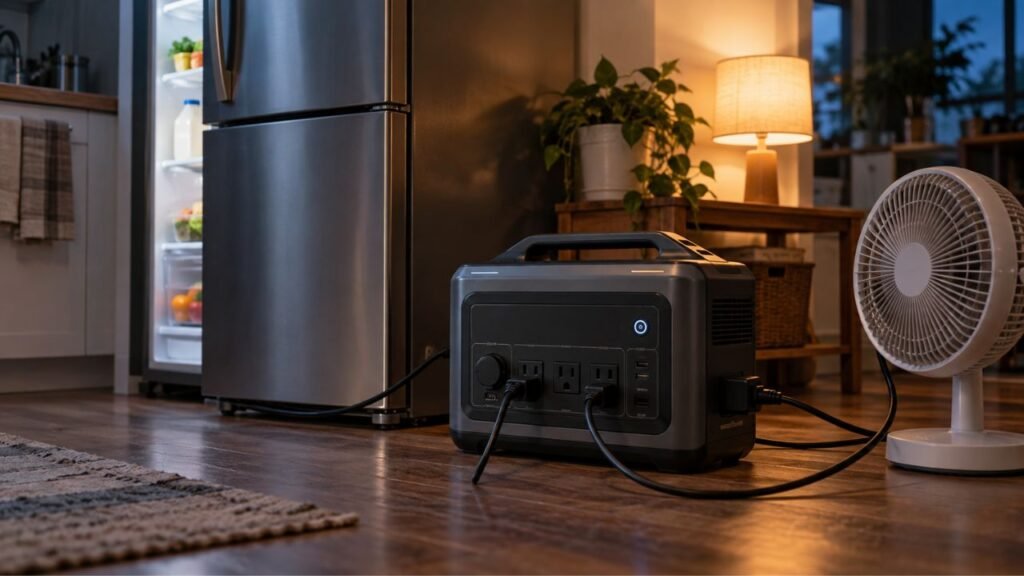
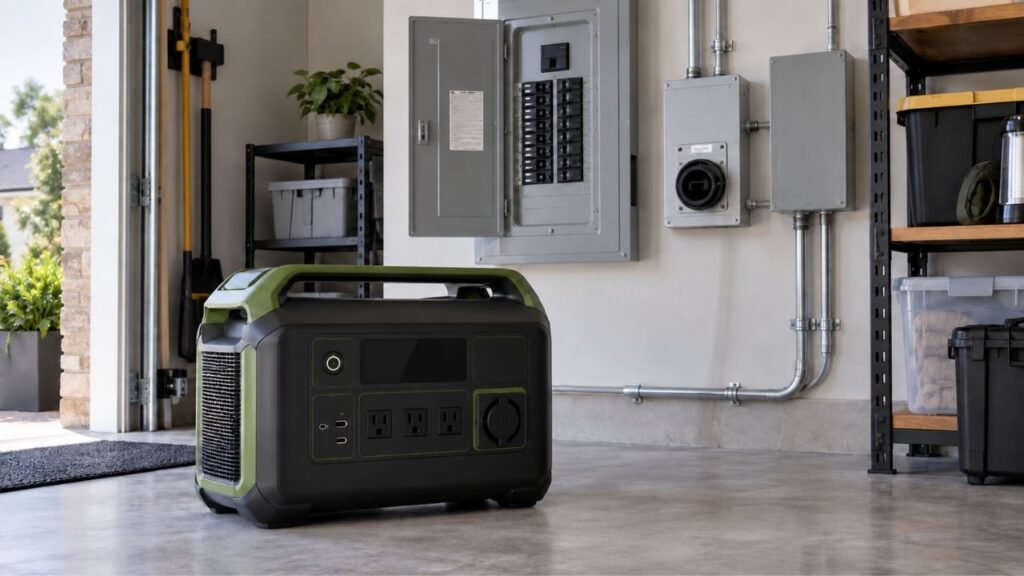
A transfer switch lets a compatible portable power station safely power selected hardwired home circuits. It disconnects those circuits from utility power before connecting them to backup power. This separation prevents electricity from feeding backward into the utility grid.
If you want refrigerator, lighting, furnace, or sump-pump circuits backed up, this setup can be much cleaner than extension cords. Below, I will explain exactly how it works, what equipment you need, and what compatibility issues matter most.
Key Takeaways
- A transfer switch moves selected circuits between utility and backup power.
- It prevents utility and backup sources from feeding circuits simultaneously.
- The power station still determines available watts and surge capacity.
- A transfer switch cannot turn 120V output into true 240V power.
- Manual transfer switches require you to change power sources yourself.
- Smart systems may transfer automatically when compatible equipment is installed.
- Voltage, outlets, neutral configuration, and switch ratings must match.
- A qualified electrician should handle permanent transfer-switch installation.
What Does a Transfer Switch Actually Do?
A transfer switch controls which electrical source supplies specific home circuits. During normal conditions, those circuits receive electricity from your utility service.
When backup power becomes necessary, the switch separates those circuits from utility power. It can then connect them to your portable power station.
That separation is the most important part of the system.
Without proper isolation, backup electricity could flow backward through your electrical service. This condition is commonly called backfeeding.
A properly installed transfer switch prevents both sources from feeding transferred circuits together. Your home therefore receives backup electricity without energizing the utility connection.
However, the transfer switch does not generate any electricity itself.
Think of it as a traffic controller for electrical power. It decides which approved source gets access to specific circuits.
Your portable power station still supplies the actual backup electricity.
How Does a Transfer Switch Work With a Portable Power Station?
The basic process is easier to understand when you follow the electricity. Power moves from your battery station through transfer equipment and into selected circuits.
1. Utility Power Normally Supplies Your Circuits
Under normal conditions, electricity enters your home from the utility grid.
Your transfer switch remains in its normal utility position. The selected circuits operate exactly as they usually would.
Depending on your installation, these circuits might include:
- Refrigerator
- Kitchen outlets
- Furnace blower
- Sump pump
- Internet equipment
- Bedroom outlets
- Essential lighting
Your portable power station does not need to supply these circuits yet.
2. The Portable Power Station Connects to the Backup Input
During an outage, your power station becomes the alternate electrical source.
A compatible cable connects the station’s AC output to the home’s backup connection. Some installations use a separate power inlet mounted near the electrical system.
Other manufacturer-designed systems may connect differently.
Possible connection types can include receptacles such as:
- TT-30
- L5-30
- L14-30
- 14-50
These connector types are not automatically interchangeable.
The cable, voltage, receptacle, transfer equipment, and power station must match properly.
3. The Transfer Switch Isolates the Utility Source
Before battery power reaches transferred circuits, utility power must remain isolated.
A manual transfer switch accomplishes this mechanically through its switching arrangement. Smart systems can perform the same basic isolation electronically or electromechanically.
This prevents the utility and power station from feeding the same circuit together.
That protection matters even when the utility currently appears completely dead.
Utility power can return unexpectedly during an outage. Proper transfer equipment keeps that returning electricity separated from your backup source.
4. The Switch Connects Circuits to Battery Power
Once isolation occurs, the transfer switch connects selected circuits to backup power.
The portable power station’s inverter now becomes their AC electricity source.
The inverter converts stored battery energy into usable household alternating current.
However, the transfer switch does not increase the station’s abilities.
It cannot increase:
- Continuous inverter output
- Starting surge capacity
- Battery capacity
- Output voltage
- Available amperage
The switch simply routes the electricity your station can already provide.
5. Your Appliances Begin Using Backup Electricity
Transferred circuits can now operate from your portable power station.
A refrigerator connected to a transferred circuit can keep cooling. Your furnace blower may continue moving heated air throughout your house.
Lights and selected outlets can remain usable as well.
Everything still depends on the power station having enough output capacity.
You must account for both normal running watts and startup surges.
A refrigerator might use modest power after starting. Its compressor can briefly demand considerably more during startup.
Sump pumps, furnace blowers, freezers, and well pumps behave similarly.
6. Utility Power Is Restored After the Outage
Eventually, your electric utility restores normal service.
With a manual transfer switch, you normally return transferred circuits yourself. Follow the operating sequence specified for your installed equipment.
A compatible smart system may handle this transition automatically.
Either way, the important principle remains unchanged.
Your selected circuits should receive electricity from one approved source at a time.
What Components Connect the Power Station to Your Home?
Several components work together to deliver battery power into hardwired circuits. Knowing each part makes the complete system much easier to understand.
- Portable power station: Stores battery energy and produces household AC electricity through its inverter.
- AC output receptacle: Provides the electrical output used for the home-backup connection.
- Compatible power cable: Carries electricity between your station and backup connection equipment.
- Power inlet: Provides a dedicated connection point in installations requiring one.
- Transfer switch: Selects utility or backup power for designated home circuits.
- Circuit breakers: Protect electrical circuits against excessive current and certain faults.
- Branch circuits: Carry electricity from the panel toward outlets and appliances.
- Main electrical panel: Distributes electrical power throughout your home’s existing wiring.
These components must work as one properly designed electrical system.
A transfer switch alone cannot connect every portable station to every house.
Portable Power Station Transfer Switch Power Flow
Following the direction of electricity makes this setup much easier to visualize.
During normal operation, the electrical path generally looks like this:
Utility grid → electrical panel and transfer equipment → selected circuit → appliance
During backup operation, the path changes:
Portable power station → compatible cable or inlet → transfer switch → selected circuit → appliance
The switch changes the circuit’s power source without combining both sources.
Your appliances usually do not care whether electricity comes from utility service. They simply require suitable voltage, frequency, and available power.
That is why inverter quality and output ratings still matter.
The transfer switch handles routing. The portable power station handles electricity production.
Manual vs Smart Transfer Switches for Portable Power Stations
Portable power stations can work with different transfer-switch designs. The important difference is how the change between power sources occurs.
Manual Transfer Switch
A manual transfer switch requires you to change power sources yourself.
When utility electricity disappears, you connect your compatible power station as required. You then move selected circuits from utility to backup operation.
These systems are often practical for essential-load backup.
You can dedicate circuits serving things such as:
- Refrigerator
- Furnace
- Sump pump
- Lights
- Internet equipment
- Important outlets
One advantage is straightforward load planning.
Because only chosen circuits are included, your family has fewer opportunities to accidentally power large unnecessary loads.
The disadvantage is that somebody must operate the system.
If nobody is home during an outage, a normal manual switch cannot independently transfer your circuits.
Smart or Automatic Transfer Switch
A smart transfer switch can automate more of the process.
Depending on the system, it may detect utility failure and transfer designated circuits. It may also reconnect utility power after stable grid service returns.
Some systems provide additional features, including:
- App-based monitoring
- Automatic circuit control
- Load prioritization
- Battery monitoring
- Scheduled charging
- Solar integration
- Automatic load shedding
However, compatibility becomes especially important here.
You should not assume a generic automatic generator switch supports every power station.
Many smart home-backup systems use manufacturer-specific communication and control hardware.
The portable station, switch, cables, firmware, and configuration may all need compatibility.
Can Any Portable Power Station Work With a Transfer Switch?
No. A transfer switch must be compatible with your power station and electrical system. Several electrical specifications need to work together correctly.
| What Must Match | What You Need to Check | Why It Matters |
| AC voltage | 120V or true 120/240V | Determines which home loads can operate |
| Continuous output | Power station inverter rating | Limits total running load |
| Surge output | Peak or startup capability | Motors may require extra startup power |
| AC receptacle | TT-30, L5-30, L14-30, 14-50, or another type | Determines connection hardware |
| Transfer-switch rating | Voltage and amperage limits | Equipment must safely handle the circuit |
| Neutral configuration | Equipment specifications | Incorrect arrangements can cause protection issues |
| Grounding design | Manufacturer and installation requirements | Helps maintain proper electrical protection |
| Circuit voltage | 120V or 240V branch circuits | Determines which circuits can receive backup power |
| Manufacturer compatibility | Approved products and accessories | Smart functions may require proprietary equipment |
The physical plug is only one compatibility factor.
Two devices can have connectors that appear suitable but operate differently electrically.
That is why you should never choose transfer equipment based only on plug shape.
Does the Transfer Switch Determine How Much Power You Get?
No. Your portable power station determines how much backup electricity is available.
This point causes plenty of confusion.
Suppose your transfer equipment carries a considerably higher electrical rating. Your portable station might still provide only 3,600 watts continuously.
You still have approximately 3,600 watts available from that station.
The larger switch does not increase the inverter’s output.
In simple terms:
Transfer-switch rating does not equal portable power station output.
The switch needs enough capacity to safely handle the connected electrical system. Your inverter rating determines how much power your battery station can actually deliver.
This difference matters when several household circuits operate simultaneously.
You might have ten transferred circuits available but lack enough inverter capacity. Turning everything on together could overload the portable power station.
How Many Home Circuits Can a Portable Power Station Support?
Circuit count alone does not tell you whether your station can handle them. You need to consider the actual electrical demand from connected appliances.
Circuit Count Is Not the Same as Electrical Load
A transfer switch might provide six, ten, or more circuit positions.
That does not mean every circuit can operate at maximum load simultaneously.
Several lightly loaded lighting circuits may consume very little electricity.
One central air conditioner could demand more power than all those lights combined.
Focus on appliance demand rather than simply counting breakers.
Add Your Simultaneous Running Loads
Start by identifying appliances that may operate at the same time.
For example, imagine these approximate running loads:
- Refrigerator: 150 watts
- Internet equipment: 20 watts
- LED lighting: 80 watts
- Furnace blower: 500 watts
- Television: 100 watts
Their combined running demand would be approximately 850 watts.
Real equipment can consume more or less electricity than these examples.
Always use your appliance labels or manufacturer specifications when available.
Account for Starting Surge
Motor-driven appliances can briefly demand much more power when starting.
Examples include:
- Refrigerators
- Freezers
- Sump pumps
- Well pumps
- Furnace blowers
- Air conditioners
That brief demand can trip your power station even when running watts seem reasonable.
You therefore need both continuous output and adequate surge capacity.
Leaving some headroom also makes the system more dependable.
Can a 120V Portable Power Station Power 240V Home Circuits?
Normally, no. A 120V-only portable power station cannot directly operate true 240V appliances.
Connecting it through a transfer switch does not change that limitation.
The transfer switch does not manufacture a second electrical phase or higher voltage.
Common household 240V loads can include:
- Central air conditioners
- Electric clothes dryers
- Electric ranges
- Larger well pumps
- Electric water heaters
- Some EV chargers
These appliances require a properly designed 120/240V backup source.
Some larger portable power systems can provide true split-phase 120/240V output. They may achieve this through one large station or paired compatible units.
Those systems require matching transfer equipment and connection hardware.
So, check the actual electrical output rather than marketing terms alone.
If your station only provides 120V, plan around suitable 120V circuits.
Why Neutral and Ground Compatibility Matters
Neutral and grounding details can affect transfer-switch compatibility and electrical protection. You do not need to redesign these connections yourself, but they deserve attention.
Floating Neutral vs Bonded Neutral
Portable power equipment can use different neutral and grounding arrangements.
Some backup sources have neutral connected to equipment ground internally.
Others operate with a floating neutral.
Your transfer equipment may also switch the neutral or leave it continuous.
Those differences can affect how protective equipment behaves.
Some Transfer Switches Do Not Switch Neutral
Many residential manual transfer switches transfer the hot conductors only.
The home’s neutral can remain connected through the existing electrical system.
That arrangement may work correctly with certain floating-neutral backup sources.
Other system designs need different equipment.
This is one reason two apparently similar portable stations may have different requirements.
Have the Combination Verified
Ask your electrician to confirm the entire equipment combination.
Important items include:
- Portable power station neutral design
- Transfer-switch neutral arrangement
- Equipment grounding
- Circuit protection
- GFCI requirements
- AFCI requirements
- Manufacturer instructions
- Local electrical requirements
Do not add or remove neutral-ground bonds based on internet instructions.
Incorrect changes can create electrical faults or defeat safety protections.
What Happens When Utility Power Goes Out?
The exact operating procedure depends on your transfer equipment. A typical manual setup follows a straightforward sequence after the outage begins.
- Confirm that normal utility service has actually failed.
- Check that your power station has sufficient battery charge.
- Connect the approved cable or backup connection as required.
- Enable the power station’s appropriate AC output.
- Move designated circuits from utility to backup operation.
- Bring larger loads online gradually when practical.
- Watch the station’s real-time output and remaining battery level.
- Turn off unnecessary loads to extend backup runtime.
Avoid treating an outage as a race to energize everything.
Start with what actually matters.
Refrigeration, lighting, communications, heating controls, and pumps often deserve priority.
Then add optional loads only when enough capacity remains.
What Happens When Grid Power Comes Back?
Utility power can return without much warning during an outage.
Your transfer equipment keeps restored utility power separated from backup electricity.
With a manual system, you normally transfer circuits back to utility operation yourself.
Follow the operating sequence provided for your installed switch.
After normal utility power is restored, the power station can be disconnected or recharged according to its instructions.
A compatible smart system may handle the transition automatically.
It can detect acceptable utility service and return circuits to grid electricity.
Some systems may also begin recharging the battery afterward.
Will a Transfer Switch Make Backup Power Automatic?
Not necessarily. A standard manual transfer switch still requires human operation.
Installing one does not automatically give your power station outage detection.
Automatic operation requires a compatible system designed for that purpose.
That may include:
- Automatic or smart transfer equipment
- Compatible portable power station
- Communication hardware
- Proper control settings
- Manufacturer-supported connection equipment
There is another important distinction here.
Automatic transfer is not the same as UPS transfer speed.
A system might automatically switch during an outage yet take several seconds. Another integrated battery system might transfer much faster.
Sensitive electronics can care about that difference.
If uninterrupted operation matters, check the manufacturer’s published transfer time.
Do not assume every automatic system functions like a computer UPS.
Transfer Switch vs Interlock Kit for a Portable Power Station
Both methods can provide a safe home-backup connection when properly designed. However, they give homeowners very different ways to manage their circuits.
Transfer Switch
A transfer switch commonly controls a predefined collection of backup circuits.
Those circuits are chosen during installation.
This arrangement can make outage operation straightforward because everyone knows which circuits are available.
It also limits access to circuits outside the backup configuration.
That restriction can help prevent accidental overloads.
Manual and smart transfer-switch options are available, depending on your equipment.
Interlock Kit
An interlock works directly with a compatible main electrical panel.
It mechanically prevents the main utility breaker and backup breaker from operating together.
This gives you broader access to breakers inside the existing panel.
During an outage, you choose which individual circuits remain turned on.
That flexibility is useful when backup priorities change.
However, it also requires more careful load management.
You could accidentally activate too many high-demand circuits for your power station.
Neither method increases your battery station’s available output.
Your inverter remains the limiting power source in either setup.
What Home Circuits Make Sense for Portable Power Station Backup?
The best backup circuits are usually loads that protect safety, comfort, food, communication, or essential home functions.
Common candidates include:
- Refrigerator
- Freezer
- Wi-Fi router and modem
- Essential LED lighting
- Furnace blower
- Sump pump
- Selected kitchen outlets
- Selected bedroom outlets
- Garage-door opener
- Security equipment
- Medical devices when appropriate
Your priorities will depend on your home and outage conditions.
A winter outage may make heating equipment your biggest concern.
A summer storm might make refrigeration and sump pumping more important.
Choose circuits based on actual needs rather than convenience alone.
What Circuits May Be Too Large for Smaller Power Stations?
Some household loads can quickly exceed smaller portable power station limits.
Common high-demand loads include:
- Central air conditioning
- Electric resistance heating
- Electric clothes dryers
- Electric water heaters
- Electric ranges
- Large well pumps
- Hot tubs
- High-power EV chargers
This does not mean portable battery systems can never run them.
Large expandable systems may support some major household appliances.
However, these loads often require substantial continuous and surge capacity.
Many also require true 240V split-phase output.
Check each appliance before including it in your backup plan.
How Does Battery Capacity Affect Transfer-Switch Backup?
A transfer switch lets you reach household circuits, but battery capacity determines runtime.
This brings us to an important distinction.
Watts tell you how much electrical power you can supply at once.
Watt-hours tell you how much stored energy you have available.
Imagine a station with a 3,000-watt inverter and 3,000Wh battery.
The inverter rating helps determine which loads can run simultaneously.
The battery capacity helps estimate how long those loads can continue.
A simple runtime estimate looks like this:
Estimated runtime = usable battery watt-hours ÷ average load watts
For example, a 3,000Wh battery supporting an average 500-watt load has a theoretical six-hour result.
Real runtime will usually be lower.
Inverter losses, battery reserves, temperature, cycling loads, and conversion losses affect results.
Reducing unnecessary loads can therefore make a major difference.
Can You Recharge the Power Station While It Powers the Transfer Switch?
Sometimes. This feature depends on your portable power station and connection setup.
Many newer systems support some form of simultaneous charging and discharging.
For example, solar panels may keep adding energy while your station powers essential circuits.
Certain systems may also recharge from another approved AC source.
However, operating limits can change while charging.
You may encounter restrictions involving:
- Maximum AC output
- AC input power
- Solar charging limits
- Pass-through operation
- Battery charging priority
- Temperature
- Connection mode
Never assume simultaneous charging is supported simply because both ports exist.
Check the operating instructions for your exact system.
Solar charging can be especially useful during longer outages.
It may extend runtime significantly when sunlight and array capacity are sufficient.
Common Transfer Switch and Portable Power Station Problems
A properly designed system should be straightforward to operate. Still, a few problems appear repeatedly when equipment, loads, or settings do not match.
The Transfer Switch Is On but the Circuit Has No Power
First, check whether the station’s AC output is actually enabled.
Some portable stations keep their AC inverter disabled until you activate it.
Other possible causes include:
- Transfer control in the wrong position
- Tripped circuit breaker
- Empty battery
- Loose approved connection
- Incorrect connection equipment
- Circuit not included in backup wiring
If the installation itself seems questionable, stop troubleshooting and contact your electrician.
The Power Station Immediately Shows Overload
An overload warning usually means connected demand exceeds inverter capability.
You may have too many appliances operating simultaneously.
A motor could also be drawing a high startup surge.
Turn off nonessential circuits and reduce the load.
Then restart according to your power station’s instructions.
If one appliance repeatedly causes overloads, compare its starting requirements with your station’s surge rating.
GFCI or AFCI Protection Keeps Tripping
Repeated protective-device tripping deserves careful attention.
Possible causes can involve:
- Appliance faults
- Branch-circuit problems
- Neutral configuration
- Grounding arrangement
- Transfer-equipment compatibility
- Leakage current
Do not bypass GFCI or AFCI protection to make the system operate.
Have the electrical configuration checked instead.
Only Some Circuits Work
This situation may be completely normal.
A manual transfer switch usually backs up only circuits selected during installation.
Other possibilities include:
- Individual switch left in utility position
- Breaker turned off
- Load-shedding system disabling circuits
- 240V load connected to incompatible backup power
- Power station reaching its output limit
Check your circuit labels before assuming something has failed.
240V Appliances Do Not Work
Start by checking whether your power station provides true 120/240V split-phase output.
A standard 120V portable station cannot directly power true 240V circuits.
A transfer switch cannot correct that limitation.
You need compatible 240V backup equipment for those loads.
Is a Transfer Switch Safe With a Portable Power Station?
Yes, when the power station and transfer equipment are properly matched.
The transfer switch’s central safety role is electrical source isolation.
It prevents selected circuits from being connected simultaneously to utility power and your backup source.
A safe installation also needs several other things handled correctly.
These include:
- Correct transfer-switch rating
- Proper conductor sizing
- Suitable circuit breakers
- Correct inlet and cable
- Compatible voltage
- Correct neutral configuration
- Proper equipment grounding
- Approved installation methods
A portable power station does have one important advantage over fuel generators.
Battery stations do not produce carbon monoxide during normal operation.
That makes indoor battery use possible when the manufacturer allows it.
However, electrical hazards still remain.
A battery-based system still involves substantial voltage and current.
What Should You Check Before Connecting a Portable Power Station to a Transfer Switch?
Compatibility should be confirmed before buying cables or transfer equipment. This checklist helps you discuss the system clearly with your electrician.
- Continuous inverter wattage: Determines sustainable combined electrical load.
- Surge wattage: Determines whether motor-driven appliances can start reliably.
- Battery capacity: Helps estimate how long your essential loads can operate.
- Output voltage: Confirm whether the station provides 120V or true 120/240V.
- Available amperage: Check the maximum current available from the selected output.
- AC receptacle: Confirm the exact outlet used for home integration.
- Connection cable: Use the correct manufacturer-approved or properly specified cable.
- Transfer-switch voltage: It must match the intended backup configuration.
- Transfer-switch current rating: Equipment must be appropriately rated for the installation.
- Circuit requirements: Identify which circuits are 120V and which require 240V.
- Neutral configuration: Confirm compatibility between the station and transfer equipment.
- Grounding requirements: Ensure the system follows the correct electrical design.
- GFCI and AFCI protection: Confirm that protective devices operate correctly.
- Manufacturer compatibility: Smart systems may require specific approved components.
- Local electrical requirements: Permits and inspection rules can differ between jurisdictions.
- Professional installation: Have permanent panel connections completed or verified appropriately.
Completing this checklist prevents most unpleasant surprises after installation.
Do You Need an Electrician to Install a Transfer Switch?
Yes. Permanent transfer-switch work should be handled by a qualified electrician.
The installation interacts directly with your home’s electrical distribution system.
It can involve:
- Main electrical panel work
- Branch-circuit wiring
- Circuit protection
- Source isolation
- Neutral connections
- Grounding
- Conductor sizing
- Transfer-equipment mounting
Improper wiring can create shock, fire, or backfeeding hazards.
Your electrician can also help select appropriate backup circuits.
That matters because an oversized circuit list can overwhelm your power station.
Once installed, normal manual operation can be simple enough for homeowners.
Ask the electrician to label everything clearly and demonstrate the proper sequence.
Everyone who may operate the system should understand those steps.
When Is a Transfer Switch Worth Using With a Portable Power Station?
A transfer switch makes sense when you want battery backup integrated with home wiring.
It is especially useful when several essential hardwired circuits need backup.
For example, you may want to operate:
- Refrigerator
- Furnace blower
- Sump pump
- Kitchen outlets
- Bedroom outlets
- Essential lighting
Without transfer equipment, you might need extension cords running between rooms.
That approach becomes inconvenient when several appliances need power.
A transfer switch provides a more organized home-backup system.
It can also make outage preparation easier for other household members.
However, not everyone needs one.
If you only want to run a refrigerator and phone charger, direct connections may be enough.
The transfer switch becomes more valuable as your backup needs grow.
Conclusion
A transfer switch lets a compatible portable power station safely supply selected home circuits. It works by disconnecting those circuits from utility power before connecting backup electricity.
The switch itself does not increase watts, voltage, or battery capacity. Your portable power station still determines which appliances can operate and how long they can run.
Before installing a system, check voltage, inverter output, surge capacity, connectors, neutral design, and circuit requirements. Pay special attention to 120V versus 240V loads.
When everything is properly matched, a transfer switch can make battery backup much more convenient. You get centralized access to important circuits without relying on extension cords throughout your home.
Related FAQs
Here are quick answers to common questions about portable power stations and home transfer switches.
Can You Connect a Portable Power Station to a Transfer Switch?
Yes, you can connect a compatible portable power station to suitable transfer equipment. The station’s voltage, output receptacle, inverter capacity, neutral configuration, cables, and switch specifications must all match the intended installation.
Do All Portable Power Stations Work With Transfer Switches?
No. Some smaller stations lack suitable high-current outputs or home-integration support. Other models may only provide 120V power, while certain transfer systems require true 120/240V output or manufacturer-specific hardware.
Can a Transfer Switch Work With a 120V Power Station?
Yes, an appropriately designed transfer system can use a 120V portable power station. However, it can only support compatible 120V circuits unless the complete backup system provides true split-phase 240V output.
Can a Transfer Switch Make a Portable Power Station Provide 240V?
No. A transfer switch only routes available electrical power between sources and circuits. A 120V portable station remains a 120V source after connecting through transfer equipment.
Can a Portable Power Station Run a Whole House Through a Transfer Switch?
Possibly, but the answer depends on your home’s electrical demand. Larger systems can support many circuits, while smaller stations may only handle essential loads such as refrigeration, lighting, internet equipment, and heating controls.
Does a Transfer Switch Prevent Backfeeding?
Yes. Properly designed and installed transfer equipment keeps utility power and backup electricity isolated. This prevents the power station from unintentionally feeding electricity back toward the utility grid.
Is a Manual Transfer Switch Better Than an Interlock for a Power Station?
Neither option is universally better. A transfer switch provides organized, predetermined backup circuits, while an interlock offers broader breaker flexibility. Your panel, power station capacity, budget, and preferred load-management method should guide the choice.
Can a Power Station Stay Connected to a Transfer Switch All the Time?
Some integrated systems are designed for permanent connection, while others are not. Follow the power station and transfer-equipment manufacturer’s instructions regarding continuous connection, charging, standby operation, and long-term battery management.
Can Solar Panels Charge the Power Station While It Supplies the House?
Many portable power stations support solar charging while delivering AC power. However, charging limits, output limits, and operating modes vary between models, so verify simultaneous charging and discharging support first.
Does a Transfer Switch Increase Portable Power Station Output?
No. A transfer switch cannot increase inverter wattage, surge capacity, voltage, or battery storage. It only provides a controlled method for routing the power station’s existing output to designated household circuits.

Warren Turner writes practical guides and reviews on generators, portable power stations, and battery backup systems. He focuses on real-world performance, everyday power needs, and helping readers choose dependable equipment without unnecessary complexity.