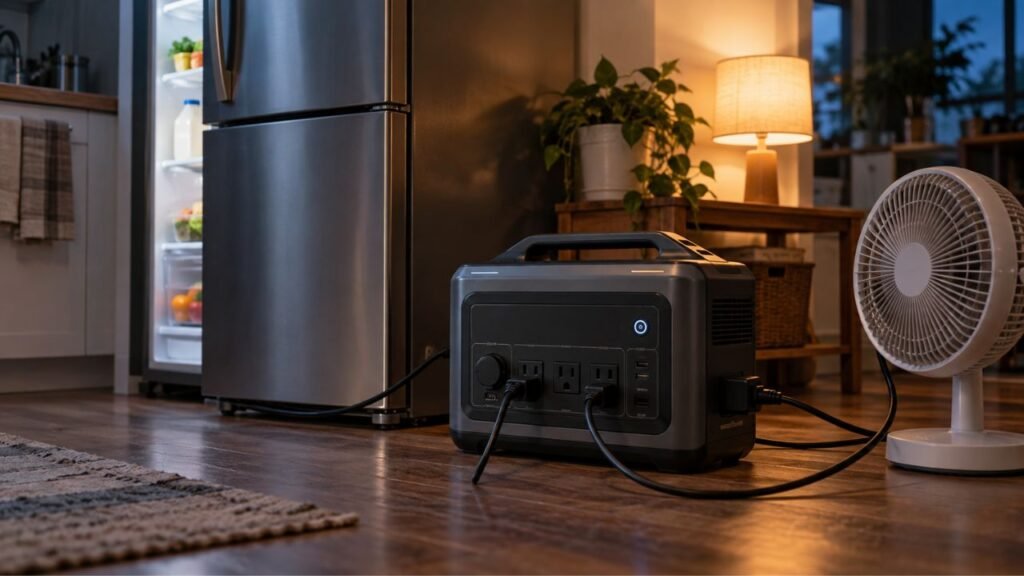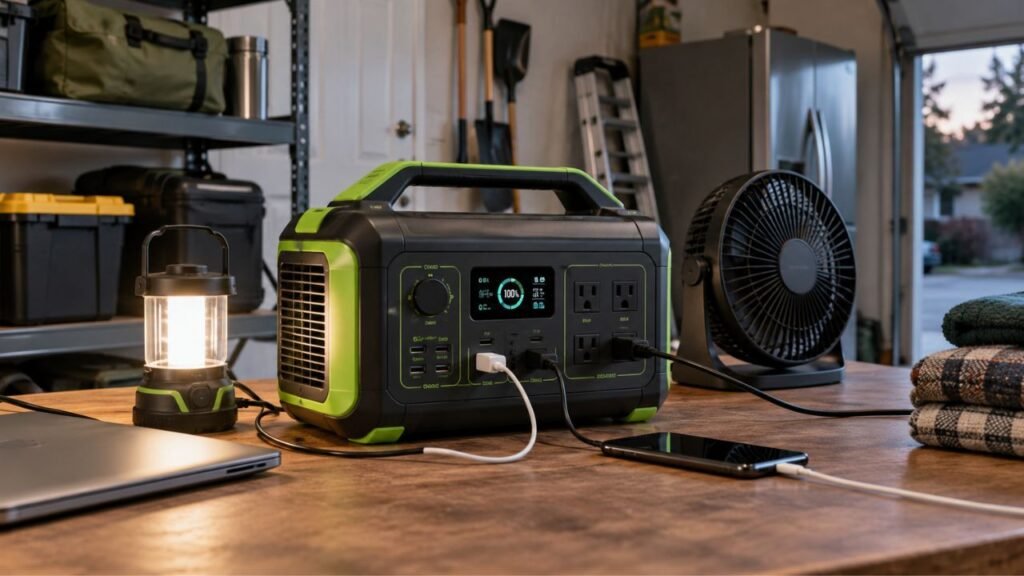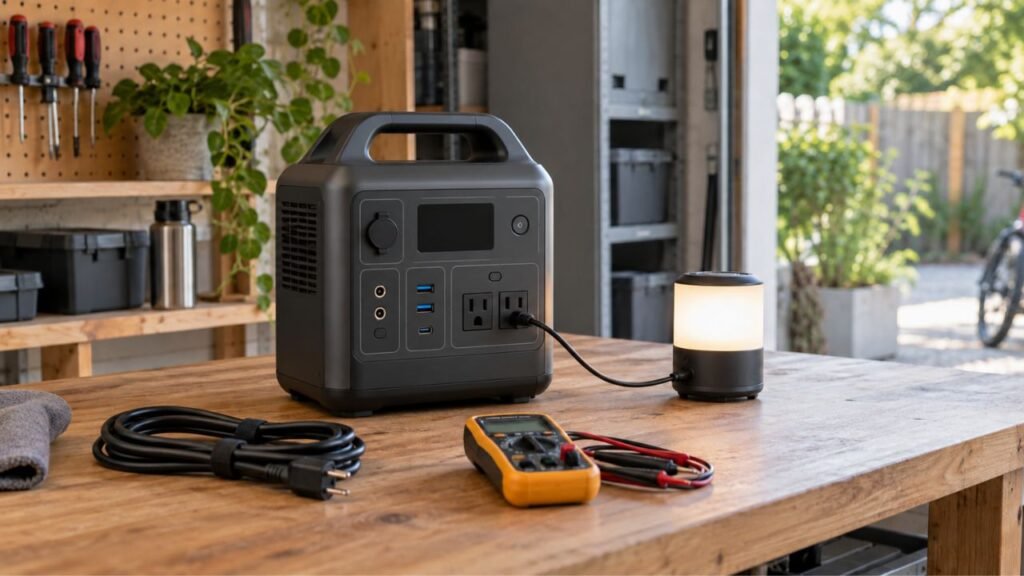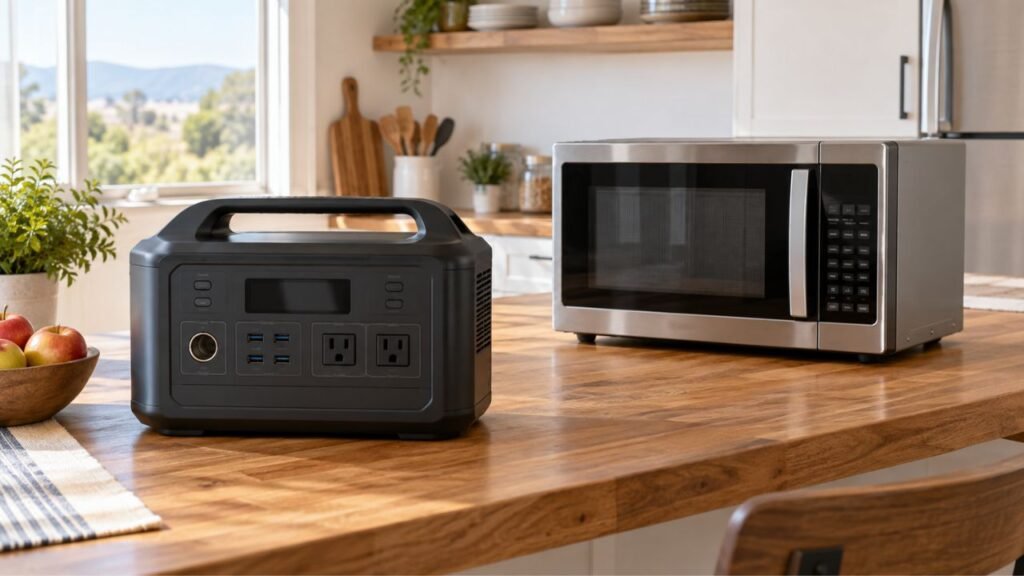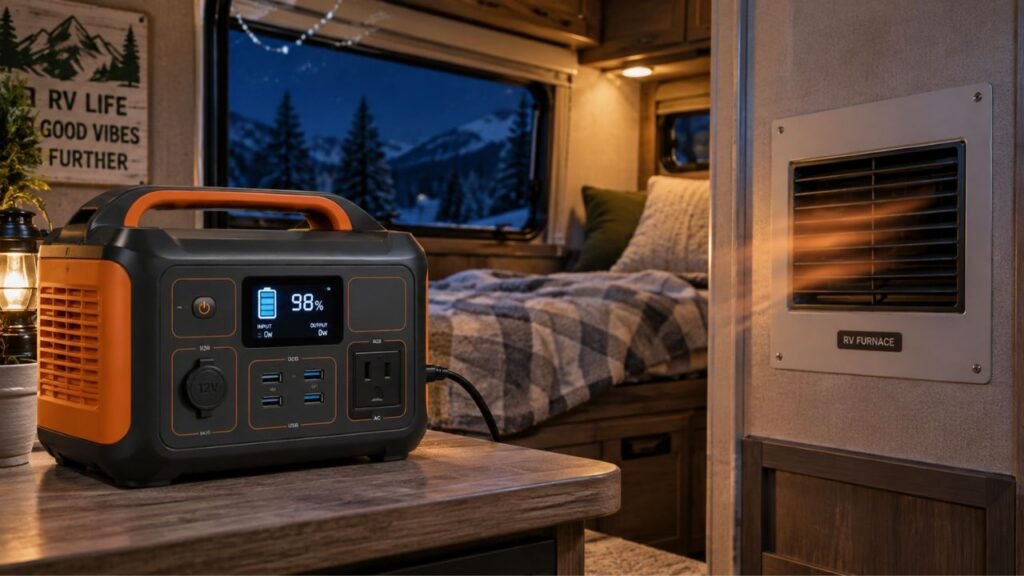
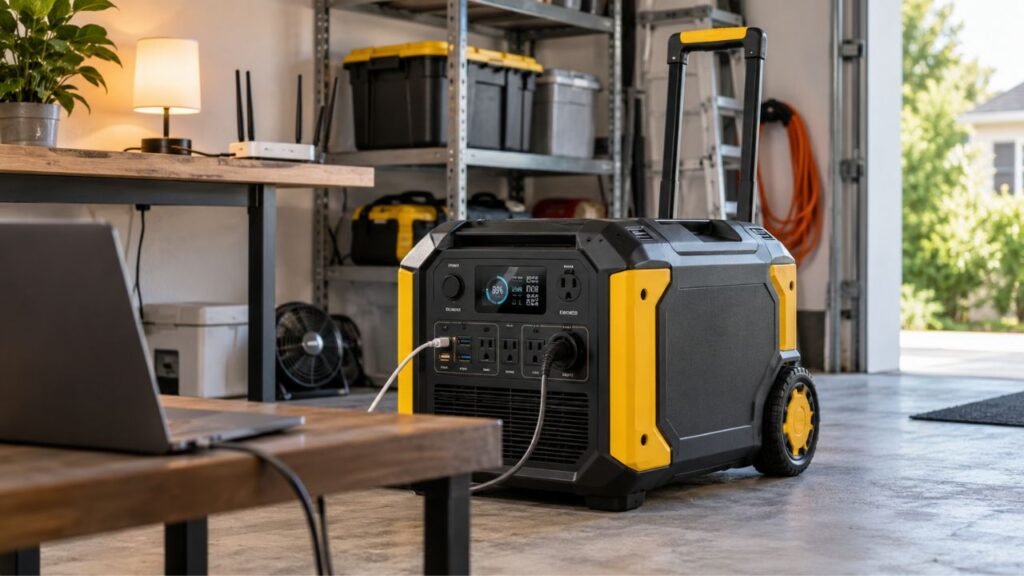
To calculate simultaneous portable power station loads, add the running wattage of every device operating at the same time. Compare that total with the station’s continuous output rating. Then calculate the highest realistic startup surge and compare it with the station’s surge rating.
The process is simple once you separate running watts from startup watts. I’ll show you how to find device wattage, calculate overlapping loads, allow useful headroom, and avoid common overload mistakes.
Key Takeaways
- Add only devices that will actually operate at the same time.
- Compare combined running watts with the continuous output rating.
- Calculate appliance startup surges separately from normal running loads.
- Include other active devices when a motor appliance starts.
- Do not automatically add every appliance’s surge rating together.
- Check individual AC, USB, and DC output limits too.
- Use watt-hours for runtime, not for simultaneous load calculations.
What Is a Simultaneous Load on a Portable Power Station?
A simultaneous load is the combined electrical demand happening at one moment. It tells you how much inverter output your power station needs.
Suppose you are powering these devices together:
- Laptop: 65 watts
- Wi-Fi router: 15 watts
- LED lights: 30 watts
Your simultaneous load would be:
65W + 15W + 30W = 110W
That means your power station must continuously provide at least 110 watts.
However, connected devices and active devices are not always identical.
You might have five devices plugged into the station. If only three are drawing meaningful power, calculate those three active loads.
This distinction becomes especially important during home backup. You probably will not use every connected appliance simultaneously.
What Numbers Do You Need Before Calculating the Load?
You only need a few specifications to calculate simultaneous loads correctly. Most appear on the appliance label or power station specification sheet.
Running Watts
Running watts describe the power an appliance normally consumes during operation.
A laptop may draw around 65 watts while charging. A light might consume 10 watts continuously.
Running wattage is what you use when calculating normal simultaneous demand.
Starting or Surge Watts
Some appliances temporarily need more power when starting.
Common examples include:
- Refrigerators
- Freezers
- Sump pumps
- Well pumps
- Air conditioners
- Power tools
- Other motor-driven equipment
A refrigerator might normally use 180 watts. However, its compressor could require much more power during startup.
This temporary demand is called startup, starting, or surge wattage.
Continuous Output Rating
The continuous output rating tells you how much power the station can supply steadily.
For example, a station rated for 1,800 watts continuous should normally support combined AC loads below that limit.
The battery capacity does not change this restriction.
A 3,000Wh battery with a 1,500W inverter still cannot continuously support a 2,000W load.
Port and Output Limits
You should also check the limits of individual outputs.
A station may have:
- Several AC outlets
- USB-A ports
- USB-C ports
- 12V DC outputs
- High-current DC outputs
The station might support a high total output while individual ports have lower limits.
That means total inverter wattage is not the only specification that matters.
How Do You Find the Wattage of Each Device?
Start with the actual equipment you plan to power. Manufacturer labels and real measurements are usually more useful than generic appliance charts.
Check the Appliance Nameplate or Power Adapter
Look at the back, bottom, side, or power adapter.
You may see information such as:
- Input watts
- Input voltage
- Current in amps
- Rated power
- Maximum power
If watts are already listed, use that number as your starting point.
Remember to check electrical input rather than useful appliance output.
For example, a microwave advertised as “1,000 watts” of cooking output may draw more electrical power from the outlet.
Calculate Watts When Volts and Amps Are Listed
For simple estimates, you can use:
Watts = Volts × Amps
For example:
120V × 2A = 240W
A device rated at 120 volts and 2 amps may therefore require about 240 watts.
However, volts multiplied by amps does not always equal true power perfectly for AC motors and electronic equipment.
If the manufacturer provides actual watts, use that figure instead.
Measure Real Power With a Watt Meter
A plug-in watt meter can give you a much better real-world number.
This is especially useful for:
- Refrigerators
- Freezers
- TVs
- Computers
- Pumps
- Variable-speed equipment
Some devices constantly change their power consumption.
A laptop may draw more while charging and working heavily. It may draw much less after its battery becomes full.
Real measurements help when your calculated load approaches the station’s limit.
How Do You Calculate the Total Simultaneous Running Load?
The basic calculation is straightforward. Add the normal running wattage of every device you expect to operate together.
Use this formula:
Total Simultaneous Running Load = Device 1 Watts + Device 2 Watts + Device 3 Watts + Other Active Loads
Here is a simple home-backup example.
| Device | Running Watts | Starting Watts | Running Now? | Watts Included |
| Refrigerator | 180W | 700W | Yes | 180W |
| Wi-Fi router | 15W | None | Yes | 15W |
| LED lights | 40W | None | Yes | 40W |
| Laptop | 65W | None | Yes | 65W |
| Coffee maker | 1,000W | None | No | 0W |
| Total | 300W |
The normal simultaneous running load is:
180W + 15W + 40W + 65W = 300W
So, under normal operation, these devices need about 300 watts together.
These appliance numbers are examples only. Your actual equipment may consume different amounts.
How Do You Calculate Simultaneous Startup or Surge Load?
Running load tells you what happens during steady operation. Startup load tells you whether the station can survive sudden short power spikes.
Add the Starting Device to Everything Already Running
Suppose the refrigerator from our example starts its compressor.
Its startup demand is 700 watts.
The router, lights, and laptop are still operating:
- Router: 15W
- Lights: 40W
- Laptop: 65W
Those background loads total:
15W + 40W + 65W = 120W
Now add the refrigerator’s starting demand:
700W + 120W = 820W
Your highest simultaneous load during that startup event becomes approximately 820 watts.
This is more useful than checking the refrigerator surge alone.
The power station must support the appliance starting while everything else remains powered.
Do Not Double-Count Running Watts
This is an easy mistake to make.
Suppose the refrigerator specification says:
- Running watts: 180W
- Starting watts: 700W
If 700W represents its total startup demand, calculate:
700W + other active loads
Do not calculate:
700W + 180W + other active loads
That would count part of the refrigerator demand twice.
However, specifications are not always presented the same way.
Some documentation may describe an additional startup requirement rather than total startup watts.
Always check how the manufacturer defines the number.
What If Two Motor Loads Could Start Together?
Now imagine you are also powering a sump pump.
The refrigerator and pump might occasionally start close together.
For critical backup planning, calculate that realistic overlap.
For example:
- Refrigerator starting demand: 700W
- Sump pump starting demand: 900W
- Router and lights: 55W
If both motors could genuinely start together:
700W + 900W + 55W = 1,655W
Your power station would need sufficient short-term surge capability.
However, do not automatically combine every motor surge in your home.
Calculate the worst combination that could realistically happen together.
Should You Multiply Running Watts by Two or Three?
You may see advice saying motor appliances need two or three times their running wattage.
That can be a useful rough estimate when better information is unavailable.
However, it should not replace actual manufacturer specifications.
Different compressors, pumps, tools, and motors behave differently.
If you can find documented starting watts, use them instead.
Should You Add Safety Headroom Above the Calculated Load?
It is usually sensible to avoid operating continuously at the station’s absolute maximum.
Suppose your normal simultaneous load is 1,300 watts.
Using about 20% planning headroom gives:
1,300W × 1.20 = 1,560W
A station around the 1,600W continuous-output range would provide more flexibility than one rated exactly at 1,300 watts.
A planning margin can help with changing loads and unexpected device behavior.
A practical range might be around 15% to 25% for planning purposes.
That is not a universal electrical requirement. It is simply useful sizing headroom.
For startup events, compare your calculated peak with the manufacturer’s actual surge specification.
Do All Devices Need to Be Counted at Their Maximum Wattage?
Not necessarily.
Different appliances behave differently during operation.
Constant loads stay relatively steady. Examples include many lights and routers.
Variable loads can change substantially. Computers and electronic devices often fall into this group.
Cycling loads switch themselves on and off. Refrigerators and freezers are common examples.
For simultaneous output calculations, think about what each device could draw during the scenario you are testing.
For runtime calculations, average consumption becomes more important.
These are two different calculations.
A refrigerator could require a large startup surge for seconds. It does not consume that startup wattage continuously.
How Do You Calculate Different Load Scenarios?
You will usually get better results by creating several realistic scenarios. This avoids sizing your station around an unlikely everything-at-once situation.
Scenario 1: Essential Loads Only
Suppose you need:
- Refrigerator: 180W
- Router: 15W
- Lights: 40W
- Laptop: 65W
The running load becomes:
180 + 15 + 40 + 65 = 300W
This is your basic essential-load scenario.
Scenario 2: Essential Loads Plus a Coffee Maker
Now you want to make coffee without disconnecting anything.
Add a 1,000W coffee maker:
300W + 1,000W = 1,300W
Your station now needs to sustain around 1,300 watts.
That is a big jump from the previous 300W load.
Scenario 3: Refrigerator Starts While Making Coffee
Now the refrigerator compressor starts while the coffee maker operates.
Use the refrigerator’s 700W starting demand instead of its 180W running demand.
The calculation becomes:
700W + 1,000W + 15W + 40W + 65W = 1,820W
The station sees approximately 1,820 watts of momentary demand.
This is why startup overlap matters so much.
Your normal load looked modest until the high-wattage appliance joined it.
Scenario 4: Reduce the Load Instead of Buying Bigger
You do not always need a larger power station.
You could simply avoid using the coffee maker while another high-demand appliance starts.
During an outage, load scheduling can stretch both inverter capacity and battery runtime.
That may let a smaller power station cover your essential needs safely.
How Can You Reduce Simultaneous Load Without Losing Essential Power?
You can often reduce peak demand without sacrificing important equipment.
- Run one high-wattage heating appliance at a time.
- Avoid operating several cooking appliances together.
- Stagger pumps and other motor-driven equipment when possible.
- Keep refrigerators and essential electronics prioritized.
- Delay optional charging until high-draw appliances finish.
- Use direct USB-C charging when appropriate.
- Turn off unused AC outlets when your station supports it.
- Group devices into essential, optional, and high-draw categories.
- Watch the station’s live wattage display during actual use.
This type of load management can be especially valuable during outages.
You may discover that you need less inverter capacity than expected.
Do AC, USB-C, and DC Loads All Count Together?
Different output types can have separate electrical limits. Check both the total station rating and each port specification.
AC Loads
Household appliances normally use the power station’s AC inverter.
Their combined demand counts toward the applicable AC output limit.
If your AC inverter supports 1,800 watts, several connected AC devices must remain within that rating.
USB-C and USB-A Loads
USB ports often have individual maximum ratings.
For example, one USB-C port might support much more power than another.
Some stations also share output capacity across several USB ports.
Check the manual when charging several devices simultaneously.
12V DC Loads
DC ports have voltage and current limits too.
A 12V socket may have a current limit even when the overall station can provide much more power.
Do not assume the full inverter rating applies to that DC connection.
Check the Station’s Total Combined Output
Some stations can provide AC, USB, and DC output together.
However, there may still be a total system limit.
Multiple outlets do not create additional inverter capacity.
A station with six AC outlets does not mean each outlet can deliver the station’s full rated output simultaneously.
What About 120V and 240V Simultaneous Loads?
Larger portable power stations may support both 120V and 240V equipment.
For these systems, simultaneous-load planning becomes more important.
You should verify:
- Total continuous inverter output
- 120V output limitations
- 240V output limitations
- Individual outlet ratings
- Per-leg limits when applicable
- Surge limits
- Approved operating configuration
Do not assume every 240V-capable station distributes power the same way.
Check the manufacturer’s manual for your specific model.
Does Pass-Through Charging Change the Load Calculation?
Some portable power stations can supply devices while the battery is charging.
This may be described as pass-through charging, bypass operation, EPS, or UPS functionality.
However, the available output can depend on operating mode.
A station might have different limits while connected to shore power.
Charging input also does not automatically increase the inverter’s normal output rating.
If you plan to run heavy loads while charging, check the manufacturer’s stated bypass or pass-through limits.
Simultaneous Watts vs. Watt-Hours: Why Are They Different?
Watts and watt-hours answer two different questions. Keeping them separate prevents many sizing mistakes.
Watts Tell You Whether the Station Can Run Everything
Watts describe the power your devices require at one moment.
If your active devices demand 1,500 watts together, your inverter must support that simultaneous load.
Battery capacity cannot compensate for an undersized inverter.
Watt-Hours Tell You How Long Everything Can Run
Watt-hours describe stored energy.
Once you know the average operating load, you can estimate runtime.
A basic formula is:
Runtime = Usable Battery Energy ÷ Average Load
For example, suppose a station provides about 850Wh of usable energy.
If the average load is 100 watts:
850Wh ÷ 100W = 8.5 hours
Real runtime can vary with efficiency, temperature, load behavior, and battery condition.
Why You Should Not Use Surge Watts for Runtime
Startup watts normally last for only a short period.
Suppose a refrigerator needs 700 watts to start but 180 watts afterward.
You should not calculate its entire runtime using 700 watts.
Use startup watts when checking inverter compatibility.
Use normal or average energy consumption when estimating runtime.
A Complete Simultaneous Portable Power Station Load Example
Let’s combine everything into one practical example. Assume these wattages are representative numbers for demonstration only.
| Operating Situation | Calculation | Required Output |
| Normal essential loads | 180 + 15 + 40 + 65 | 300W |
| Refrigerator starting | 700 + 15 + 40 + 65 | 820W peak |
| Coffee maker added | 180 + 15 + 40 + 65 + 1,000 | 1,300W |
| Refrigerator starts during coffee use | 700 + 15 + 40 + 65 + 1,000 | 1,820W peak |
| 20% headroom on 1,300W running load | 1,300 × 1.20 | 1,560W |
This example reveals two different requirements.
Your normal continuous requirement reaches 1,300 watts when making coffee.
Adding 20% planning headroom gives a target near 1,560 watts.
Your separate momentary peak requirement reaches approximately 1,820 watts when the refrigerator starts.
Therefore, you would want a station whose continuous rating comfortably handles the running load.
Its surge capability must also cover the calculated startup event.
A 1,000W station could easily handle the 300W essential-load scenario.
It could not continuously support the 1,300W coffee-maker scenario.
That is why calculating several real-world scenarios works better than simply adding every appliance in your house.
Common Mistakes When Calculating Simultaneous Loads
Avoid these mistakes when planning your power station setup.
- Adding watt-hours instead of watts.
- Counting every appliance you own as simultaneous.
- Forgetting loads already running during motor startup.
- Double-counting an appliance’s running and total starting watts.
- Treating surge output like continuous output.
- Assuming every motor requires exactly two or three times running watts.
- Ignoring individual outlet and port limits.
- Forgetting combined USB or DC limitations.
- Using appliance output power instead of electrical input power.
- Relying entirely on generic appliance wattage charts.
- Confusing battery capacity with inverter output.
- Assuming extra outlets increase total available wattage.
Most of these problems disappear once you separate power from energy.
Think watts for what you can run and watt-hours for how long.
A Quick Formula for Calculating Portable Power Station Loads
You can reduce the entire process to three useful calculations.
1. Normal simultaneous running load
Total Running Watts = Sum of All Active Device Running Watts
2. Peak startup load
Peak Load = Starting Watts of Starting Appliance + Running Watts of Other Active Devices
3. Continuous-output target with planning headroom
Target Output = Simultaneous Running Watts × Headroom Factor
For example:
1,300W × 1.20 = 1,560W
One important warning applies to startup calculations.
If the published starting-watt figure already represents total startup demand, do not add that same appliance’s running watts again.
When Should You Measure the Load Instead of Calculating It?
Calculations work well when equipment specifications are clear.
Measurement becomes more useful when power consumption constantly changes.
Consider measuring actual power when:
- A refrigerator has uncertain compressor demand.
- A freezer cycles differently throughout the day.
- An air conditioner uses variable-speed technology.
- A pump has unclear startup requirements.
- A computer changes greatly with workload.
- Only amps and volts appear on the appliance label.
- Your calculated load sits close to the station’s limit.
Real measurements can also reveal loads you overlooked.
A watt meter can show actual operating consumption before an emergency occurs.
Final Words
Calculating simultaneous portable power station loads is mainly about timing.
First, add the running watts of everything operating together. Then calculate the highest realistic startup event while the other loads remain active.
Compare the normal total with the station’s continuous output rating. Compare the startup event with its surge capability.
Finally, check individual AC, USB, and DC limits before connecting everything.
Once you separate running load, startup load, and battery runtime, portable power station sizing becomes much easier.
Related FAQs
What Happens If My Simultaneous Load Exceeds the Power Station’s Rated Output?
The power station may trigger overload protection and shut off its AC output. Some units may first display a warning or error code. Reduce the connected load before restarting the output.
Do I Add Starting Watts and Running Watts Together?
Add the starting demand of the appliance currently starting to the running watts of other active devices. Do not add that appliance’s running watts again if its stated starting watts already represent total startup demand.
How Much Below Maximum Output Should I Keep My Power Station?
There is no single percentage required for every station. For planning, leaving roughly 15% to 25% headroom can provide flexibility for changing loads and unexpected demand.
Can I Plug In More Devices Than the Power Station Can Run?
You can physically connect several devices, but their combined active demand must remain within applicable output limits. The number of outlets does not increase the station’s inverter capacity.
Does a Power Strip Increase a Portable Power Station’s Available Wattage?
No. A power strip only provides additional connection points. Every device connected through it still counts toward the same power station output limit.
Should I Calculate Refrigerator Watts Using Running or Starting Watts?
Use running watts when calculating normal continuous demand. Use starting watts when checking whether the inverter can handle the refrigerator compressor’s short startup surge.
Do USB Devices Count Toward a Portable Power Station’s Total Load?
Yes, USB devices consume battery power and can contribute to total station output. You should also check each USB port’s individual and combined output limits.
Can Two Appliances Start at the Same Time and Overload a Power Station?
Yes. Two motors or compressors starting together can create a much larger temporary load. Calculate realistic overlapping startup events when planning critical backup power.
Does a Portable Power Station Use More Battery When Several Devices Run Together?
Yes. Higher combined power consumption generally drains stored energy faster. Calculate runtime using the average combined wattage rather than short startup surges.
Is a 2,000W Portable Power Station Able to Run 2,000W Continuously?
Only if the manufacturer specifies 2,000 watts as its continuous output under your operating conditions. Product names and peak ratings do not always represent continuous inverter capacity.

Warren Turner writes practical guides and reviews on generators, portable power stations, and battery backup systems. He focuses on real-world performance, everyday power needs, and helping readers choose dependable equipment without unnecessary complexity.