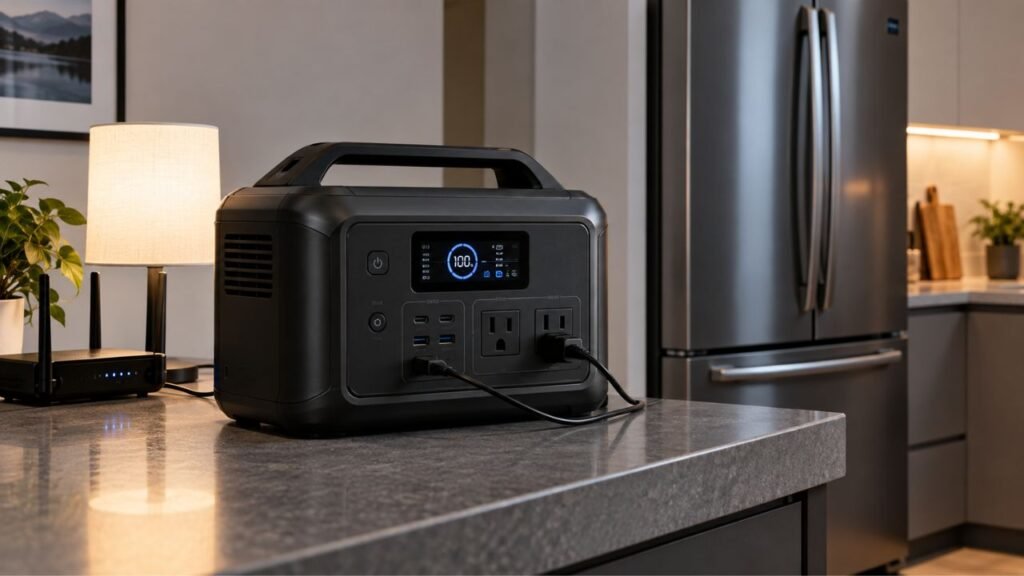
Running watts can mislead portable power station owners because they show normal operating demand only. They do not reveal startup surges, changing appliance loads, overlapping starts, or inverter limits. An appliance may look compatible based on running watts yet still overload the power station during startup.
This guide explains where running watts fall short when sizing backup power. I’ll also show you how to calculate loads more realistically.
Key Takeaways
- Running watts describe normal demand, not maximum appliance demand.
- Motors and compressors can draw much more power during startup.
- Appliance wattage can change throughout its normal operating cycle.
- Other connected devices reduce the power available for startup surges.
- Two automatic appliances may create overlapping startup demands.
- Surge wattage and surge duration both matter for difficult loads.
- Watts determine what you can run, while watt-hours affect runtime.
- Appliance manuals provide better sizing information than generic wattage charts.
What Do Running Watts Actually Tell You?
Running watts tell you how much electrical power an appliance normally needs while operating. You may also see this number called rated watts or operating watts.
For example, imagine a refrigerator normally consumes 200 watts while running. That 200-watt figure describes its normal operating demand after its compressor starts.
Portable power stations also have a continuous output rating.
A station rated for 2,000 watts can normally supply up to 2,000 watts continuously. Every AC appliance running simultaneously shares that available output.
However, this does not mean every appliance below 2,000 watts will work.
Some appliances briefly require far more power during startup. Others constantly change their electrical demand while operating.
That is where running watts can become misleading.
You should also keep watts separate from watt-hours.
Watts tell you how much power is required right now.
Watt-hours tell you how much stored battery energy is available.
A large battery cannot compensate for an inverter that lacks enough output.
Why Can Running Watts Be Misleading?
Running watts provide an important starting point, but not the complete picture. Several real-world electrical behaviors can make that simple number surprisingly unreliable.
Running Watts Ignore Motor Startup Surges
This is the biggest reason running watts cause sizing mistakes.
Motors and compressors often need extra current when they first start. That brief demand is commonly called starting watts, surge watts, or inrush demand.
You will commonly encounter startup surges with equipment such as:
- Refrigerators
- Freezers
- Sump pumps
- Well pumps
- Furnace blowers
- Window air conditioners
- Portable air conditioners
- Air compressors
- Vacuums
- Power tools
Imagine your refrigerator uses 250 watts during normal compressor operation.
You might assume a 500-watt power station can easily handle it.
However, suppose the compressor briefly needs 900 watts during startup.
The refrigerator’s 250 running watts look perfectly safe. Its startup demand tells a completely different story.
A 500-watt inverter might immediately enter overload protection instead.
The refrigerator could fail to start even with plenty of battery capacity.
The exact difference between running and startup demand varies widely. Some motors have modest surges, while others have much larger ones.
That is why multiplying running watts by two or three is only an estimate. It should never replace actual manufacturer specifications when those specifications are available.
Running Wattage Is Not Always a Fixed Number
Another common mistake is treating running watts like a constant number.
Many appliances do not operate at one fixed power level.
A refrigerator’s compressor turns on and off throughout the day. Its fans, defrost heater, controls, and compressor may operate at different times.
A variable-speed air conditioner can also change its power consumption.
A power tool might draw relatively little power without mechanical resistance. Its demand may increase significantly when cutting or drilling under load.
Computers provide another familiar example.
A desktop computer may consume little power while sitting idle. Heavy processing or gaming can quickly increase the electrical load.
Therefore, one wattage number cannot describe every operating condition perfectly.
Think of running watts as a useful reference point instead. Then consider how the appliance behaves during actual use.
Other Devices Reduce the Available Surge Headroom
You also need to consider what is already running.
Imagine a portable power station provides:
- 2,000 watts continuous output
- 4,000 watts peak output
You might assume any appliance requiring less than 4,000 starting watts works.
That assumption can still cause trouble.
Suppose other appliances already consume 1,500 watts continuously. Your inverter is already handling most of its continuous output capacity.
Now a pump tries to start.
Its startup demand gets added to everything already operating.
The station does not temporarily forget about those existing loads.
This matters during home backup because several essential devices often operate together.
Your refrigerator, router, lights, furnace, and sump pump may all share one power station.
Always size the complete system rather than checking appliances individually.
Two Appliances May Start at Nearly the Same Time
Automatic appliances create another problem that owners sometimes overlook.
You can manually decide when to start a microwave or power tool. You usually cannot control exactly when a refrigerator compressor restarts.
The same applies to equipment including:
- Freezers
- Sump pumps
- Well pumps
- Furnace blowers
- Air conditioners
Suppose your refrigerator and sump pump are both connected.
Each appliance may look safe when tested separately.
Then heavy rain causes the sump pump to start.
At nearly the same moment, the refrigerator compressor also starts.
The combined surge may exceed the station’s temporary output limit.
This can happen even when combined running watts remain quite low.
When several motor loads operate automatically, consider possible startup overlap.
Surge Wattage Without Surge Duration Can Still Mislead You
Peak output numbers also need some context.
A portable power station might advertise 4,000 watts of surge output. That number sounds impressive, but another question matters:
How long can the inverter actually provide that output?
A very brief electronic spike is different from a motor startup event.
Some motors need elevated current while accelerating to operating speed.
If the inverter cannot support that demand long enough, several things may happen.
Output voltage may fall.
The appliance may fail to start properly.
The power station may enter overload protection.
The AC output may then shut down completely.
Unfortunately, manufacturers do not always describe surge duration the same way.
Some provide detailed overload curves or time limits. Others simply advertise one peak wattage number.
When powering difficult motor loads, check both surge output and duration.
Running Watts Do Not Tell You Everything About Motor Current
You may encounter several additional specifications when researching larger appliances.
These include:
- Starting amps
- Inrush current
- Locked-rotor amps
- LRA
- Running amps
- Power factor
You do not need to become an electrical engineer.
However, these numbers can explain why a motor behaves unexpectedly.
Locked-rotor amps describe very high current that a motor may draw before reaching normal speed.
You may especially encounter LRA information on compressors and HVAC equipment.
Be careful when converting amps into watts for AC appliances.
For simple resistive loads, volts multiplied by amps may closely represent watts.
Motors can be more complicated because power factor affects real power.
For AC equipment:
Volts × amps = volt-amps
Volt-amps and watts are not always identical for motorized equipment.
For typical homeowners, the manufacturer’s wattage or startup specification remains easier to use.
Running Watts vs Starting Watts vs Battery Capacity
Several power specifications appear together on portable power stations. Each number answers a different question, so separating them prevents many sizing mistakes.
| Specification | What It Tells You | When It Matters | Common Owner Mistake |
| Appliance running watts | Normal operating demand | During regular operation | Treating it as maximum demand |
| Appliance starting watts | Total temporary startup demand | Motor or compressor startup | Ignoring it completely |
| Additional starting watts | Extra power above running demand | Load calculations | Confusing it with total starting watts |
| PPS continuous output | Sustainable inverter output | Normal AC operation | Comparing it directly with battery Wh |
| PPS surge output | Temporary maximum inverter output | Startup events | Assuming it works continuously |
| Battery capacity in Wh | Stored battery energy | Estimating runtime | Assuming more Wh means higher output |
You need all three major pieces for proper planning.
Continuous output tells you what the station can keep running.
Surge output tells you what it may successfully start.
Battery capacity tells you approximately how long those loads can operate.
Ignoring any one of these can produce an underpowered setup.
Do Not Confuse Total Starting Watts With Additional Starting Watts
Starting-watt calculations become confusing because different charts use different definitions.
Suppose an appliance has these requirements:
- 300 watts running
- 1,200 watts total starting
The appliance does not necessarily need 1,500 watts during startup.
Its total startup demand is already 1,200 watts.
The additional starting demand is:
1,200W – 300W = 900W additional starting watts
This distinction matters when calculating several devices together.
Suppose other equipment consumes 500 watts while that appliance starts.
Your approximate temporary load becomes:
500W + 1,200W = 1,700W
You can calculate it another way:
800W total running load + 900W additional startup demand = 1,700W
Both methods reach the same result.
Problems occur when someone adds total starting watts to running watts twice.
Before using any wattage chart, check its column labels carefully.
Look specifically for wording such as:
Starting watts
or
Additional starting watts
They are not automatically the same measurement.
A Real-World Portable Power Station Example
A simple home-backup example shows why running watts alone can look reassuring. The figures below are illustrative because actual appliances vary by model.
Imagine your portable power station provides:
- 2,000W continuous AC output
- 4,000W temporary surge output
You connect these essential loads:
| Appliance | Running Watts | Total Starting Watts |
| Refrigerator | 200W | 800W |
| Sump pump | 900W | 2,400W |
| Router and lights | 100W | Minimal surge |
The combined running demand is:
200W + 900W + 100W = 1,200W
Looking only at running watts, everything appears comfortable.
Your 2,000-watt inverter has 800 watts of continuous headroom remaining.
Now consider the sump pump starting while everything else operates.
The pump’s additional startup demand is:
2,400W – 900W = 1,500W
Add that to the normal running load:
1,200W + 1,500W = 2,700W temporary demand
Suddenly, your 1,200-watt setup briefly requires around 2,700 watts.
The station may still handle that because its surge rating is 4,000 watts.
However, the calculation reveals why running watts provided an incomplete answer.
Now imagine the refrigerator compressor starts during that same period.
Its additional startup demand would be:
800W – 200W = 600W
The theoretical overlapping demand becomes:
1,200W + 1,500W + 600W = 3,300W
That still falls below this example’s 4,000-watt peak rating.
However, surge duration and real appliance behavior must also be considered.
This is why testing realistic combinations matters before an emergency arrives.
Which Appliances Make Running Watts Most Misleading?
Motorized equipment usually creates the greatest difference between startup and normal demand. Pay extra attention to these common household loads:
- Refrigerators and freezers: Compressors can create substantial startup demand.
- Sump pumps: Pump motors may start automatically during storms.
- Well pumps: These can have demanding motor startup requirements.
- Furnace blowers: Their motors cycle automatically during heating.
- Window air conditioners: Compressors can briefly draw heavy startup current.
- Portable air conditioners: Compressor operation creates similar concerns.
- Air compressors: Motor startup can be demanding under pressure.
- Vacuums: Their motors may pull significantly more current during startup.
- Circular saws: Load changes dramatically once the blade contacts material.
- Garage-door openers: Motors briefly require higher starting current.
Resistive appliances behave differently.
Space heaters, toasters, electric kettles, and heating elements often have little motor-style startup surge.
However, they can still be challenging because their running wattage is high.
A 1,500-watt space heater does not need a huge compressor surge.
It simply consumes around that high power level while heating.
That can drain a portable power station surprisingly quickly.
Can Running Watts Also Mislead Runtime Calculations?
Running watts are often used when calculating runtime, but simple division has limitations. Appliance cycling, inverter losses, and varying loads all affect the result.
Appliances Do Not Always Draw Rated Watts Continuously
Suppose you have a 1,000Wh portable power station.
You connect an appliance rated at 200 watts.
A simple calculation gives:
1,000Wh ÷ 200W = 5 hours
That calculation is useful as a theoretical starting point.
However, many appliances do not draw 200 watts continuously.
A refrigerator compressor might run periodically and then switch off.
Its average hourly energy consumption may therefore be much lower than its compressor’s running wattage.
Other appliances can vary in the opposite direction.
A power tool might exceed its low-load wattage once heavily loaded.
The most accurate runtime estimate comes from real energy consumption over time.
Inverter Losses and Power Station Self-Consumption Matter
You also cannot normally use every advertised watt-hour through an AC outlet.
The inverter converts battery power into household AC power.
That conversion uses some energy.
The display, cooling fans, control electronics, and battery-management system also consume power.
Therefore:
Advertised battery Wh ÷ appliance watts
usually represents an idealized calculation.
Actual runtime will normally be different.
Efficiency also changes with output level, temperature, and inverter design.
For that reason, avoid assuming one efficiency percentage fits every station.
Startup Surges Usually Are Not the Main Runtime Problem
A startup surge may look enormous compared with running watts.
However, that surge often lasts for a very short time.
Its main challenge is usually power delivery, not total battery energy.
For example, a compressor may briefly require several times its running power.
That demand can trip an undersized inverter immediately.
Yet because the event is short, it may consume relatively little energy.
Repeated cycling still contributes to battery use.
However, saying startup surges automatically slash runtime can be misleading.
For runtime, average energy consumption matters far more.
For successful startup, instantaneous inverter output matters more.
Those are related issues, but they are not identical.
Why Appliance Labels Can Give You an Incomplete Picture
Appliance labels are useful, but they do not always provide every number needed. Knowing what the label actually represents helps prevent incorrect power-station sizing.
The Label May Show Rated Watts or Amps
Some appliances list watts directly.
Others provide voltage and amperage instead.
A label may also represent maximum rated demand rather than typical consumption.
Operating mode can make a noticeable difference.
A refrigerator’s compressor, fan, lighting, and defrost system do not always operate together.
A power tool’s actual current changes with mechanical load.
Therefore, use the label as an important reference rather than perfect prediction.
Starting Watts May Not Be Listed
Many appliance labels provide no simple starting-watt figure.
Look through the manual or technical specifications for terms including:
- Starting watts
- Surge watts
- Startup current
- Inrush current
- Starting amps
- Locked-rotor amps
- LRA
HVAC equipment sometimes provides LRA rather than startup watts.
If the information is unclear, contacting the appliance manufacturer may be worthwhile.
This is especially helpful before buying an expensive power station.
Generic Appliance Wattage Charts Are Only Estimates
Online wattage charts can help during early planning.
However, they should not replace specifications for your actual appliance.
Two refrigerators of similar size may use completely different compressors.
Two sump pumps may also have very different motor characteristics.
Age, design, efficiency, and operating condition can affect electrical demand.
Use information in this order whenever possible:
- Manufacturer manual or technical specifications
- Appliance nameplate
- Manufacturer technical support
- Proper real-world electrical measurement
- Generic appliance wattage estimates
This approach gives you a much stronger sizing estimate.
Can You Measure the Real Running and Starting Watts?
Real-world measurement can improve your calculations, especially when specifications are unclear.
A plug-in electricity meter can help measure:
- Normal running wattage
- Long-term energy consumption
- Appliance cycling behavior
- Average consumption over several hours
- Differences between operating modes
However, ordinary plug-in meters may not capture very fast inrush events accurately.
Their screen may update too slowly to display the true peak.
Professional electrical meters can include dedicated inrush measurement functions.
Those tools are designed to capture extremely short startup-current events.
For most homeowners, you do not need to make dangerous measurements yourself.
Manufacturer data is often enough when accurate specifications are available.
Never open electrical panels or expose live wiring for these measurements.
Work involving hardwired or 240-volt equipment should be handled appropriately.
What Happens When Running Watts Look Safe but the Power Station Still Cannot Handle the Load?
When startup or changing load demand exceeds inverter capability, several symptoms can appear. Recognizing them can save you from blaming the battery unnecessarily.
- The appliance attempts to start but immediately stops.
- The power station displays an overload warning.
- AC output switches off automatically.
- The appliance repeatedly tries to restart.
- A compressor or motor may briefly hum.
- Other connected equipment may shut down.
- The station may require an AC-output reset.
- Output may restart after the overload disappears.
These symptoms do not automatically mean the power station is defective.
The battery can be fully charged while this problem occurs.
The real limitation may be inverter output rather than battery capacity.
Modern quality power stations usually include overload protection.
That protection is designed to shut output down before excessive demand causes damage.
Repeatedly forcing an incompatible motor to restart is still not recommended.
Instead, identify the startup requirement and adjust the load setup.
How Should You Size a Portable Power Station Correctly?
Running watts remain useful when you combine them with several other checks. This step-by-step method gives you a much more realistic power requirement.
Step 1: List Everything That May Run Together
Start with realistic simultaneous loads.
You do not need to add every appliance you own.
For home backup, your list might include:
- Refrigerator
- Freezer
- Internet equipment
- Several lights
- Furnace
- Sump pump
- Television
- Phone chargers
Think about what could operate at the same moment.
That is what determines your continuous requirement.
Step 2: Add Their Running Watts
Next, total the running watts of simultaneous loads.
Suppose your expected combination totals 1,300 watts.
Your power station’s continuous AC output must exceed that demand.
Avoid planning to operate directly at the inverter’s limit whenever possible.
Real appliances change consumption, and unexpected loads may appear.
Step 3: Identify Motor and Compressor Loads
Now mark every device containing a significant motor or compressor.
These deserve extra attention.
Typical examples include refrigerators, pumps, freezers, air conditioners, and furnace blowers.
Look for actual starting specifications whenever possible.
Step 4: Calculate Additional Starting Demand
When you know total starting watts, calculate the extra startup requirement:
Additional starting watts = total starting watts – running watts
Suppose a freezer uses:
- 250W running
- 1,000W starting
Its additional startup requirement is:
1,000W – 250W = 750W
Add those extra 750 watts to your simultaneous running load.
That gives you a more realistic temporary demand.
Step 5: Check Realistic Overlapping Starts
One large startup event is often enough for basic sizing.
Home backup can require more careful planning.
Consider whether two automatic appliances might start together.
Examples include:
- Refrigerator + sump pump
- Freezer + refrigerator
- Air conditioner + refrigerator
- Well pump + furnace blower
You do not necessarily need to assume every motor starts simultaneously.
Instead, consider combinations that can realistically overlap.
Step 6: Compare the Result With Surge Capability
Now compare your calculated startup requirement against the station’s specifications.
Check:
- Continuous AC output
- Peak or surge AC output
- Published surge duration
- Overload limitations
- Voltage requirements
Do not compare appliance startup demand only with battery capacity.
A 3,000Wh battery can still have an inadequate inverter.
Step 7: Leave Practical Operating Headroom
Try not to build a system that works only at perfect ratings.
Some extra output margin can accommodate:
- Changing appliance demand
- Measurement uncertainty
- Automatic cycling
- Additional small loads
- Unexpected startup overlap
- Age-related changes in equipment
There is no single headroom percentage that fits every situation.
Your margin should reflect how important and unpredictable the loads are.
Emergency home backup generally deserves more conservative planning.
Can Load Sequencing Solve a Startup Problem?
Sometimes you can operate equipment successfully by controlling startup order.
Start the largest motorized appliance first.
Allow its startup surge to finish.
Then connect or switch on smaller loads afterward.
Suppose your power station struggles when several appliances start together.
You might start the refrigerator first.
Wait until its compressor settles into normal operation.
Then connect your lights, router, television, or other smaller equipment.
This reduces the chance of several startup demands overlapping.
However, load sequencing has an important limitation.
Automatic equipment can restart whenever its controls call for operation.
A refrigerator compressor might restart while your sump pump is running.
Therefore, manual sequencing cannot eliminate every possible overlap.
Certain HVAC systems may also benefit from properly selected soft-start equipment.
A soft starter can reduce difficult compressor startup demand in some applications.
Compatibility must be checked for the specific equipment involved.
What Should You Check Before Buying a Portable Power Station?
Running watts should be only one item on your buying checklist. Review the complete electrical picture before choosing a station.
- Continuous AC output: Must support your normal simultaneous load.
- Surge AC output: Must accommodate realistic startup events.
- Surge duration: Important for motors needing longer acceleration time.
- Appliance running watts: Establishes your normal load requirement.
- Appliance startup demand: Helps identify difficult motor loads.
- Simultaneous loads: Shows what the inverter actually faces together.
- 120V or 240V requirements: Some household equipment requires 240-volt power.
- Battery capacity: Determines how long your equipment may operate.
- Pure sine-wave output: Important for many appliances and electronics.
- Boost-mode limitations: Some modes reduce voltage instead of increasing true inverter capacity.
- Manufacturer documentation: Provides more context than headline marketing wattage.
If home backup is your goal, also think about how equipment connects.
Powering appliances directly from outlets differs from supporting home circuits.
Transfer equipment must be suitable for the application and installed correctly.
Never connect a portable power source in a way that can backfeed utility lines.
Conclusion
Running watts are necessary when sizing a portable power station, but they cannot answer every important question.
They tell you how much power equipment normally requires after startup. They do not fully describe motor inrush, changing loads, startup overlap, or surge duration.
For reliable sizing, think about three separate questions.
Can the station run your equipment continuously?
Check continuous output and combined running watts.
Can the station successfully start your equipment?
Check startup requirements and inverter surge capability.
Can the battery keep everything running long enough?
Check battery capacity and realistic energy consumption.
Looking at all three gives you a far more dependable backup setup.
Related FAQs
Running watts create several common questions when homeowners compare appliances and portable power stations. These quick answers cover the most important ones.
Are Running Watts the Same as Rated Watts?
Running watts and rated watts commonly describe the power an appliance needs during normal operation. However, manufacturer terminology can vary, so always confirm how the specification is defined in the manual.
Are Starting Watts and Surge Watts the Same Thing?
Starting watts and surge watts often describe temporary power needed when equipment starts. However, manufacturers may define peak, surge, and overload ratings differently, especially when describing portable power station output.
Can a 1,000-Watt Power Station Run a 900-Watt Appliance?
A 1,000-watt power station may run a 900-watt appliance if startup demand and other connected loads remain within its limits. A motorized 900-watt appliance could still require much more power during startup.
How Much Higher Can Starting Watts Be Than Running Watts?
Starting demand varies significantly between appliances and motor designs. Some have modest increases, while certain compressors and motors can demand several times their normal current during startup.
Do Startup Surges Drain a Portable Power Station Faster?
Startup surges consume some battery energy, but they are usually very brief. Their bigger concern is whether the inverter can deliver enough temporary power without entering overload protection.
Why Does My Power Station Overload When the Watts Look Low?
The appliance may have a startup surge exceeding the power station’s inverter limit. Other connected equipment, changing loads, or overlapping motor starts can also create temporary demand above the displayed running watts.
Can Two Appliances Start at the Same Time?
Yes. Automatic appliances such as refrigerators, freezers, pumps, and furnace blowers can start at nearly the same time. Their overlapping startup demand may temporarily exceed the inverter’s surge capability.
Does More Battery Capacity Mean More Running Watts?
No. Battery capacity and inverter output are separate specifications. A high-capacity power station can store plenty of energy while still having an inverter too small for a high-wattage appliance.
Can Boost Mode Replace Higher Surge Capacity?
Not necessarily. Some boost modes allow certain high-wattage appliances to operate by adjusting output voltage rather than increasing true inverter capacity. Follow manufacturer restrictions and avoid assuming boost mode suits every device.
How Can I Find My Refrigerator’s Starting Watts?
Check the refrigerator’s manual, technical specifications, compressor information, or manufacturer support resources. If startup watts are unavailable, look for startup current, inrush current, or locked-rotor amp information.

Warren Turner writes practical guides and reviews on generators, portable power stations, and battery backup systems. He focuses on real-world performance, everyday power needs, and helping readers choose dependable equipment without unnecessary complexity.